
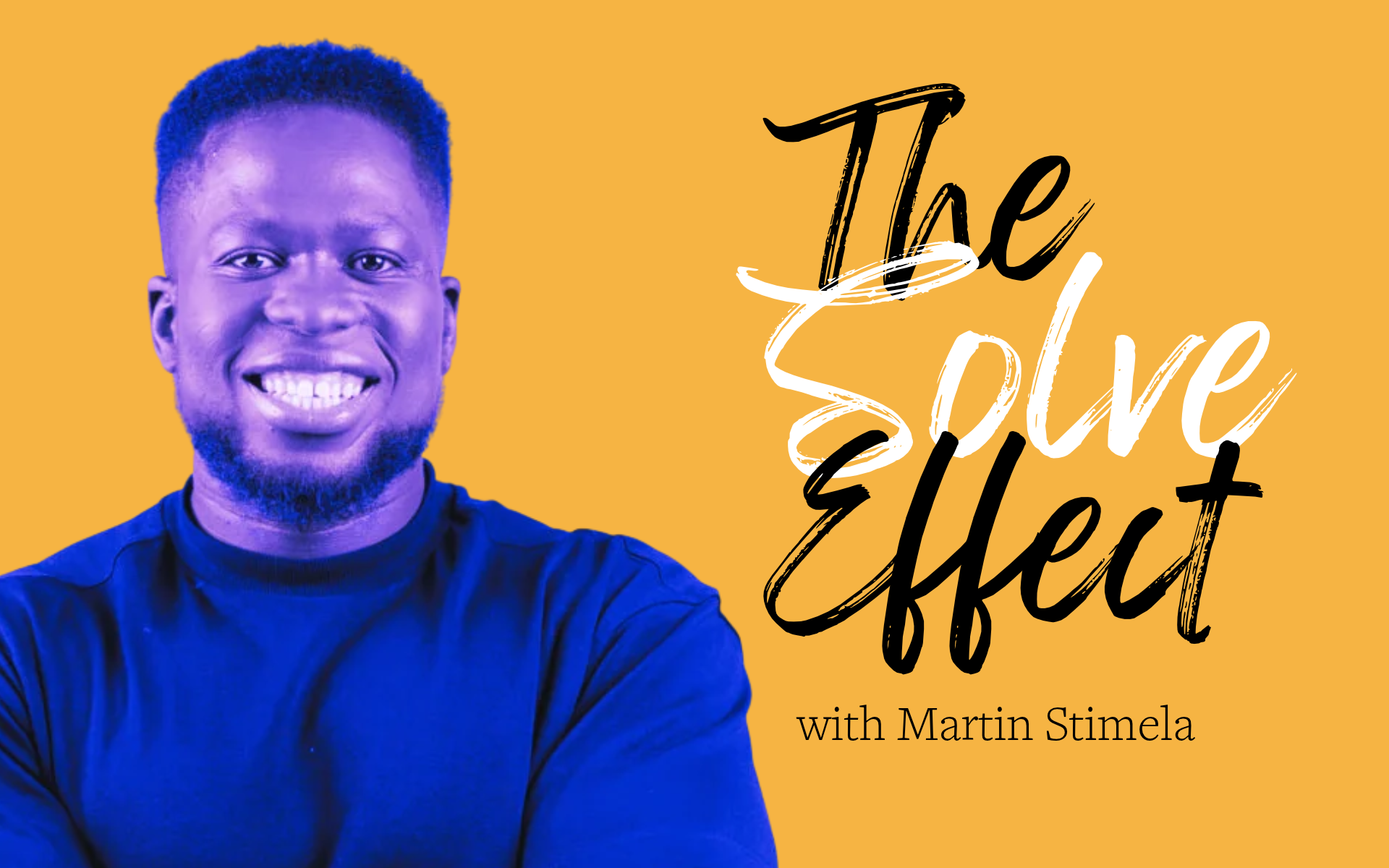
This is a transcript of Episode 27 of The Solve Effect, edited and condensed for clarity. Listen on Spotify, Apple Podcasts, or Amazon Music.
Show notes
Martin Stimela is the co-founder and CEO of Brastorne, a technology company based in Botswana that enables internet access without expensive data plans or smartphones. Founded in 2013 with co-founder Naledi Magowe, Brastorne builds on feature phone technologies like USSD, SMS, and voice, so people can get informed, get paid, and get connected on the phones they already own. Its flagship product, mAgri, gives smallholder farmers access to agricultural information, markets, and a social community for about $1 a month. Over 13 years, Brastorne has connected 5.9 million people across Botswana, Zambia, the Democratic Republic of the Congo, Cameroon, Guinea, and Côte d’Ivoire. The company is profitable and funded through retained earnings and grants, with no investors on its cap table.
Brastorne was selected as a Solver in Solve’s 2021 Digital Inclusion Challenge for mAgri, a USSD-based mobile platform that connects smallholder farmers to information, markets, and each other on basic phones. Brastorne also received the Heifer International Prize for Innovation in Smallholder Agriculture.
The Solve Effect is a production of MIT Solve, MIT’s initiative connecting social entrepreneurs to the funding, partnerships, and expertise they need to scale.
Transcript
Hala Hanna
Welcome to The Solve Effect, where we highlight extraordinary people tackling the world's toughest challenges with bold, innovative solutions. I'm Hala Hanna, Executive Director of MIT Solve.
Solve is celebrating its 10th anniversary this year, and to mark the occasion, you'll be getting two episodes a month. One of those will be our special series with guest host Alexander Dale, Director of Global Programs at MIT Solve.
This series will highlight 10 Solvers from the past decade who embody the spirit of Solve: innovation, grit, resilience, and impact. Enjoy!
Alexander Dale
Hello, I'm Alexander Dale. When you want to access the internet, can you? Because you're listening to this, likely on a smartphone or tablet, the answer is probably yes.
For 350 million phone users in Africa, the answer is still no.
Many of these individuals use feature phones with expensive messaging and limited access to digital tools, market access, and best practices for their livelihoods.
Today's guest decided that level of disconnection was unacceptable. Martin Stimela is the co-founder and CEO of Brastorne, a technology company based in Botswana that enables internet access without expensive data plans or smartphones.
No matter what type of phone you can afford, Brastorne ensures you can access the resources you need to get informed, get paid, and get connected. In the 13 years since its founding, Brastorne's tools have connected 5.9 million people across six African countries to the internet. Today, we're catching up with him to learn more about what it takes to build a durable network of users and how that unconventional internet access can transform communities.
Martin, welcome to The Solve Effect.
Martin Stimela
Thank you. Thank you for having me.
ATD
I'd like to start at the beginning. Can you take us back to the very early days of Brastorne? In 2013, it's you and Naledi Magowe working together in Botswana. What problem was it that caught your attention first?
MS
We started off with a very simple question, and that was, why should the type of phone that you own or you're using determine the type of opportunities you have access to?
At the time, everyone seemed to be building for smartphones, and using internet, but a huge part of Africa was still on basic phones. So our “aha moment,” if you may call it that, came from realizing that we had the infrastructure, people had phones, mobile networks had the reach, and technologies like USSD, SMS, and voice, they already worked. We didn't need to wait to get smartphones. We just needed to redesign the digital experience around what people already had.
ATD
What were some of the first attempts you tried to bridge that gap and build those solutions to meet people where they are?
MS
We've pretty much landed on agriculture and the reasoning was very, very simple. We realized that Africa has a lot of underserved communities and the majority of the poor are into agriculture because purely agriculture doesn't need much skill to get into.
So with that knowledge, we started thinking around how do we build solutions around agriculture that reached the masses, that reached the underserved communities that we were trying to work with. And that's how we landed on building solutions for agriculture, giving access to started off with smallholder farmers.
ATD
You mentioned earlier the term USSD, and I know that that's a really common tool within the digital inclusion space. It's not necessarily one that we talk about a lot in the US or in some other spaces that our listeners might be more familiar with. Can you talk about what USSD is and what it offers you in this feature phone environment versus SMS?
MS
Yeah, sure. So USSD actually stands for Unstructured Supplementary Service Data. I don't think anyone calls it that. Nobody knows that—
ATD
I’ve never heard that fully explained before.
MS
Yeah, but it's just basically a real time communication protocol.
I'm not sure if you guys recall this on the old Nokia phones, you used to be able to load airtime or credit, phone credit on your phones by dialing some sort of short code. So you dial a star, then there was a number, then a hash at the end, and it popped up a menu and says you've credited your phone of this much amount. That is pretty much the same sort of thing that we've used to build our solutions on.
ATD
So talk me through what that user experience looks like for a smallholder farmer then. They have a feature phone, they're in agriculture, they connect with Brastorne. What does their experience with their phone look like? How does that change?
MS
So if you think most users don't think of your big screens on your smartphones, but if you think of those old brick phones (the Nokias, the Motorolas) that's pretty much a typical phone that was used or that is being used by a lot of smallholder farmers in Africa.
So someone just dials a short code, you dial a star, a number, a hash at the end, and that brings up a menu. You're able to choose your language, and immediately you're able to start accessing services. If you're using USSD, then you can select what you want to interact with and you can start getting information very, very quickly in real time. If it's a phone call, same thing, you're dialing this number and you pick your language and you interact with the service via voice and you're getting responses back in real time.
ATD
And how many different languages are available?
MS
As many as necessary, depending on the geography and the market that we enter. We always try and localize the solutions. So for example, in Botswana, you will have it accessible in English, in local languages such as Setswana. When you go to the DRC, that will be in French, that will be in Lingala, in Swahili. So you just really customize it as much as possible to the local audience.
ATD
That's a lot of different translation time though to make sure that you're building out for all those different languages, I'm sure, with some unique idiomatic or colloquial aspects to each one of them.
MS
Absolutely. I mean, our philosophy is always give value first, then progressively understand the user better.
So the only way you do that is meeting them where they are on that device. You're not asking them to change anything. And then obviously, whatever language, whatever local nuances are there, you would apply it to that. But once you have them hooked, then it becomes easier for you to actually develop with them.
ATD
So on that idea of understanding users, my understanding is that 80% of your users are young people and about 60% are women. Is that roughly the right numbers?
MS
That's roughly right, yeah. It's usually the young people who are more eager to try things out. We still do have a lot of, and I mean this is common anywhere you go, you still have a lot of technophobia. So your early adopters are usually the young people.
And for women, we find that women are very, very close to agriculture. They're the ones that are out there in the fields most of the time. So this really caught their attention and they became a really big user for testing out mAgri initially and for now.
ATD
And how does that user base inform the design, right? Speaking to how trying to understand your user and then adjust the design to suit, what might you do differently given a younger audience, a more female audience?
MS
A couple of things. We basically learned that simplicity mattered enormously.
As I mentioned, language matters. And therefore, even one unnecessary step can really cause someone to drop off, so our users taught us to keep testing, we removed steps, but also because, again, when we mentioned the younger population, you really have to keep them engaged and they really don't have a long attention span.
So limit the number of steps, make sure that they get in, they see the value as quickly as possible. Those that don't see value will drop off, but those that do will stick behind and they will keep telling you what they want. So you will keep improving and iterating based on their needs.
ATD
And what's an example of something that is really hooky or high value that you can offer them right at the beginning?
MS
So…chat. So if you can give them the ability to stay connected to their family members, to their friends…you know, agriculture becomes really lonely. Think of people out there in their fields. It can get pretty lonely.
When we started, really great product, great information, but people got on and they just weren't using it and we didn't know why. And that's because we gave them a huge database of agriculture and not realizing that phones are actually social things.
So all they wanted to do was first get accustomed to the platform, use it. And while using it, yes, then they will use it for things that have more utility. So the actual social bit was the utility of the platform that we built. So basically, it wasn't just give them information, was it how are we actually improving the ability to earn, to sell, to access services, and make better decisions?
ATD
Talk me through the timelines there. When does the chat feature come online and how does that learning process for your team happen?
MS
Yeah, so 2015, I think we launched commercially, 2016, 2017.
Six months later, we introduced the chat function. They start carrying their phones with them. We're giving them something that's cheaper than SMS, cheaper than voice. It's on USSD. Sub-Saharan Africa has the highest data charges in the world, but the lowest incomes in the world. So chat became really big and we started seeing the numbers growing from your 60,000s to the millions, literally overnight.
ATD
Wow, that must have been a very cool week to have that.
MS
It was. And also because we're very high on impact, we realized that people were using the platform, but they were also sharing it with their partners, they were sharing it with their friends. So there was a virality there in that people just kept sharing it. So one user would share it with 10, they would share it with another 10 users. And then it just really grew organically.
ATD
You talked about how USSD and Brastorne mAgri are cheaper than other alternatives. Can you put that cost into context?
MS
Yeah, so the best way to think of it is you're literally paying $1 a month to have unlimited access. It is like WhatsApp. Maybe you've got WhatsApp on a feature phone, so you're able to stay in touch with your colleagues, your friends, your market for $1 a month or about 3 cents a day.
ATD
That seems very inexpensive.
I want to pick up on the other side of that aspect where you have revenue and internet access via feature phones in some of the poorest countries in Africa doesn't necessarily sound like a slam dunk investment pitch, but you are a for-profit and you've done really well. So I would love to understand how that pitch went to investors and kind of what you've learned from some of that fundraising process as well.
MS
Really good question! Because we were profitable and cash positive, it allowed us a lot of choice and flexibility. So we learned very quickly that the right capital matters almost as much as the amount of capital you get.
We currently don't have anyone on our cap table, so we are fully funded by ourselves through our retained earnings, and would take cash loans here and there. A lot of it is also grants, as I mentioned. But the idea is, there is use for the money that we have. And we normally only fund activities that we realize are not so profitable in the short term, but will allow us to have the impact and the reach that we need in the long term.
And then ironically, we realized that it's harder to get there. It's more expensive to reach maybe the outskirts and the rural areas. But those are the most sticky. Once you have them, those are the people that will stay on and derive the value and also get the most impact.
ATD
For sure. I love the bootstrappy approach where you don't have to rely on equity investment.
MS
Yeah, remember in Africa, well, Sub-Saharan Africa, outside of your South Africa, Kenya, Nigeria, Egypt, the four big markets, it's really difficult to get VC capital. Especially when you come from a country like Botswana, which is upper middle income, you know, you don't even get donor funding, or much donor funding, because they think the country is rich. So you really have to build something that will start generating and taking care of itself very early on.
[AD BREAK: Devex]
Want to stay up to date with the latest news and humanitarian crises, global health, food security and philanthropy? Then dive into the week's most critical stories with DevEx's This Week in Global Development podcast. DevEx is the platform for insider journalism on global development. Each week we break down major headlines and invite members of our newsroom to share their expert analysis.
Whether it's the rollout of next generation malaria vaccines, a restructuring of the development finance architecture, or investments in climate-resilient agriculture, we ensure you have the insights you need to navigate the sector and stay informed on the latest trends and policy changes shaping global development.
Subscribe to the podcast on your preferred platform via the link in the description.
ATD
Brastorne was selected by Solve in 2021, which is then six, eight years into this work. What did that selection change for you? How did that change your work?
MS
Solve was really, really important for us. And it wasn't just about the award. Getting Solve really gave us credibility. It opened up networks and access to capital.
And it really was important because of those links. And we've had a lot of partnerships, we've had a lot of strategic investors, maybe not in money, but it opened us up to organizations such as Heifer International, a couple of others who were doing work in and helped us expand into other regions of Africa. So it was really, really important to us from the point of view of credibility and networks.
ATD
Tell me a little bit more about those partnerships and that expansion. So you started in Botswana, you're now in several different countries. What other regions are you hoping to get to?
MS
Our model has always depended on partnerships. We learned quite early that you don't scale across Africa alone. So the mobile operators we work with, they give us distribution and infrastructure. But in terms of markets, currently we're in Botswana, we're in Zambia, that's in southern Africa. We're also in the DRC, which is the Democratic Republic of Congo. We're also in Cameroon, we're also in Guinea, and we've just entered Cote d'Ivoire, also known as Ivory Coast.
We're quite ambitious in that we've realized that obviously there's a need for a solution. And if we can take it across Africa as quickly as possible before we believe there will be a closing window when technology changes and maybe things get much cheaper. Smartphones become much more readily available, AI doing its thing, but we want to be able to capture as much of the database as possible so that we can grow with them.
ATD
I want to ask about both of those pieces. So let's start with the technology changes on the devices themselves. You've built this really sticky user base around feature phones. What pieces become obsolete when users get a smartphone? What pieces can stick around? And how much is that happening within your user base? You mentioned this kind of closing window.
MS
Normally in value-added services, which is what we build, you typically have a shelf life for about a year, maybe about two years. But if you look at our products such as your mAgri, which have been running since 2013, 2015 commercially and are still going strong, and in most of the markets where we've deployed are actually the most successful products, revenue-wise. And also you find that 80% of the customers we started with are still our customers to date.
ATD
Some amazing retention.
MS
Yeah. And that's purely because of impact. We've been able to retain a lot of our users. And that's because even as someone upgrades and gets a smartphone, your community doesn't upgrade with you. It's not like everybody upgrades at the same time.
So we do find that we still have people on smartphones still using this basic technology. And that's because their community remains on feature phones. So the next step now is how do we build sort of a WhatsApp that can work on feature phones as well as working on smartphones. And that's what we're building with our technologies, cross channels.
ATD
Tell me a little bit about how you're thinking about AI. When we talk with innovators, what AI is useful for, how they want to include it varies a lot. And so I'm always interested both in the specific things that you might be building, but also your overall approach to how you are approaching this wave of technology change.
MS
So look, our idea, because we really believe in impact, is leave no one behind. We realize the importance of AI and we have to work with AI if we're going to stay relevant. So we don't think the user needs to have an AI device to benefit from AI, right?
So the intelligence can sit behind the interface. So a farmer, for example, can call a number, speak in their own language, and the AI can help understand that question, use that context, and deliver information back to the farmer through voice. So they don't physically have to upgrade or change their way of doing business or living, but basically we do on our side, but still provide the convenience from the comfort of their own home.
ATD
The comfort of their own field, as it were. AI can often be seen as expensive, data hungry, relatively high bandwidth, all of that can sit on your side and doesn't need to be exposed on the user space. Is that right?
MS
That's correct, because we're really about volume. This is why our charges are so low, like I mentioned, 3 cents a day. But if we can get the millions on board, if they're paying $1 a month or $1 a week, whatever that is, that kind of makes up for that, economies of scale.
ATD
Do you have a plan for how you would have your own data spaces or have, I know there's a conversation also about kind of whether Africa can own its data, can have data centers on the continent, and how some of that sovereignty almost builds out as well…are you involved in any of those conversations? You have the volume where that feels like it could become relevant.
MS
So yes and no. I mean, remember, Africa is vast. It's three-and-a-half Americas fit in one Africa, right? And it's about 54 countries, all sovereign, with their own laws. So it's really difficult to think of Africa as a whole.
Yes, it's got the population, but you're still having to navigate different countries, geographies. And because it's so vast, it still remains 2G or 3G king. It's really difficult to deploy 4G, 5G across that whole landscape.
So we've got our own challenges as well that we have to think about. Obviously it will reduce the cost significantly. It's just obviously that first initial investment. There's a lot of energy. Here, obviously with the sun and everything, it will reduce the costs. But I think individually as organizations, as companies such as ourselves, is how do we build and create our own knowledge so that we are not going to your Anthropics of the world, and it becomes quite costly. But if we've got our own data, we know what people are asking, we've got the answers, so we create our own local LLMs, we can better serve our population. And that, if we've got our own intelligence, whatever the direction it takes, will always be a player.
ATD
I want to close with two more personal questions. If you could give your early career self a piece of advice, right? You've been at this for 13 years longer. What would that advice be?
MS
So I'm an entrepreneur and there's opportunities everywhere, you know, but I've also learned that, and I would tell myself that seeing an opportunity and pursuing an opportunity are two different things. So I would really tell myself to pick the problems where you have an unfair advantage. It allows you to go much deeper and then you can let the evidence tell you where to expand. If I knew that, if I knew that then, it would have saved me a lot of headache.
ATD
Can you share a little bit more about a headache that it would have saved you or how you understand that unfair advantage?
MS
To give myself grace, to be fair, I really didn't know because you're trying to build something that no one understands. You're literally saying, I want to give internet to people who have “no business having internet.”
Basically, how do you provide internet to people on feature phones?
The phones are not built for internet. But then if you dissect that and said, what is internet? Internet is just access and it's used predominantly for access to information, access to markets and access to a social community. That's what we're seeing with these social networks, your Googles, your ChatGPTs, whatever, right? Those are pretty much the three reasons we use the internet.
So breaking that down and thinking everyone has those needs and how can I provide that value to someone who doesn't have a device that is designed specifically for that? That really was the question. So building something that was against everything that I believed coming from corporate and also against everything that the partners I needed to work with, like the mobile networks, believed in and understood was quite a challenge.
And that's why it took about five years. Throwing everything and the kitchen sink at it to actually launch the service. But, I'm glad that we did. But had I known that, and had I known this narrative, I had the conviction, but had I known how to go about the trial and errors, I think it would have saved me a lot of runway and a lot of money in the beginning.
ATD
Hopefully some other entrepreneurs are able to hear this and save themselves some headache. I know it's an ongoing learning journey with every group of innovators that I talk to and everyone who's interested in it.
MS
But sometimes it's important because that really is, you know, what sieves out the bad ideas from the great ideas, tests out your conviction because there will be a lot of dark days.
And if you fight for something, you know, relentlessly believe in it. Go the extra mile, then it's worth it. And every time you get another bad day, you know what you had to go through to see this dream come alive. So it just becomes much more worth it.
ATD
When you look at the future, you're building something very positive. Do you lean more on hope or on courage for the future?
MS
Definitely courage. You know, hope is great. Hope is good because actually you need a bit of both coming to think of it because hope helps you imagine the world that you want to see, right? Just how things can be different.
But courage is really what's going to…that's where the rubber hits the road, so to say. It's what makes you do something about it. And building in Africa really requires optimism, which is the hope side. But it also requires the courage to keep building when your infrastructure isn't perfect, electricity keeps going, capital is difficult to come by, and the conventional wisdom just keeps saying customers aren't commercially attractive in Africa.
ATD
And you've proven that wrong over and over again, with millions of customers.
MS
Thank you.
ATD
Congratulations on such a journey. We appreciate so much your work and you being a Solver and we look forward to continuing to following and supporting your journey through that AI and smartphone waves that you're dealing with next.
MS
Fantastic. And thank you so much, Alex and the team for having me on.
HH
If you haven't yet, please subscribe to The Solve Effect wherever you get your podcasts.
This episode was produced by Bridget Weiler and Elisabeth Graham.
Audio engineering by Kurt Schneider at MIT Audiovisual Services.
Music by Tunetank.
For more information about MIT Solve's 10th anniversary, check out solve.mit.edu
See what else is happening this week in Global Development from DevEx: https://www.devex.com/focus/this_week_in_global_development
If you enjoyed this episode of The Solve Effect, sign up for our newsletter, CrowdSolve.
CrowdSolve is a monthly newsletter that highlights social impact news and updates from the inspirational innovators across our community. Subscribers are the first to hear about upcoming MIT Solve events, challenges, new episodes of The Solve Effect, and more.