
Transit X: resilient, solar-powered, personal mass transit
Resilient, privately-financed transportation infrastructure with the cost, capacity, and convenience to replace cars and roads.
Resilient infrastructure is mainly about resilient transportation. Flooding is by far the largest contributor of poor resiliency. Our current transportation system (roadways and railways) shuts down when streets flood. Flood are very costly because vehicles are destroyed by flood waters and roads often suffer severe damage.
The conventional approach to improving resiliency is make enormous public investments in upgrading our roadways and railways. These efforts attempt to slow or block the flooding and its damage through soft and hard barriers. This isn't very effective. It costs too much, takes too long to implement, and results are insufficient and short-lived.
Cities that deploy Transit X can convert much of the roadways and parking lots into green space and permeable surfaces that help mitigate flooding. Temperatures in cities are often several degrees higher due to head-island effect. By "greening" the surface of our cities, Transit X can lower the temperature of car-free cities by several degrees. If Transit X is successful in de-carbonizing transportation, then that will help slow (or even reverse!) pollution-induced climate change.
We propose the rapid deployment of a new privately-financed transportation infrastructure that offers superior resiliency.
The solution is an elevated, high-capacity, personal mass transit network that has the cost, capacity, and convenience to supplant cars, buses, trains, and trucks.
We need to elevate our expectations for transportation.
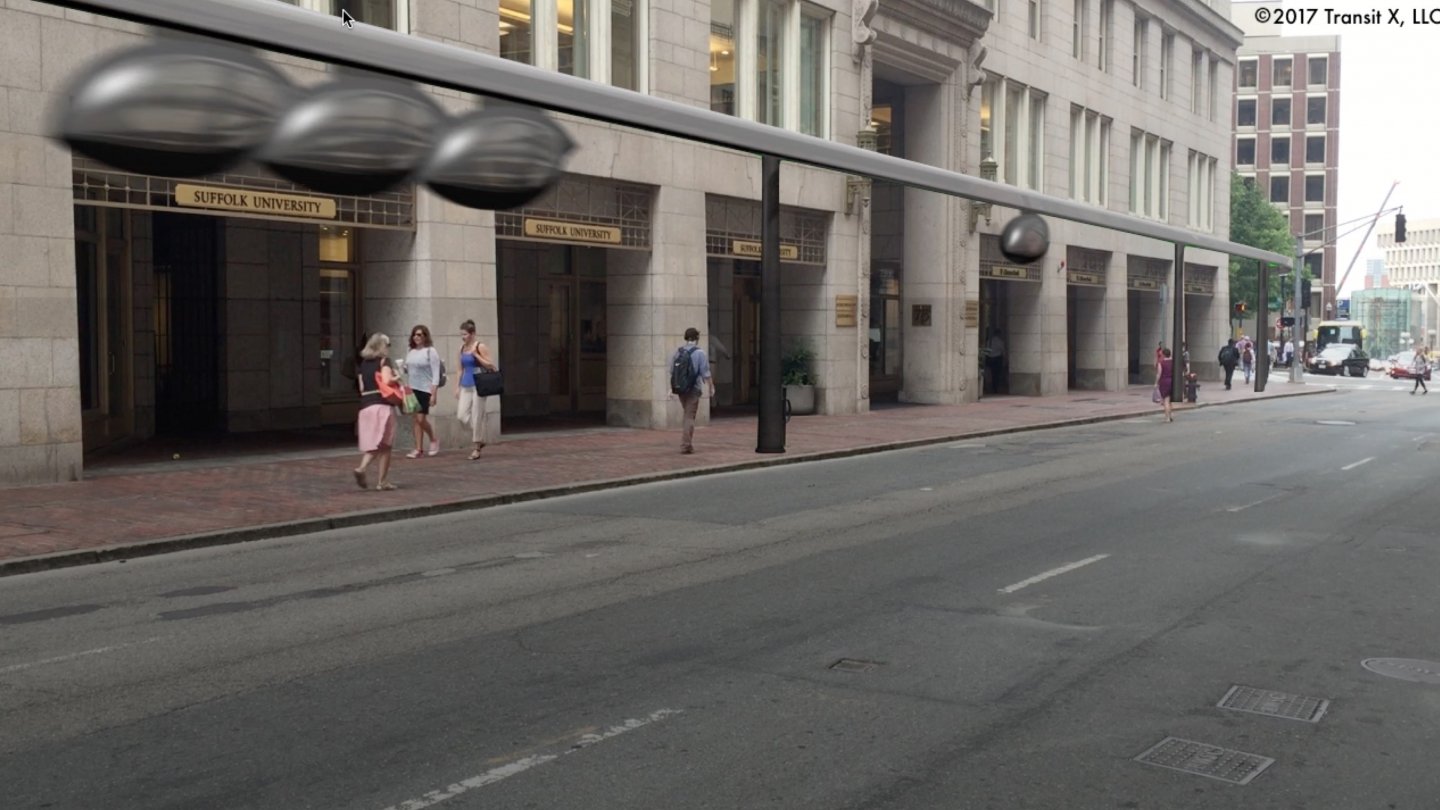
- Resilient infrastructure
Transit X pods and tracks (podways) are extremely lightweight, efficient, low cost, and high capacity. Over 100 companies have attempted to create new surface transportation concepts over the past 40 years, and none have been commercially successful. Our business model does not require public funding and replaces a "multi-modal" approach with a "universal mode" that can displace cars and trucks.
We provide resilient energy through a solar+storage distributed micro-grid that is installed above flood levels.
Our innovative "station-less" design enables Transit X to fit into dense cities along existing roadways, while reducing the need for impervious surfaces that exacerbate flooding.
Our technology uses well-proven composite materials to reduce the weight which reduces the cost of building an elevated infrastructure that is resilient to flooding. Our pods are made from ultra-light composites which significantly reduces the loads that our tracks need to support. Our use of composites also enables rapid installation because we don't need to pour concrete or weld steel. Our automated control system enables ultra-high capacity operation across a metropolitan region.
We have signed agreements with over 10 cities who are moving forward with Transit X, and our first projects will break ground in 2019. Our demonstration system that will be shown publicly this fall (2018). Over 150 cities have expressed interest in moving forward once we demonstrate a first system, and so we are also creating the manufacturing and installation capacity to rapidly deploy our solution in multiple countries.
Our goal is to rapid de-carbonize the world's transportation and provide half of the world's passenger miles traveled by 2033. We estimate that it will cost $3 trillion and will be privately financed. Within five years, Transit X will be operating in over 100 cities, and over 10 cities will be predominately car-free. As a side-effect, we expect Transit X can achieve the carbon reduction targets of the 2015 Paris Climate Agreement. Millions of lives will be positively impacted from less pollution, safer transportation, and higher resiliency.
- Urban
- Suburban
- Lower
- Middle
- Upper
- Sub-Saharan Africa
- US and Canada
- East and Southeast Asia
Transit X provides an extremely high service level of transportation at a low cost similar to existing mass transit. We aim to provide service across an entire metropolitan regions so that it is convenient to the vast majority of residents. Our formula-based pricing model assures that Transit X fares are lowered as our mode share increases. This positive feedback loop from network effects creates high barriers to entry, happy customers, and a natural monopoly.
We contract with large manufacturing firms to build the track and vehicles. We use large global engineering firms to deploy multiple projects in parallel.
Our service requires the deployment of a new physical transportation network where pilots are expected to break ground in 2019 and scheduled to be operational by 2020. We have created over 700 proposals (see transitx.com/proposals) for local, state, and national governments around the world. Our solution currently provides civic leaders a compelling vision of creating a sustainable, resilient, private-funded transportation infrastructure that can create car-free cities with a higher quality of living. Government can now avoid planning for significant investments for electric vehicle charging stations, signalization, and investments in extending public transit.
Our first pilots will begin operations in 2019 in highly-congestion cities in the Philippines, India, and Africa. Our solution needs government agreements for use of public rights-of-way, environmental approvals, safety certifications, etc.
We expect a fast adoption curve due to its low cost and the elimination of waiting and congestion. We hope to serve 40,000 people per day within 12 months in our first pilot, and the number of customers served will quickly accelerate as additional networks enter operation.
Within 3 years, we expect to be operating in over 20 cities and serving a population of 5 million passengers per day.
- For-Profit
- 20+
- 3-4 years
The strength of our vision and the practicality of our solution is a powerful combination that attracts people who see this as the solution the world has been waiting for. Selling Transit X to governments is relatively easy because we help solve their most pressing challenges, while not needing public funding, offering to build local factories, and paying the government 5% of gross revenue. This high value proposition has enabled us to build a significant global business development team with strong connections to governments at multiple levels.
The majority of revenue comes from passenger fares, freight, and advertising. Due to our low capital costs and low operational costs, we expect to be highly profitable with many projects achieving a positive return on investment within a few years. Our physical infrastructure, network effects, and formula-based pricing model forms a high barrier to entry and a natural monopoly that enables us to be sustainable over a long period of time. Because our projects are profitable, we can raise billions of dollars through the debt market using bonds for projects that are green or infrastructure-related.
Most costal cities are not aware that a private company can finance and build a new transportation network with the capacity and affordability to replace cars, buses, trains and trucks. MIT Solve can help build awareness of our solution. For example, MIT and the City of Cambridge should take the lead in moving to a car-free, resilient transportation infrastructure and being selected as a top Solver will encourage them to evaluate this option. I have also found that being a Solver (2016) provides good networking opportunities with like-minded people and firms from around the world.
Transit X represents a Silver Bullet of transportation that upends the conventional thinking about public transportation, mass transit, public financing, and the cost of building transportation infrastructure. The conventional forms of transportation are entrenched and overcoming the inertia of the status quo requires validation from communities such as MIT and MIT Solve.
Being selected as a Solver helps build credibility because the MIT brand is well-known and respected around the world.
- Peer-to-Peer Networking
- Connections to the MIT campus
- Impact Measurement Validation and Support
- Media Visibility and Exposure
- Grant Funding
- Other (Please Explain Below)