
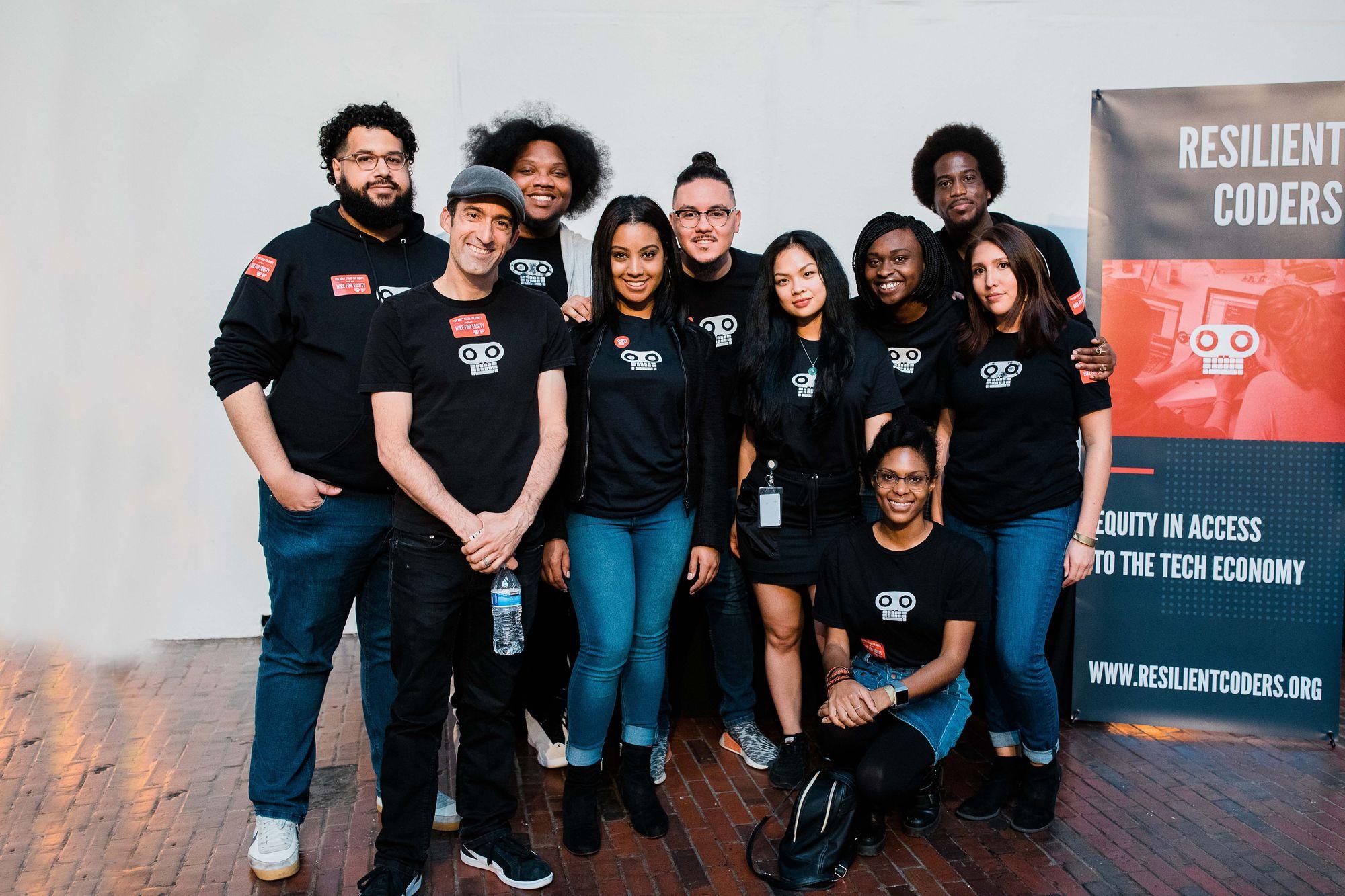
When Resilient Coders first joined the MIT Solve community as a custom challenge winner, they were already making waves with their mission: training young adults from underserved communities for high-growth careers in tech. But their journey didn’t stop there. Through Solve, they connected with Truist Foundation – whose purpose is to inspire and build better lives and communities, with a focus on fostering economic mobility through small businesses and career pathways – and became a grantee. Today, Resilient Coders is not only scaling its impact but also helping shape the future of inclusive innovation as a member of Truist Foundation’s Inspire Awards Advisory Council.
Truist Foundation recently awarded more than half a million dollars in grants at its 2025 Inspire Awards to scale innovative solutions to challenges experienced by adults in the middle and late stages of their careers. Learn more.
In this Q&A, we speak with Ayanna Lott-Pollard, Executive Director of Resilient Coders, and Lynette Bell, Truist Head of Philanthropy and President of Truist Foundation, about the power of long-term partnership, the importance of wraparound support, and what makes a transformative solution stand out.
Resilient Coders has had a unique path—from a Solve custom challenge winner to a Truist Foundation grantee and now part of a Challenge Advisory Council. Looking back, what were the key moments or decisions that helped strengthen this partnership?
Ayanna: The most pivotal moments in our partnership with Truist Foundation and MIT Solve have always been rooted in authentic connection and shared learning. Early on, our relationship with Mackenzi Dow at MIT Solve and Raj Borsellino at Truist Foundation helped build a bridge of trust between our organizations. I am deeply grateful for the intentional decisions to support my own growth and development through coaching and access to the Truist Leadership Institute. Both organizations have gone beyond funding the work to investing in our teams’ leadership, recognizing that organizational strength begins with strong, grounded leaders and staff. The proximity and personal investment shaped how we’re growing as an organization.
When we identified internal and external gaps in HR systems, marketing, and operational infrastructure, both Solve and Truist Foundation responded with support that was strategic, not transactional. They helped us build capacity in ways that anchored our organization and freed us to focus on big-picture strategy: scaling impact and refining how we capture data to highlight our outcomes.
How are you thinking about the relationship between worker well-being and small business resilience?
Lynette: They’re absolutely interconnected. A small business is only as strong as the people behind it. When workers are supported, through access to mental health care, stable housing, childcare, or simply being paid a living wage, businesses are more likely to thrive, innovate, and retain talent.
We’ve seen this play out across our grantee network. Since 2021, our strategic funding has supported more than 25,000 workers who have built careers across various industries. The most successful grant partners didn’t just train workers – they created ecosystems of support. Resilient Coders is a great example of that. Their wraparound services – from childcare support to psychological safety – aren’t add-ons but essential. And through this model, they remind us that economic mobility starts with human dignity.
As someone who leads an organization rooted in equity, how do you think about designing wraparound supports that center the lived experience of your participants, especially those who may be older or returning to the workforce?
Ayanna: At Resilient Coders, we don’t assume we know what wraparound supports our community will need. While we draw insights from data through surveys, interviews, and debriefs at the conclusion of each cohort, we approach each program cycle with humility, curiosity, and an open door. Equity for us means co-designing with our participants, not for them. The lived experience of our learners is the guide because the needs continue to fluctuate based on local and national economic factors. Our wraparound supports address a wide range of needs from childcare, food and housing insecurity to navigating challenges related to citizenship.
Funding from Truist Foundation made it possible for us to hire a Community Advocate and Recruitment Manager who has a background in psychology and clinical mental health counseling. Having that expertise embedded within the team day-to-day has been transformative. It ensures that each participant is met with dignity, empathy, and practical support no matter the challenge. We are constantly reminded that building pathways to economic mobility starts with creating environments of psychological safety and trust.
Resilient Coders’ journey from being a custom challenge winner at Solve, to becoming a Truist Foundation grantee, and now serving on the Truist Challenge Advisory Council is a powerful example of long-term partnership and trust-building. How does this kind of sustained engagement shape the way Truist Foundation thinks about supporting and growing with nonprofits over time?
Lynette: When we first connected with Resilient Coders, what stood out wasn’t just their powerful mission – it was their clarity of purpose and the way they centered the lived experience of their learners. Over time, that clarity evolved into trust, and trust into partnership. We’ve seen firsthand how long-term engagement allows organizations to build capacity, take risks, and ultimately scale impact in ways that short-term funding stalls or simply cannot.
In philanthropy, there’s often pressure to measure success in quick wins. But the most meaningful change happens over years, not months. For us, it reinforces the idea that impact really does take time. When you invest in leadership development and organizational capacity, you create space for bold ideas to flourish. And honestly, that’s where the magic happens. It’s when nonprofits know they have a partner who’s in it for the long haul, so they can take risks, innovate, and ultimately transform communities. It’s a model we’re proud of and one we’re continuing to replicate across our portfolio.
How has your experience on the Truist Foundation Inspire Awards Challenge Advisory Council shaped your thinking about what makes a standout application or a transformative solution in this space?
Ayanna: Serving on the Challenge Advisory Council has given me a front-row seat to what decision makers look for, what questions they ask, and how they balance innovation with impact. It’s been eye-opening to see that what truly makes an application stand out isn’t just a compelling mission or idea, but the ability to communicate it with clarity, evidence, and strategic foresight.
As a leader, I live within the frameworks of Resilient Coders every day, and sometimes I can become so deeply connected to the mission that I forget to step back and articulate why it matters to investors. Serving on the Council has sharpened that skill. It’s helped me tell our story in a way that connects our passion to purpose, our purpose to measurable outcomes, and our outcomes to shared value. It’s also influenced how I design internal frameworks that more clearly articulate the problem we’re solving and the systems we’re trying to change.
Moving forward, I will think more critically about alignment between vision, execution, and impact, and coach my team to do the same. Ultimately, my participation has deepened my respect for the partnership between funders and nonprofits, and reminded me that sustained partnership grows out of long-term trust, transparency, and co-creation.
What advice would you give to other organizations that are interested in developing a social impact challenge?
Lynette: Start by asking: who are you designing this for, and are they in the room with you? The best challenges are co-created with the communities they aim to serve. That means listening deeply, being transparent about your intentions, and staying flexible as needs evolve.
It’s also important to think beyond the challenge itself. What kind of long-term support will the finalists receive? How will you help them grow after the spotlight fades? One of the things we’ve learned through Truist Foundation’s Inspire Awards is that visibility is powerful, but it’s just the beginning. The real impact comes from sustained investment, mentorship, and connection. If you’re building a challenge, build it with longevity in mind.
Tags:
- Custom Challenges
- Truist
Related articles
-
A LEAP in evidence-based innovation for education
How to address the need for evidence-based innovation in education by empowering researchers, social entrepreneurs and education organizations to work together.
-
Journey Through the Learner//Meets//Future Challenge: Part One
Solve shares trends and learnings from open innovation challenge that identified AI-enabled tools to improve assessment for Pre-K - Grade 8 learners in the United States. In March 2024, Solve launched a new challenge funded by the Bill & Melinda Gates Foundation to find ideas and tools that improve educational....jpg)
-
Announcing 5 Winners of the Supporting Survivors of Modern Slavery Challenge
In May 2024, MIT Solve collaborated with the Hewlett Packard Enterprise Foundation and The Anti-Slavery Collective to launch the Supporting Survivors of Modern Slavery Challenge. The challenge invited innovators from around the world to submit solutions that support individuals who have survived modern slavery, recognizing the complex needs of those...