
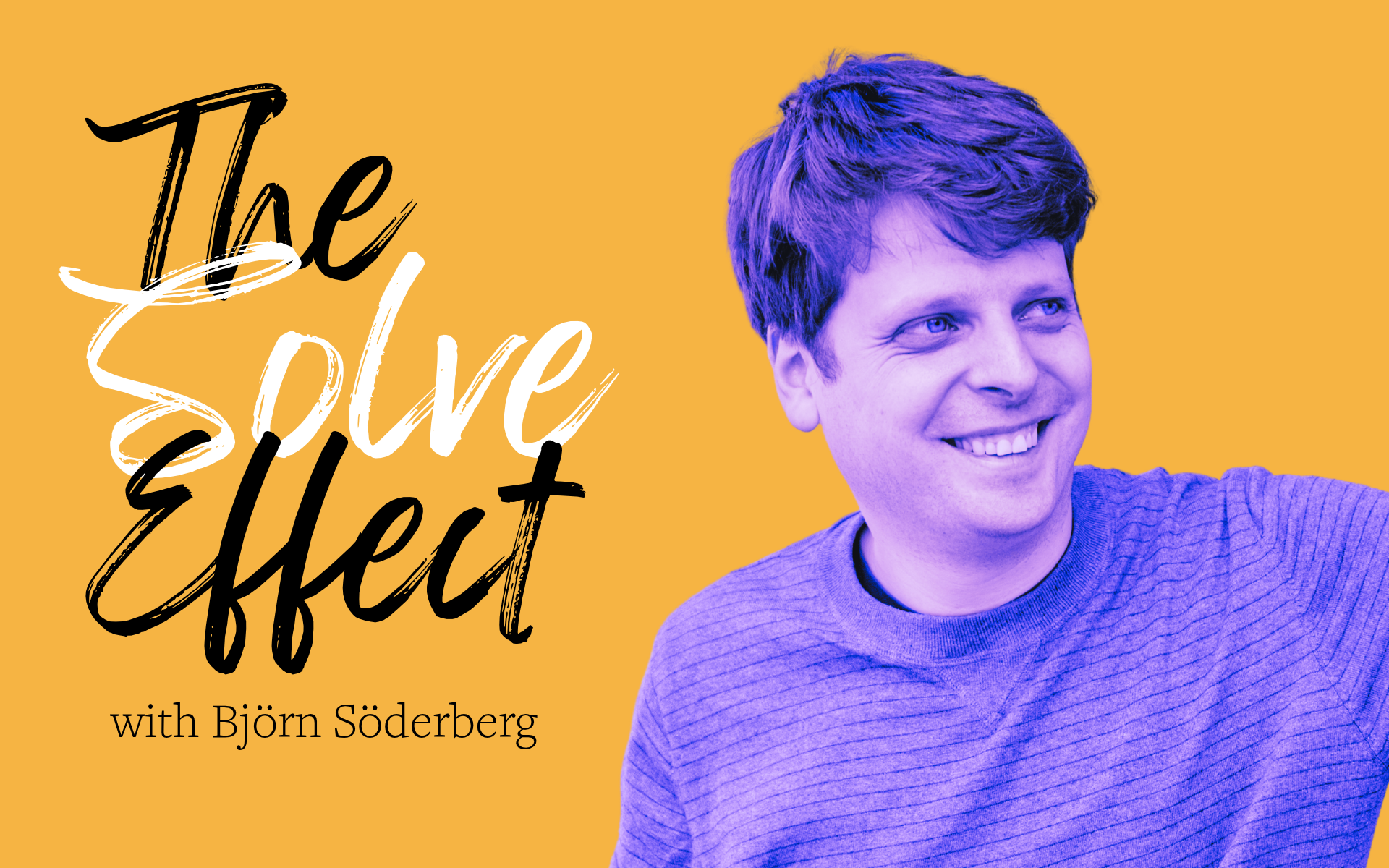
This is a transcript of Episode 25 of The Solve Effect, edited and condensed for clarity. Listen on Spotify, Apple Podcasts, or Amazon Music.
Show notes
Björn Söderberg is the co-founder and managing director of Build up Nepal, an award-winning social business. He has lived in Nepal since 2005 and has spent 20 years building social businesses that tackle poverty and climate change. His ventures include Fair Enterprise Network AB, a Swedish impact investment company. They also include WebSearch, an IT company with 35 programmers in Nepal, and Watabaran Biofuel, which made biofuel briquettes and was sold in 2013. He has led Build up Nepal through the pandemic and a recession, improving its technology and model and growing its impact and international profile. He is also an expert in Compressed Stabilised Earth Bricks and other alternative building technologies in Nepal.
Build up Nepal was selected as a Solver in Solve's 2023 Climate: Housing + Adaptation Challenge for its ECO2Bricks: interlocking and made from construction and industrial waste, mixed with stabilizers and compressed in a machine, that reduce the cost of safe housing for low-income families in disaster-prone areas.
The Solve Effect is a production of MIT Solve, MIT's initiative connecting social entrepreneurs to the funding, partnerships, and expertise they need to scale.
Transcript
Hala Hanna
Welcome to The Solve Effect, where we highlight extraordinary people tackling the world's toughest challenges with bold, innovative solutions. I'm Hala Hanna, Executive Director of MIT Solve.
Solve is celebrating its 10th anniversary this year, and to mark the occasion, you'll be getting two episodes a month. One of those will be our special series with guest host Alexander Dale, Director of Global Programs at MIT Solve.
This series will highlight 10 Solvers from the past decade who embody the spirit of Solve: innovation, grit, resilience, and impact. Enjoy!
Alexander T. Dale
Hello, I'm Alexander Dale.
Nepal is one of the most earthquake-prone countries in the world. When the ground moves, the cost is massive and lingering.
In April 2015, a 7.8-magnitude earthquake claimed more than 9,000 lives and destroyed over 800,000 homes. Björn Söderberg had been in Nepal since arriving from Sweden 14 years before. In the aftermath, while helping families rebuild, he kept hearing the same thing: people wanted safe brick homes, and the income to afford them.
Enter Build up Nepal, which trains local entrepreneurs to produce climate-friendly eco-bricks and build affordable homes designed to stay standing through the next quake.
Eleven years on, that model has built over 12,000 resilient homes, created close to 2,000 green jobs, and cut construction emissions by 75 percent. When another quake struck western Nepal in November 2023 and destroyed more than 79,000 homes, every structure built with their technology was still standing.
Today, we talk about designing with and for an adopted community, what it takes to turn disaster response into a business that lasts, and where the model goes next.
Björn, welcome to The Solve Effect.
Björn Söderberg
Thank you. Nice to be here.
ATD
I'm struck by the many different disasters that you've seen in Nepal. Tell me a little bit about that 2015 quake to start. Where were you and what was that day like?
BS
I was in Sweden and my wife was in Nepal. So it took a while to get in contact and I was on the first flight back home. And I was here for the second quake that came a couple of weeks later.
We thought we tried to help families and do our best and try to help them to get back into safe shelter. We had no plans to start a new organization. We were just going out.
It's a massive disaster. And like I was so shocked. I was like the scale of this disaster. We came back to a village that I had been many years earlier. The entire village is destroyed, three houses left standing. Everything else was just complete rubbles. And as always, somehow it's almost always the poor families being hit the hardest. So over there we started figuring out how can we build something back better.
ATD
You just say you didn't want to start an organization. I applaud that instinct. As someone who teaches students, one of the things I tell them is don't start an organization unless you have no other option. What sort of organization were you working with in order to do that rebuilding support?
BS
I was running a recycling company and an IT company in Nepal.
But we went out here and we realized that what people really needed was a safe place to stay when the rain started. So we hired a bunch of construction workers. We started building temporary homes and we learned one thing pretty quickly: there was 1,100 damaged houses in that village alone. And there was another 1,000 in the next village and in the next and in the next.
And then we realized that every single family living in this village has built their own home at one time in the past. The problem is that they don't have enough tools, they don't have enough equipment, they don't have enough knowledge of how to do it safely.
So we actually changed our home plan in the beginning. We went back to Kathmandu. We bought two trucks of tools. We distributed them in the village and our construction workers became trainers. And in about 10 days, we built a temporary house for every person in the whole village.
ATD
1,000 or 1,100 of them?
BS
When they started building on themselves and we stopped building for them.
ATD
Tell me how you got to making bricks rather than providing tools.
BS
That came late because then we started thinking about after everyone got a temporary shelter, how do we build permanent houses? And the real question is, how can we build something that is strong enough to withstand an earthquake, but cheap enough that the poor families who doesn't have anything can actually afford it?
We started building with bamboo. It's a local material, really cheap, good earthquake resistance. We built up 10 houses. They looked beautiful. And then my wife was telling me, “Bjorn, we have to slow down a bit here. I'm talking to these women. I don't think they're really on board with this.”
She was saying, like, these houses made of bamboo is good, but it's not enough. That's not what they dream about. They want a brick house. So we flipped it around and started thinking, how can we make bricks that is really, really cheap, that is made in the village by local materials and especially that is eco-friendly because the brick industry is one of the biggest problems for the climate that we have in Nepal. It's a huge amount of CO2 emissions. It is child labor. It emits black carbon that sticks in the glacier and the speed of melting. It is just such a bad industry. But at the same time, if that's what everyone wants, how can we make bricks in a different way?
So that's what we started figuring out. And we found the technology that's been used in many other countries called compressed stabilized earth bricks. So we took that technology, we brought it to Nepal, and we started building houses. And what was amazing was when we were building our first house, we had reached up to the window level, and we had every single family in the whole village standing around and looking. And I realized that They were not looking to us to explain how it worked. They started explaining to each other, look, these bricks stick together.
And by the time the day was done, everyone was just asking, when can I have the bricks for my house? And that's when we realized that we had really found something here that works.
ATD
So everyone's seen bricks, but I do want to highlight this piece. If they picture a small reddish rectangle, that is not your eco bricks.
How do you describe them to someone who hasn't seen them before?
BS
Well, if you have built with Lego, it's basically that principle. They interlock like Lego. They stick together so they're really easy to build with. The main difference is there are holes in these bricks. And through these holes, you can thread rebars. And that's what gives it the main earthquake resistance. Because when a house shakes, what you want in an earthquake is it needs to hold together as one piece.
So you put rebars through these holes in the bricks, anchor it in the ground and makes it really, really strong in an earthquake and also really, really easy to learn how to build.
ATD
So everyone in the village is watching. Everyone in the village wants their own bricks. The final piece of your model that I've always been really impressed by is the way in which you've built a network of social entrepreneurs who are making their own bricks. How did you get to that trainer and local production model?
BS
It actually came exactly from this village where we were experiencing this. Everyone wanted these bricks. And the reason why they wanted this was simple. What they saw was an earthquake-resistant house that cost 25% less than a brick house. Because that's the key thing with our bricks. They're not only earthquake resistant, they're substantially cheaper. And because of the way we're building, it's not just the bricks that is cheaper. The entire method of construction is cutting down the amount of concrete you need, the amount of labor you need. It makes it simply cheaper to build the entire house.
So our question became, how can we take this amazing technology and spread it to every town, to every village, across the whole country? And having lived in Nepal for a while and worked with different social businesses, what I've always seen as the big challenge is that reaching that last mile is so complicated. Because when you go out to start working in a mountainous village, all of a sudden you need a vehicle to drive out there. You need to hire someone who's going to be there. You get all these extra costs.
So we started looking for local entrepreneurs. In fact, No, to be frank, we didn't start looking. One came to us and he was living in the next village. He had seen what we were doing there. He said, can I buy a machine from you and do this in my village? Then we realized after he started that, like this is what we should do to others.
ATD
What are some of the stories for some of those entrepreneurs that have really stuck with you? How many do you have in the network right now?
BS
We have 220 active enterprises who is currently producing. And there is many of them, especially one guy because he was quite early. He started up in 2016-17. And at that time, I was out there. I was also part of doing the training. We trained him in the production. We were there when he built his first house. And we barely heard from him again.
And then he came into our office one day, four years later, and showed pictures of a resort he had built in a nearby tourist resort. And after that, a little bit later, I came by and visited his village. And when I come there, driving around the road, I just start seeing one house after the other on the side of the road and realized that he has in the last next five years, he went on to build more than 200 houses in his community, making these bricks the most common building material. And the main point was the only thing he really needed was that the machine and the training in the beginning, because he took it from there.
ATD
So what I like about that entrepreneur doing 200 houses in his village is it's this kind of systems-change for how that's built. And you've talked about how they are, these bricks are more affordable, they're less polluting, they're lower cost, they're more earthquake resilient. What prevents them from becoming the default?
BS
Number one is perception. Because it is still, what we see actually is that out of our 12,000 houses, approximately I would say 9 to 10,000 is built by poor and low income families. And it's the cost that's driving it, basically, because they couldn't afford the other bricks to see this as the ideal example.
Where we are struggling more is to break into like the middle class markets and like those who build bigger houses and can afford something fancier because the cost difference isn't as important for them.
ATD
They're used to the look of a traditional fired bricks and that's what they're dreaming of.
BS
If you look around in any town in Nepal, you're going to see fire bricks everywhere. That's what a brick house is. So someone doesn't really think that what kind of bricks should I have? He just to go down to the brick kiln and buy bricks. You don't really even know about the alternative.
What changes that is when someone like this entrepreneur, Dinesh, when he has built his 200 houses, that perception is completely changed. In his village, his bricks is the default because that's what you start seeing.
What we realized after a while is that it is not enough to train the entrepreneur and the builders. We need to build an entire ecosystem around these enterprises. Today we hold community meetings, bring the community together and let them ask their questions and do practical demonstrations. We let them walk through some of the buildings. We take government officials on a short visit and let them go to a nearby school that has been built or a nearby house that has been built.
And then we work with them to understand how this technology really works. And when you get that system to come together, then you get a whole community that really starts accepting it. And from there, we get a snowballing effect.
ATD
You've talked about going from one house to word of mouth to get others to get to that default, then bringing whole villages together. Tell me about what the snowball is beyond that.
BS
In 2023, we had this other earthquake. It's in a remote area of West Nepal that destroyed about 79,000 homes. The difference was we had two entrepreneurs in this area, and they had built 24 buildings. And that was both houses, but it was also some government offices, it was schools, it was critical buildings, it was hospitals. And not one of these buildings were even damaged.
So that suddenly created this awareness. People could see that when most of the other buildings fell down, each and every one of these was standing tall. And in the two and a half years since, we have created 60 new entrepreneurs in the same area, who is now preparing for the reconstruction which is about to come.
ATD
I remember that tragedy where you came and it was both horrendous that so many thousands of people had lost their homes and this opportunity then to say, how do we get this to become the default given this shock?
BS
When you have a reconstruction, what happens is that everything falls down in seconds, but it also gets rebuilt in a similar way.
Like people are sitting in a similar way now for almost three years for this reconstruction to start, to get the government funds and starts building. And when that comes, we are looking at thousands of families starting to build at the same time. So what our challenge has been in the last few years is to build a supply chain that can actually withstand that.
ATD
And is that making bricks ahead of time and then having them stored or is that figuring out just additional capacity for that surge?
BS
Yeah, it's a mix. There is definitely some bricks ahead of time in store, but there's only so much you can do of that. The biggest thing is to have, I mean, 60 entrepreneurs all trained, ready to make bricks at short notice, everyone having a small stock combined,. It is also, we have in the last one and a half year trained 1,500 masons,
ATD
Hopefully that funding comes through quickly.
You talked about going and looking at, what technologies are out there originally when thinking about how to, when you're coming up with eco bricks.
And certainly at Solve, we see a lot of compressed earth bricks. That is not an uncommon technology for things that get submitted to our challenges. I'm curious how you interact with other people who are doing compressed earth bricks around the world, how you distinguish your work versus theirs and whether you're able to share some of that in other places too?
BS
I could find hundreds of projects around the world working on this technology and everyone reporting the same thing. It is great. It is disaster resilient. It is cheap. It is better. People are liking it. And then the question becomes, but why doesn't it scale?
We have also looked what happened in Thailand, the only other country where this has become a big technology. And what's interesting is that Thailand has the exact same model. They have a research institute in their case who started working on the technology and then a network of about 500 local entrepreneurs producing.
It is the local enterprise model that has turned the technology, I mean, it's one thing to take a technology, but you want to adapt it. What we have been spending the last 10 years doing is figuring out how to make it easier to make a brick, how to make it faster, how to make it even cheaper to build with, how to do quality control when you don't have all the access to a lab and all these things.
Our main concept is that our model is based on sharing in open source. Because the best thing that could happen is: take our concept and our model to your country and do it there and see if we can replicate it in more places because the solution is amazing. And we don't have any kind of IP [Intellectual Property]. We wouldn't want one because our whole model in the first place is based on entrepreneurs replicating what we have done. The lacking piece is really the model around it that can make it scale, because it is one thing to have a technology, it's another thing to disrupt the market.
ATD
It's another thing to disrupt the market, but it's really great to see both that open source ethos and where else that might get picked up.
BS
One example that is the kind of thing that I think is interesting for others also is that the traditional disadvantage of compressed stabilized earth bricks is it is earthen bricks. So what we have in Nepal is a lot of floods. And then you wonder how do they stand in water?
The simple answer is they're not very good. So what we have done is that we have changed the formula a bit. So in flooded areas, we use stone dust, which is a byproduct from aggregate crushing, widely available wherever you have aggregate, which is essentially everywhere around Nepal.
When you make the same thing with stone dust instead, we can submerge them, and it is this kind of like micro-innovations that has made that suddenly we opened up the whole area.
Earlier we could use this in the hills. Now we can use it all over Nepal in the areas that is most flooded down in the southern plain as well. And this is exactly the kind of thing that I think could transfer to other countries where you have problems of humidity and of moisture and floods.
ATD
So you talk about floods and obviously this is a natural segue there, for Nepal was faced with yet another disaster. This glacial collapse and flood a few weeks ago at this point. How close was that to communities where Build up Nepal is already active and what has been your response and reaction to that disaster?
BS
What's felt so horrible about this one also is that it's many of these communities are the very same ones that we were part of rebuilding after the 2015 earthquake. It's just so painful to see because what happened is that this glacier flood that came, it was something that the scale of this disaster was something that we have never seen before.
We have had some flash floods and they have been horrible. They have sometimes swept away a whole village, but what came down the mountain a month ago was like a tsunami.
What's been really, really difficult working after this one is the extreme loss of life that we see here. There is communities where half the people are gone and every single family, almost, has been torn apart. People are telling stories like, I happen to be on this side of the house and my wife was on the side that was closer to the river.
We meet so many broken families that kids who are over become orphans, there are parents who lost their children, there is everyone has lost someone. And so this has been really, really tough from a human perspective. And the other thing is when we had an earthquake, we also have like, we had a plan. we clean up the old house and we build a better one that can stand the next one.
ATD
The materials are there, the people are more or less there, things are there, they're collapsed, we have to rebuild. But in this case.
BS
The other challenge is …where are we going to build? The place is covered in five to nine meters of clay and stone. You don't even have a place to rebuild right now. So the government and others are talking about trying to figure out how can we move entire towns to safe locations, which is—
ATD
Really messy process from a land tenure alone, I would imagine.
BS
Yeah, and this is also the question like people have been settling around these rivers for a reason. It's the most fertile soil. It is where the river is the lifeline for communities. As if that suddenly becomes the danger, it shifts everything. And instead, are you going to settle on a mountain side that is in 50 degrees slope and be hit by a landslide instead? So it's really, really complicated.
We decided almost on the first day that: let's focus long-term because what we have learned from previous disasters is that it gets more difficult for every day that passes.
When the news cameras disappears and the funding disappears, the problem starts getting worse and it takes years to solve.
ATD
It's like three years that it's taken to rebuild from the second earthquake.
BS
That's three years in which the rebuilding has not yet started.
So we are looking at probably another six, the 2015 earthquake took eight years to rebuild from. And that's what we're seeing is that by the time that is getting close to done, I mean, the funding is long gone.
Most of the organizations that were there in the beginning cannot stay on for the full duration because there are other disasters. So what we started thinking is that…how can we get this right this time? In every disaster we have heard is that, okay, we're going to build a temporary shelter. It is meant for three to six months until we can build permanent houses.
ATD
But permanent houses clearly are taking years, not three to six months.
BS
Yes, and in the meantime, what the family often gets is a box of corrugated metal sheets. And I mean, sure, you get roof over your head, but what happens in that box is when the sun hits on the summer, you get 50 degrees inside. In the winter, it gets equally cold. And when it rains, the noise that it makes inside there is that it's like you're sitting inside the drum. So these so-called shelters are barely livable.
So what we wanted to do this time was to make something that's actually a temporary home, a place that you can start to recover, that you can actually live in, that's built to stand up to seven years so that you can have a place until this permanent reconstruction is possible because we know the time it takes. So we have reactivated our old enterprises. We have started some new ones. We have the bricks in the bottom and we are using a mix of bamboo with mud plaster on the top because in this case, it's temporary. It gives us a lightweight, low cost structure that's well insulated.
This becomes a home that's actually livable. The indoor temperature is actually pleasant in the summer and in the winter. You don't get that noise and you have a door you can close, you can have a proper bedroom, a place that you can live and a place that you can start to recover.
These houses won't last for 50 years like our brick houses do, but they will last for the initial five to seven that you need to get into something else. And the other thing that's maybe even equally important with it is that the families here didn't just, they lost everything. They lost their homes, they lost their loved ones, and they lost their farmland. So they also don't have any source of income right now.
When you build a traditional shelter with these metal sheets, about 90% of the cost of it leaves the community and goes to a factory either in southern Nepal or in India or sometimes in China.
Very little stays in the community. When you build it our way, about 72% of the cost stays within the community because it's all local material, it's all local work, it's everything.
ATD
And just keeps that wealth in the community and in circulation in that local economy.
It's so inspiring watching you innovate on every single one of these problems after disaster, after disaster, and to see that done jointly with communities so that you get this local factor in each different case.
You've talked about how bricks are really polluting and a high-carbon piece of Nepal.
I'm curious how you think about your own role within climate and how you prioritize that against affordability, against earthquake safety, against community economies. both on the mitigation and the adaptation side.
How do you think about climate, given that you are very much in the front lines of it?
BS
I mean, it's very much impossible not to think about it when you live in Nepal, because the first thing is we literally see the Himalayas melting. We have seen increasing floods coming every year, becoming more and more intense.
We know that on one hand, yes, Nepal just contributes to a very teeny part of the global warming. But what Nepal does contribute, the brick factories are a major part of that problem. They're one of the big polluters. When we started this, for me, it needs to be something eco-friendly.
At the same time, we should be clear about one thing. Out of the 12,000 or so houses we have built, I would guess that 11,999 did not choose it because of the climate factor, the mitigation. I mean, they wanted a cheap house that they could afford, that would be safe in the next disaster. The climate benefit is something that most of these families is not even aware of.
But my concept is that we need to make things that is climate friendly simply the better choice from all other aspects as well. It needs to be cheaper, it needs to be stronger, it needs to be better, and it's climate friendly.
ATD
An electric vehicle is more fun to drive and a better vehicle than in different ways. It's got fewer parts, it got lower emissions. A heat pump is a better way of heating and cooling things for lots of different reasons.
BS
And I think that's because that's the way we reach scale.
ATD
What do you think people get wrong about adaptation?
BS
I think they wait until the disaster has come to start to think about it properly, mainly.
This is what we should have started 10 years earlier. The researchers have been warning us about this for the last 20 years and warning us of exactly the effect. Their predictions are accurate. we need to realize that this was not the last glacier collapse we're going to be seeing in Nepal. It was the first one.
ATD
We've known each other for some years now and I don't think I've ever actually asked you, how did you end up in Nepal?
BS
I grew up in Sweden. And when I was 19, I went to Nepal to work as a volunteer. I made some of my best friends there. I started a recycling company. And then I got stuck because suddenly I had a company to run, so I stayed. And then I met my wife. And then I got quite stuck here.
ATD
It's that sense of adopted community or found family in different ways.
BS
When you come here, everyone is so welcome, it is so easy to make friends. It is a very open society in that way. If you come to Sweden, you become an immigrant. If you come to Nepal, it's like, hey, you're our brother.
ATD
If you could give your early career self some piece of advice, whether that's, 11 years ago or 25 years ago, whatever period you want to pick, what would that advice be?
BS
I think I would encourage myself to like dare to think a bit even bigger and even more long term from the beginning, I think things changed for us when we started daring to think like how are we going to make this work in three years? How are we going to make things work in five years?
ATD
What's been the impetus to help you think bigger? What's pushed that? Is it just necessity?
BS
It's very much necessity combined with frustration, like the frustration that there are so many blocks in the way and like really realize that none of them are really impossible to solve.
I think there is one more thing I would tell myself as well. It is that give yourself some time to breathe because that's been the hardest part on this journey.
ATD
You get to see all that change, all that positive change, as well as you've seen some really heartbreaking pieces across Nepal. When you look at the future, this future that is both the successive democracy and more glaciers melting in floods, do you lean more on hope or on courage for building into that future?
BS
Definitely the courage.
I think we have a real chance to turn things around, but I think it's really going to depend on people. It's up to each and everyone to really do something about it. I think most of us at least go with some idea that I should be doing this or I should deal with these problems and then you get around to thinking like, nah, it's too big, it is too difficult, it is too complex and I cannot make a difference. I think it is really about forgetting about all of that and just deciding that I'm going to do it. And I'm going to do my 200% and really, really try.
ATD
Well, you are certainly an example of doing all of that with great success. So congratulations to you and to the Build Up Nepal team for just a continuous cycle of making things better and expanding your scope over the last 11 years. It is amazing to have you as part of the Solve community and we're so excited and honored to think about how we can continue to support your work.
BS
Thank you so much because it has been amazing to be a part of Solve. And I think one of the big thing that really made it for me was the days that we had the Solve meeting in New York, it was over the Climate Week. Because coming together and meeting, I think we were about 25 people in the cohort or so, other leaders we had so diverse different ideas and things we were working on. But when we sat down all day together, like for a moment, you kind of felt like it's really possible. Like there is so many others who is really doing things that you can just feel is amazing.
ATD
It is, it is. It's always an amazing piece of who's in the room and what sort of things might be possible since we're all coming at this from different angles. I think it's really important for listeners if they want to help support this rebuilding work from this latest flood. What is the best way to do that?
BS
I would say that to support the immediate rebuilding work, I mean, contact us. We have a fundraiser going in GoFundMe. Send us a mail directly in Build Up Nepal. short term, you can help support what we're doing in the rebuilding. Long term, there is only one thing that's really going to, if we want to prevent the next glacier flood, which I really hope, it comes down to changing our behavior. It comes down to battling climate change in any way possible.
ATD
Thank you so much for joining us here on the Solve Effect
BS
Thank you.
HH
If you haven't yet, please subscribe to The Solve Effect wherever you get your podcasts.
This episode was produced by Bridget Weiler and Elisabeth Graham.
Audio engineering by Kurt Schneider at MIT Audiovisual Services.
Music by Tunetank.
For more information about MIT Solve's 10th anniversary, check out solve.mit