This is a transcript of Episode Seventeen of The Solve Effect, edited and condensed for clarity. Listen on Spotify, Apple Podcasts, or Amazon Music.
Hala Hanna
Welcome to The Solve Effect, where we highlight extraordinary people tackling the world’s toughest challenges with bold, innovative solutions. I’m Hala Hanna, Executive Director of MIT Solve.
Solve is celebrating its 10th anniversary this year, and to mark the occasion, you’ll be getting two episodes a month. One of those will be our special series with guest host Alexander Dale, Director of Global Programs at MIT Solve.
This series will highlight 10 Solvers from the past decade who embody the spirit of Solve: innovation, grit, resilience, and impact. Enjoy!
Alexander Dale
Hello, I'm Alexander Dale. Here's a number worth sitting with. 85% of brain development happens before kids turn six. In those early years, the brain forms up to a million new neural connections every second, a pace that it will never reach again. And yet, for tens of millions of low-income children in India, those years pass with almost no structured learning at all.
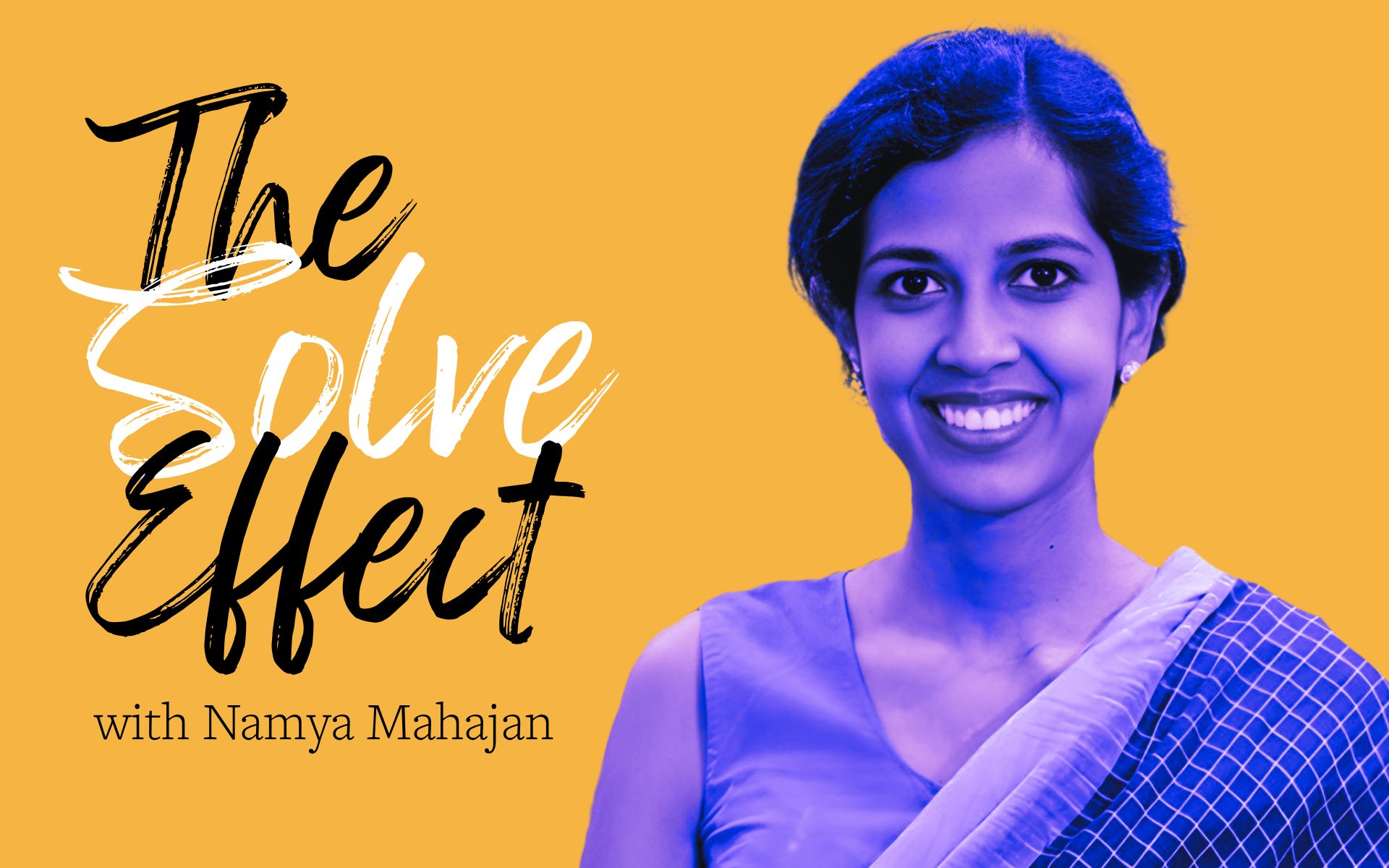
Today's guest, Namya Mahajan, decided to fix this. Namya grew up in northern India and then led SEWA's Federation of more than 100 women's cooperatives in Gujarat, where she saw firsthand how childcare shapes the economic lives of women in the informal economy.
In 2020, with her brother, Aziz Gupta, and their co-founders, she launched Rocket Learning, an edtech non-profit that meets parents where they already are: WhatsApp.
Rocket Learning provides daily bite-sized learning activities in local languages, designed for low-literacy parents, using things like dough instead of clay, and turmeric water instead of paint. It reaches more than six million children across 16 Indian states and costs about $1.50 per child, per year. Namya, welcome to the Solve Effect.
Namya Mahajan
It's so good to be back to the Solve universe.
ATD
We're always delighted to reconnect with folks, and you've had such a tremendous journey.
To get us started, can you talk a little bit about what brought you to the work of early childhood development?
NM
The pace of neural growth in the first six years is just fundamental. It's irreversible. There's research showing that what you do in those first six years can shape a child's IQ over their lifetime. It changes their school completion rates, 50% higher lifetime incomes, a ripple of effects over behaviors, the quality of relationships.
India's kids are behind before they even set foot in the school, they, are they already are starting off behind, and most of them never catch up. So it felt like a really fundamental inequality that somebody had to do something about. In SEWA, I also saw that it affects women's economic opportunity, their ability to work. And so it brought together sort of both women and children, which is the work that was my life's mission.
ATD
You launched Rocket Learning right as lockdowns were put into place for the COVID-19 pandemic. What were some of those first months actually like in a time that was really different for both women and children?
NM
So I was leading SEWA's Cooperative Federation. I left to do an MBA at Harvard Business School. So I was in Boston again and learning about entrepreneurship and how to set something up from scratch because I wanted to start something in early childhood education.
I'd come back, and lockdown started, and it became this time where I met my co-founders who were also looking at coming together to solve a big problem. In some ways, it was helpful because it felt quite natural to be spending six hours on Zoom every day talking about what would eventually become Rocket Learning.
It was our first user testing where we called young and ready workers in different places to understand what they use their phones for, to understand what they knew about teaching. We spoke to parents via WhatsApp. Our solution at that time was that parents were really the key to unlocking children's learning at this age, because kids spend more time at home and parents have a huge incentive to help their children learn, right? So if we could get the right information to parents every day, they would be able to support their kids to learn.
And we'd already thought it would happen through WhatsApp because parenting programs work, but there was no way to scale them up because it's really expensive to reach millions of parents every day.
ATD
Tell me more about what those parenting programs looked like.
NM
From the 60s, there was a program in Jamaica, it was a small program called Reach Up, which worked with parents, sent home visitors who demonstrated really simple things that they could do with their kids. And parents took up those activities for the first six years. And then that program followed kids for the next 40. And that's where those numbers came from on dramatically different life trajectories, right?
ATD
Big time series things that we can have really, really deep—and how many kids were involved in that study?
NM
So it was a small number. I think it was like 120 kids.
During COVID and lockdowns, schools and daycare centers were closed for a year and a half in India, the level of learning loss in those couple of years was so unprecedented. And we found that government systems were actually really eager to adopt a solution like ours because reaching parents, reaching homes, using digital technology was the only thing that actually could be used for kids to learn.
ATD
I remember those pandemic days because I had a nine-month-old when the pandemic started. And so I was at home, away from childcare, and looking at what can I do at home. So I can imagine some of those different contexts.
I think whenever we talk to innovators, there's some moment in those first two months where you know that it started to work. Can you talk about some moment where you're like, oh, this approach has some real potential?
NM
The COVID proof point happened quite early where we sent parents activities, but then we knew that just sending activities is not enough because eventually people get tired of it, So we wanted a way to close that loop where at the end of every video, we said, “Okay, now you do the activity with your child and share it with this other community of parents in your neighborhood.”
We saw parents come back again and again. We saw them share the report cards, the star certificates. They became their display pictures on WhatsApp. We could see that this product is sticking, which was fantastic.
I'd say the other one was after lockdowns actually finished, we were really stressed. Because everyone is telling us that parents are responding because they're stuck at home with their kids during the pandemic. But when lockdowns open up, kids are going to go back to school, and parents will say, “Not my problem anymore.”
ATD
So it's only going to work for this period, and then it's going to stop working.
NM
Yeah. So we were keeping a really close eye on active parents to see…would they just stop? And we saw that actually 80% of our parents kept going on, but 20% did drop off. And so we all called those parents to say, “Hey, what's up? Do you no longer think this is important?” And we heard enough of them say that, “My kid isn't doing it anymore because they say we already did it in school, so we're not going to do the same thing again.”
And that's when we realized, so India has the world's largest daycare network. There are 1.4 million government-run daycare centers around the country that serve basically kids under six.
We knew that not too much teaching or learning is happening because these centers focus on health and nutrition. And so the daycare workers had never been trained on how to teach. But we thought also that, “How do we work? This is a cadre that we didn't hire them.”
ATD
You don't have any direct interface or direct reason to shape what they're doing.
NM
Exactly. So why would they change their behaviors? But we kept hearing that they're using our content in their classrooms. And we were like, why? This never happens in the sector. Usually you have to work so hard to get somebody to use what you created, and here they were doing it without us even asking them to.
And so we did some really deep work in five states where we did structured interviews. And what we found was that they love teaching. They love kids. Most of them came into the work to work with kids. But they're doing a lot of nutrition, health, weight monitoring, data entry. But they really want to be teachers. And so when they got our content, which is simple enough for a parent to do, they were like, “Hey, we can do this, too.”
This educator program is now massive. We work with 400,000 daycare workers out of the 1.4 million.
ATD
And so that sense of scale is just so different and so enormous and so impressive. Can you talk a little bit about how you design some of those exercises and maybe how that's evolved over time?
NM
We test out everything. We test out the opening visual, and the opening music, and who should introduce the video. The demonstration, how should that be? And then how should it end? And each one of those elements we test over and over with different archetypes of parents or daycare workers. And then we enshrine them in content principles that are open source, and we're happy to share them. And then every piece of content kind of follows that formula. So it's a pretty involved process. We spend many, many hours on that, but it is the most important because I think a lot of us fall into the trap of: we want to make technically good content, but that means nothing if people don't want to use it. We want to create user delight, not just have communities be recipients or beneficiaries, but can they really, can they own this program more and more, and will they love it, will they seek it out?
ATD
And that's technically good in the sense of high video quality production, or technically good in the sense of: we have evidence to show that this kind of activity will improve children's brains?
NM
We're called Rocket Learning, but early learning isn't quite rocket science, right? We know broadly what curriculum works. We know what the milestones are. We know what kinds of play are great for shaping kids' brains. So of all the curriculums in the world, they're 80% the same, right? So we want to create the best science-backed curriculum, and we did with the national government in 2024. But what's more important is how that's actually done, and whether it's actually done often enough with kids.
ATD
And how many videos have you made to date?
NM
We have something like 2,000 videos in Hindi, which is our main language. And we now work in nine languages. So we're working on converting those 2,000 into nine languages, because we have content for parents, but also content for daycare workers. And we have content for parents across birth to six now. So it's a fairly big bank, probably the biggest bank in the sector. And again, all this content is under Creative Commons. Other organizations have dubbed, translated, used parts of it in different ways, and we love that.
ATD
How many people does that nine languages cover?
NM
Yeah, so Hindi alone covers about 50% of India's kids. And with those nine languages, it's closer to 70% of India's population.
ATD
So you have a lot of space within that to capture many, many millions of children.
NM
That's right. We're only covering 25% of India right now. In the next five years, we're hoping to work with a million daycare workers in 70% of India.
ATD
We've talked a lot about the programmatic, what you actually do, but I want to talk about, as an organization, what was the process of making an organization like? What was most beneficial to you as an early innovator?
NM
I can say Solve was really beneficial as an early innovator.
ATD
Well, that's nice of you. It doesn't have to be the initial answer.
NM
Having co-founders for me was really important and has been really important because in those early stages, you need people around who can just, you know, whose competence you trust, whose values you trust, and who are fully bought in. So really lucky to be working with incredible people.
And as you get bigger, it's important to have them because they will tell you the truth. Your early team members will set the tone of the organization, the culture, the values. So we were very deliberate about who we brought on early; we were also really deliberate about thinking about our culture and our ways of working.
We were a fully remote distributed team. How do we make sure that we are connected to each other? We had weekly town halls.
ATD
And a lot of pieces come out when you're just having informal conversation between people and stuff is unexpected.
NM
Another early accelerator we were in, they said that there's a love bank and you have to make deposits with the people that are in your life that you spend a lot of time with, like your co-founders or team members, because you sometimes need to withdraw from it, and you don't know when. So you have to make sure you're depositing. We made sure we were deeply human-centered, community-centered.
ATD
You started in 2020, and you were selected by Solve in 2021, which is pretty early on in the organizational history. And so we've gotten to watch you go through several of those other stages of that journey and go from a pretty early pilots and early deployment to now hundreds of thousands of people, millions of children. What kinds of opportunities do you feel like you wish you'd had at the early stage that weren't necessarily as available?
NM
Well, very specific to us is that during COVID, most of our conversations with communities happened virtually, which doesn't really fully capture the essence of things sometimes. We also weren't able to measure children's learning for a while because three to six-year-olds will not answer you over the phone.
ATD
And you don't necessarily trust their answers anyway.
NM
Exactly, exactly. And so going out to meet them was not possible for quite a while. So we were working with the best curriculum designers in the world, and we were looking at really strong engagement. But for a couple of years, we didn't fully have data on how that was changing learning outcomes.
ATD
In 2022, you did a randomized control trial with J-PAL. Can you tell us a little about how that trial fit into some of your evidence?
NM
I interned at J-PAL, and one of the J-PAL ED, Iqbal Haliwal, has been on our board from the beginning, so we had connections to the investigator network.
So ICTs or randomized control trials are some of the most nerve-wracking evaluations of your work. The idea is sort of like a medical trial that you have a control group which doesn't get your intervention, but are otherwise identical to the treatment group, which does get your intervention.
And after a period of time, you can measure outcomes and see how the two cohorts have been impacted in our case in learning. And whatever you get after that is sort of your true impact, right? And that's important because especially in education, with little children, they're learning every year anyway, right?
ATD
And all the time, in all sorts of different contexts, and it's hard to piece out one particular part of it.
NM
Exactly, so we started that really early.
In December 2020, we had a call with the investigator, Karthik Muralidharan, who is one of the authorities in Indian education. We thought we were getting advice from him. And he was like, “Guys, this is really promising. You're onto something. Can we do an evaluation?” And we got off the call. We were like, “Are we ready? Probably not.”
But it just felt like an opportunity to understand the kind of impact we were having. So we went ahead, even though people told us we were crazy and I definitely got some gray hair in the two years that we did the evaluation. In fact, the first one we set up, we couldn't even do an end line because there was another wave of COVID.
The second iteration at the midline, we saw that every indicator of engagement, usage, time was going up, but we weren't yet seeing impact on learning.
Then we went to Karthik and we said, “Hey, it's been two years. We've done some 50 A/B tests in that time and, you know, we have a much better product. So can we change our product or do we have to be frozen at 2021 Rocket Learning?”
And he said, “Hey, let's bring like the latest, greatest Rocket Learning.”
And so when we rolled that out, we saw impact of 0.2 standard deviations, which is one of the highest sort of ed tech or education effect sizes in general, and especially at a cost of a dollar and a half per child. So, we know that 75% of children in our cohorts are able to reach school readiness versus about 50%, which is the national average.
ATD
It's such a big change and for so little money. It's just astonishing.
NM
Yeah, it does leverage sort of the system that's already there, right?
ATD
When you're growing as an organization, you need funding. Can you talk about the kinds of funding that you pursued in order to give you the capital to fund this work?
NM
We did think about whether we should be structured as a not-for-profit or a for-profit because, of course, the funding available is very different based on what you choose. And we landed on not-for-profit because we wanted to be laser-focused on serving the most vulnerable children in our communities, and those kids are enrolled in government daycare centers.
But there is such a risk that if you are for-profit, then there will be that mission drift, and you will eventually start serving higher income kids who also probably need your program, but just not as much. And perhaps somebody else is building for them already.
ATD
My kids are happy to use these pieces, but they're not necessarily the primary audience.
NM
We're very happy for all parents to use it, but we want to design for the parents who need it. I had many realizations about sort of how to pitch and how to approach fundraising more broadly as a conversation, as a way to bring people into your mission. I used to think it's, is it begging for money, but I think now those conversations have shifted, where you are really putting something else on the table, which is the opportunity to be part of the huge mission and create something so special with that capital.
ATD
You have been working in the last year on a voice-first generative AI companion. Everyone has to use AI in some fashion, so I want to understand how you're thinking about that.
NM
The thing I'm proud of with our AI is that we didn't see AI and be like, “Oh, this is a cool technology. Let's see how we can use it in our model.”
But actually, there was a problem that we needed to solve that we've been trying to solve. And then AI came in and we were like, “That's the right technology for this problem.” And I think that's helped us sidestep a lot of hype. But the problem is personalization.
So right now, we send basically the same content journey to almost every one of our daycare workers or to our parents. And that's brought kids from that 50% to the 75%. But in the next five years, we want to get from 75% to 90%, which would mean that we need to reach kids where they are in terms of their learning, right? And that's been a massive challenge with education more broadly. And AI came in and it was like, okay, this is actually a way for us to first understand kids' actual learning level, and then to send them a sensible number of lesson plans that are useful for that parent or for that daycare worker.
ATD
Is that sending different videos or videos that are where the content itself changes based on who the children are?
NM
The idea is to send different videos. So if a child needs to repeat a certain learning module because they haven't mastered that learning competency yet, then we can slow down the learning progression and kind of repeat the same activities or bring in different activities on that same learning outcome so that they can actually master that before we move on to the next thing, right?
ATD
One other very different space of scale, you've been scaling so much in India with such great results. I know you've also worked with organizations in Peru, South Africa, Kenya, Chile, on early childhood policy. And I wondered how much of the playbook that you have is scalable in some of those other cultural settings.
NM
What happens to the young children in South Africa and in Peru will affect all of us, right? These kids, 70% of children under 6 are in low and middle income countries and are also, 250 million of them are at risk of not reaching their full potential because they don't have access to early learning. So we need government investment into early learning. It's chronically underinvested in. Higher education gets a lot more interest in investment comparatively, whereas the brain development is happening in those first six years. So we're coming together to really talk about how important this work is and how little money and interest goes into it, given how important it is.
ATD
People are taking care of kids in all of these different contexts, whether we have a formal setting or not.
NM
Exactly. So we have a peer called Kidogo, who we love in Kenya. They work with mamapreneurs—
ATD
Also a Solver.
NM
Yes! There we go. A Smart Start in South Africa that works with women in informal settings to provide high quality ECD. So all those providers need a way to get ongoing support and capacity building, which is something that we can help.
And what we're looking at is partnering with local governments, local organizations, to build capacities, feed the idea, and work with them to develop versions of this in their own country.
ATD
If you could give your early-career self some piece of advice, what would that be?
NM
Follow the people. I think at the end of the day, who you work with matters more almost than what you're doing. So pick a problem area that you love and are interested in, but also make sure that you have people around you who inspire you, who keep you learning. who have the same values as you because that will impact your career and your happiness much more than anything else.
ATD
And my final question here, hope or courage for the future?
NM
Hope, because what we're doing is shaping the future. But courage, because they will face a world that's also more challenging than the worlds that we've been fortunate to grow up in, but I hope that what we do for them today can equip them to make it better.
ATD
Namya, thank you so much for joining us on the Solve Effect today.
NM
Thank you for having me. This was so much fun.
HH
If you haven’t yet, please subscribe to The Solve Effect wherever you get your podcasts.
This episode was produced by Bridget Weiler and Elisabeth Graham.
Audio engineering by Kurt Schneider at MIT Audiovisual Services.
Music by Tunetank.
For more information about MIT Solve’s tenth anniversary, check out solve.mit.edu
Tags:
- Podcast
- Tenth Anniversary
Related articles
-
Stacy Brown-Philpot on TaskRabbit, Trust, and Doing Hard Things
-
Bonus Episode: LIVE from Solve Challenge Finals 2026
Go behind the scenes at Solve Challenge Finals in this bonus episode of “The Solve Effect.”
-
10 Years, 10 Solvers: From 14 Days to Under 60 Minutes—Revolutionizing Radiology Reporting with Rology
Ask Amr Abodraiaa what Rology looks like from the patient's side, and the answer is: nothing at all. Invisibility is the design goal. What the patient gets is the result.