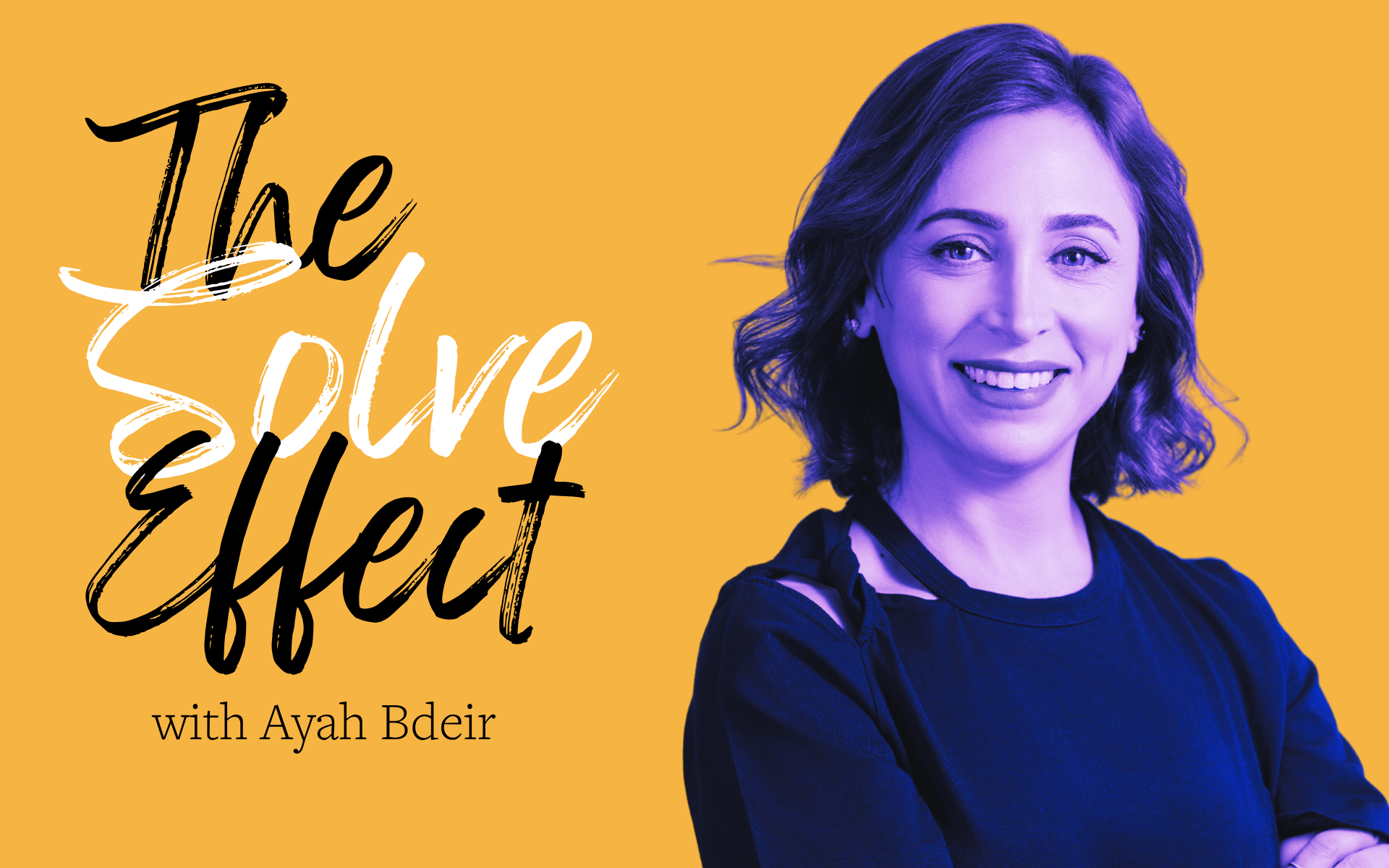
This is a transcript of Episode Nineteen of The Solve Effect, edited and condensed for clarity. Listen on Spotify, Apple Podcasts, or Amazon Music.
Show notes
Ayah Bdeir is the CEO of Current AI, a partnership of governments, foundations, and private-sector funders launched at the AI Action Summit in Paris in February 2025 to build public interest AI at scale. Before joining Current AI in January 2026, she led AI strategy at Mozilla. She holds a master's from the MIT Media Lab and degrees in computer engineering and sociology from the American University of Beirut.
Ayah founded littleBits in 2011, turning electronics into a material anyone could build with. The original 2008 prototype is in the permanent collection of the Museum of Modern Art, and the company reached tens of thousands of schools before its sale in 2019.
Ayah joined the Solve Challenge Finals 2025 stage in New York City for a conversation on AI ethics and who gets to shape the technology.
The Solve Effect is a production of MIT Solve, MIT's initiative connecting social entrepreneurs to the funding, partnerships, and expertise they need to scale.
Transcript
Hala Hanna
Welcome to The Solve Effect, where we explore the ideas and the people shaping a better future for all. I'm Hala Hanna.
My guest today has spent her entire career refusing the idea that technology is just something that happens to us, that it should remain something that we understand, shape, modify, and own. Here are a few ways Ayah Bdeir has been described: interactive artist, reluctant engineer, accidental entrepreneur, geek activist. She built littleBits, the little magnetic blocks that turned millions of kids from tech users to tech inventors, work that now sits in the permanent collection of the Museum of Modern Art. And she's been fighting the same battle across three eras of technology, the internet, social media, and now artificial intelligence.
Today, she runs Current AI, betting that technology built for the public good can exist not as a slogan, but at scale and belong to all of us. So today is a conversation not just about technology, but also about agency, openness, creativity, and how ordinary people can remain authors of technology rather than permanent tenants inside someone else's system.
Ayah, welcome to The Solve Effect.
Ayah Bdeir
Thank you. Thank you for having me.
HH
So you've moved from building a hardware company, maker communities, open source movements, and now you're building a global AI institution. They seem to all be pointing to the same question: How do we stop technology from turning people into passive consumers instead of active builders? Did I get that right?
AB
No, it's 100% right. I've always had this belief that technology is not a field or a subject or an industry to be learned, but is a foundation of everything we do in life. And as a foundation that governs how we speak, how we communicate, how we travel, how we learn, how we move through the world, we have to all be able to understand technology, to be able to be creative with technology, and to be able to invent the next generation of technology.
And so throughout my career over the past, I guess, 20 years, the governing technology of the day has changed, but the concept has remained the same: how to democratize that tech so that it's accessible to everybody, so that it's empowering and not a force of control, and so that it can inspire young and old alike to be change makers and agents of their own lives.
HH
Was there a moment or a place that you can go back to where, you know, that urge became really obvious?
AB
I feel like as far as I can remember, I've had this sense of playfulness around tech that I realized relatively quickly was not as common among my friends. It's kind of the classic image of the tinkerer kid that took things apart, that opened things to look inside, played with, I'm going to age myself, the VCR. And I taught myself how to do editing on the VCR by just like, basically creating linear editing for myself. And so I always had this sense that you could use the tool in a way that was subversive and that was not, it wasn't designed for. And now I have a four-year-old and I see him do the same. And I'm like, did I teach him this or did he just do it? And I actually don't know.
HH
I want to stay with your upbringing, because your mother helped transform Lebanon's banking industry, a corporate trailblazer. She was raising four daughters at a place in time that didn't make that really obvious. What did she model for you that you only understood much later, maybe now that you have your four-year-old?
AB
My mom is amazing because she started her career when she already had kids. In the Arab world (we’re from Lebanon) it wasn't that common in her generation for women to be studying while raising families. And she basically went to undergrad and to graduate school while pregnant. And then when she was writing her thesis, and we were young and studying, we would study side by side. We would ask her for help with our homework. And she would say, “I can't help you with your homework. I have my own homework.”
So she modeled the behavior that then we emulated, which is you work for yourself, you study for yourself, you're independent, and all four of us are like this.
She started her career in banking when there was no concept of electronic banking. And she would travel a lot with my dad and would see these little cards that my dad would use when he went out for dinner. And she got so fascinated by it, and now, 20 years later, she's built electronic banking industries in Lebanon and Jordan and Syria and multiple other countries.
HH
You mentioned your four-year-old son. He's four, just like mine. And you joke that he makes you regret a decade of telling kids to be mischievous. And I'm wondering how becoming a mom changed your view of where your mischief might have come from, but also because you have a son like me, how that reshaped your idea of feminism.
AB
Yeah, my son, Dia, makes me regret sometimes that I used to, at littleBits, we ran campaigns about that kid: that mischievous kid, the kid that never colors in the lines, that never listens to instructions, that jumps on every piece of furniture, that paints on the walls. And it was funny and it was a campaign. And it's how we talked about the littleBits inventor spirit. And then when you have that kid at home, you're like, what did I do to myself?
HH
It's called karma.
AB
Exactly. But I love it.
As a feminist, I think where it manifests the most is wanting to make sure that he is in touch with his emotions. The thing that I find myself paying more attention to is that I let him be vulnerable, and cry, and be sensitive, and be tender, and not overuse words like, you're strong, and you're the best, and you're winning, and you're a superhero. And I try to catch myself on those things and scold my family for doing it.
HH
Sounds like we have similar conversations at home.
AB
The Lebanese family. How do you have that conversation with the Lebanese family? It's impossible. Like, don't tell him, “You're the strongest.”
HH
It's like, what do you mean?
AB
Exactly.
HH
So it's a very empowering way to raise a child. And littleBits was also all about empowerment, right? It was called the Lego for the iPad generation, but what they were really learning about was how to manipulate the world around them and understand the world around them. Why does making something with your hands change how you see your own power?
AB
There is decades of thesis around that, around constructionism, the power of learning through play, around how your understanding of the world is solidified when you are manipulating the world around you and not just hearing it or having one sense occupied with that piece of information. None of that is my invention. I think that where we saw it very quickly in littleBits is in the early days, littleBits actually was not meant to be a product for kids. littleBits was meant to be a product for designers who were prototyping.
And then very quickly in the first demos, we saw kids really, really gravitate towards littleBits. You would see the face of the kid, as soon as they snap two bits together and a light comes on, and suddenly their eyes would light up and they would have this wonder and this pride and this... It's just, like, magical, magical thing that throughout eight years of running littleBits was consistent, that we would see it every time.
And so that's what for me was the thesis, is like, how do you build technology for wonder, for pride? Wonder you maybe look at it as like, “Oh, that thing is amazing.” But pride is about, “I made that thing amazing.” And that difference between wonder and pride became something that was really, really important and carries with me outside of electronics as well.
HH
Say more about that. Where does it carry now?
AB
It definitely now carries in AI. My whole “ick factor” with AI right now is that it's so obscure and it's so black box and it's given to us, bestowed on us by a handful of companies that decide what experiences we're going to have with this thing that presumably (and already visibly) is changing every aspect of our society and our bodies and our being.
And so I have a real problem with that. I have a real problem with not being able to see it from within, manipulate it, have pride in the kind of relationship I have with it. I have an issue with it. I don't think it's okay. And I think there's a short period in which we can intercept that phenomenon, but it's not an indefinite amount of time, and we have to kind of do it quickly.
HH
You created these littleBits that you could see the brick, you could snap it, break it, understand it, and AI is the anti-littleBits. It's invisible and sealed, and it's somewhere in a data center. It resonates a lot what you're saying in terms of when you design technology in secrecy, you can't really be the creator. Can I ask you one more question about littleBits?
You had scaled it to 20,000 schools. You've raised over $60 million for it. And when you sold it in 2019, you stepped away. And founders rarely talk about this, about this moment of transition. How did you grieve it?
AB
Founders rarely talk about it. It is a grief. I had merged with it. I initially started working on littleBits in 2008, as a prototype when I was an artist at an art and technology lab in New York called Eyebeam. And I was just out of the Media Lab, and I had been experimenting a lot. And then you said earlier, I became an accidental entrepreneur because I put the thing online and people started writing to me about buying, and suddenly I was like, “Oh, I'm going to raise money, I guess. I'm going to build the company, I guess.” Before I knew it, it was 10 years that I had devoted to this thing. And I had merged with it. My identity, the clothes I wore matched the littleBits brand colors. I would go out to dinner, I was a littleBits girl. You know, the kinds of news I would read was always around littleBits, the kind of books I read, everything. I had merged with it.
I worked so hard. We traveled a lot. We were building products super fast. It was a fast-moving startup. And so when I sold it in 2019, I woke up, next day, and I had nowhere to go and nothing to do and nothing to be. It was very, very disorienting.
It was disorienting to not know what to read. It was disorienting to not know what kind of clothes I wanted to wear every day, to not—to go out to dinner and not know how to answer the question, “What do you do?” Which in New York is obviously a very common question.
I would say I was in a mild to mid depression for, maybe six months, and then you go through all these times where you rehash things. Mistakes I made, and I wish I did this, and I wish I did that, and oh, we wanted to launch this product, and we never did, and now somebody else did it, and I would have regret around it, and you had all these thoughts trying to relive the past. I know it's quite difficult to kind of get yourself out of it, actually. And I don't think I've ever talked about it.
HH
Thank you for sharing. I do think it's actually quite a familiar experience. And it's a shame for people to feel like they're alone in that feeling. And part of me was thinking maybe the maker-creed that, you know, it's like collective genius over the cult of the individual, that maybe that would have made it easier for you. But no, you're right. I mean, it's…you played the game, you won the game, and then you're like, and now what?
AB
Now what am I outside of that game? And I think it's also more true for founders that become, in my case, I had become the face of the company. I had become the face of a movement. And then I sold it, COVID hit, the world shut down. Then I had a baby. And a mom already goes through like a loss of identity when she becomes a mom. Like, am I, am I an individual? Am I a mom? Am I a career-oriented person? Am I—is this my job now?
HH
Am I ever going to achieve anything ever anymore?
AB
Am I ever going to think about anything else than what he's eating next?
HH
Or even think, period.
AB
All these things that you're going through. So it was kind of like a one-two punch.
HH
What movement are we in now? I mean, you've worked so much on the openness movement. It feels to me that one of the assumptions is that openness creates better societies than optimization. And I'm wondering what you think openness protects, and what do we lose if openness loses?
AB
I think it's a multi-part argument. Bullet number one is that technology governs every single aspect of your life. And so it's really important that technology is designed well, and with all people in mind.
And in order to do that, being open is the best mechanism, so that anyone has access to it no matter where they are. Most people do not get to work in a big tech company in Silicon Valley. And so if you want to take in their perspective, and their lived experience, and their point of view, and design technology that works for them in their daily lives, their opinions matter.
Premise number two is that technology and AI, for example, now in particular, came to existence because of open source. It exists as a field—generative AI and AI in general—exists because of open source as a methodology, and as a community, and as a practice. And then to take all of that, gains from decades and just decide to close it off, it's just wrong on so many levels and does not continue the progress that it relied on to get there.
And then the third premise is the acceptance that technology is imperfect. And so when it is faulty or badly designed, it requires iteration, and improvement, and accountability, and observation, and examination.
In the case of AI, you have all these systems that are showing bias or that are showing harms, or that are being deployed in very real-world scenarios like police departments and immigration departments and war. AI is very actively used. We know that in war in Gaza and in Lebanon. And what happens when it makes a mistake, which often it does? How do you then examine it if it's not open?
HH
It's really profound because it's like openness wins morally, right? And then, AI has just consumed the open movement, the open web, and now closed has been winning economically. And I was wondering if there's something we can learn, that you learned from the Mozilla years or that you're now looking to do with the Current AI work that teaches us: how do we make the market pay for open so that open wins economically as well?
AB
You have to sell the medicine with the sugar. We couldn't sell littleBits on the box as like, we'll make your kids smarter. Nobody wanted to buy that. It had to be about the fun. And then the educational value was going to come as a byproduct of the fun.
And I think with AI, we can't sell openness for its safety values on its own. We have to sell the value that is behind it. Right now, in the moment that we're in, the big value prop of openness is resilience and sovereignty. So, many governments around the world are very worried about the state of geopolitics and about political decisions made in the United States that affect technology companies that their governments are reliant on.
And so there is now a drive to invest in openness for resilience purposes. I mean, we're part of trying to create that drive at Current AI.
HH
So Current AI is trying to build the public interest AI with governments, with philanthropies, with private companies. When you think of these groups that might not always optimize for the same thing, what does success look like? Is it about building that open source ecosystem?
AB
So we have a three-part strategy that we call a fund, build, bridge.
The mission is to build and orchestrate the public-interest AI stack from hardware all the way to the applications. It's to essentially create an alternative AI system that is open and for the public interest.
So we have a grantmaking program where we are giving out grants to builders who are creating technologies in the public interest.
Then we have build, which is essentially us building this stack up gradually through collaboration with other people, individuals, developers, companies, and governments.
And then bridge is all about creating, investing in the bridging in these networks and in these communities and kind of turning these individual initiatives into a movement.
HH
First of all, congratulations on that strategy because you've barely been in the role for four months.
AB
It will be six months soon.
HH
Whatever you're doing, you're always thinking: what is the mass movement? And I wonder, what's the hardest thing about building that institution, that movement when you have to kind of move at the speed of AI on one hand and the government on the other?
AB
We are essentially a tech company, and a philanthropy, and a government organization at once. I have no doubt that we need these three levers to do the work that we're doing, but operationally, it creates complexity.
Essentially, because AI is setting the pace, governments have to move at that pace. So that's been the helpful factor in being able to bring three different types of stakeholders that are very different than each other together.
HH
Well, good thing one of the three points is being a bridge.
There's a story that you tell that I love, that you were making an Iftar invitation…
AB
I'm surprised you remember that. It's a real story, real story. I was hosting an Iftar dinner two years ago. Gen AI and making images was the new thing, and I wanted to make an Iftar flyer—something that I thought was gonna take seven minutes.
The picture that comes out is so offensive in so many ways. First of all, visually, it's offensive because everything looked so prim and proper, and the dishes are lined up in a way that no Iftar table you would ever go to in your entire life looks like that. Like Michelin star applied to Iftar, like no, that’s not happening.
Plates are small. Barely any food on plates. And you're like, these people have been fasting all day.
Hummus is orange. Tabbouleh is like rice with like three pieces of parsley on it, or basil, or who knows what. No water ever to be seen on the table. No juice to be seen on the table. A bowl of fruit. How is a group of people who are fasting for an entire day gonna sit down at a table and eat sugar for the first thing they eat? It's just layers and layers of misunderstanding that baked into this one picture. I get triggered, and then I'm like, “Oh, I'm getting to the bottom of this.”
And I just proceeded to spend what I think was like an entire day…set aside all the things I had to do to try to debug how that was happening. Where's the data coming from? What images is it trained on? How does it make decisions?
A lot of imagery around the Arab world is colonial imagery and imagery that is orientalist, that has been created by the West's perception of the Middle East. And so it has bias baked into it. And we ended up, when I started at Current AI, creating a grant program called Culture Preservation, about how you create AI in order to preserve culture and how you build AI in order to enrich culture going forward and not erase it, not homogenize it, not flatten it.
HH
You recently met Pope Leo XIV for the release of the AI encyclical, Magnifica Humanitas. And it struck me that a lot of your language, Ayah, human flourishing and dignity and agency, I mean, it sounds moral even before sounding technical. Do we, the technologists, need a richer moral vocabulary?
AB
There's a lot of very interesting work that happens on that front, but many times the ethicists, the researchers, the social psychologists, the UX designers, they're not in the conversation. People tend to operate in circles that look like them.
I'm traveling in many worlds, maybe partially because I'm an immigrant, maybe partially because as Lebanese, we've been traders all our lives and all centuries ago. I find that the opportunity now is in bringing in learnings and hypotheses and ideas that people have created around moral language, around codes, around behavior, around human flourishing. There's code switching you have to do, there's translation that you have to do among people that usually don't share language. And I think that is what's needed as opposed to a new language.
HH
I love that link you're making between being an immigrant and then being a bridge builder and code switcher. I think you and I both left Lebanon in 2006. We both left through Jordan. And I was wondering if open source, in some way, is the engineering version of building things that no one can take away from you, it's the portable thing that you can take wherever you go.
AB
I 100% believe that. It's why I started my career doing open source hardware. And I feel like probably now throughout my whole career, I'm trying to translate open source as a methodology to education, to AI, to cultural preservation in this case. It just feels very natural to me as a vector.
HH
Yeah. It made me giggle that you coined the term “electronics as material.” I felt like it's a designer's revenge on engineering.
AB
I was like all cotton balls and silk and pipe cleaners, and everything else was like electronics and like metal and magnets. And you know, it was very antithetical.
HH
If your four-year-old asks you 20 years from now, when everybody was building AI, what were you doing? What would you say?
AB
I was in the AI resistance! No, we're building a better AI. We're building an AI that is...around a global, collective, and collaborative vision that is not governed by any one country or any one company.
HH
I want to end our conversation where you seem to always end up: with mischief. I saw that your favorite word in Arabic is “kazdoura.” I love that word because it's a walk that's really about presence and connection and a little bit of trouble. You never know what's going to happen. And is openness just the grown-up word for mischief, you know, the right to poke at things, take it apart, see how it works?
AB
Yeah, the right to, the right to take and make it yours, to put your stamp on it, to repurpose it, leave it for someone else, to then take and make theirs and repurpose it. Open source by definition is about a community of people. Sometimes it's online, sometimes it's in physical space, but it's always in community. It's all the, honestly, it's all the things that I love kind of in one. Like you're helping me now see the arc actually in a way that maybe I didn't before. I think open source is mischief.
HH
Ayah, thank you so much.
I hope we go on a kazdoura together soon.
Thank you for fighting the good fight and for putting hummus in the training set.
AB
Thank you. Thank you for having me. And thank you for always having the depth of conversation that we don't have so often in these spaces. I love your podcast.
HH
There's a moment in the conversation with Ayah where the engineer disappears, and the kid with the VCR shows up—the one who took the machine apart, not because it was broken, but because it was closed.
Ayah has spent her career insisting the box should open. In hardware. In classrooms. In a ridiculously small bowl of hummus. And now in a global bet that AI built for the public good can exist, at scale, and belong to all of us.
I love the idea that open source is mischief for grownups. The right to poke at things. Take it apart. Make it yours. Leave it for someone else to make theirs and make better.
So let’s be good enough ancestors. And make some good trouble.
I'm Hala Hanna. This wasThe Solve Effect.
If you haven’t yet, please subscribe to The Solve Effect wherever you get your podcasts.
This episode was produced by Bridget Weiler and Elisabeth Graham.
Audio engineering by Kurt Schneider at MIT Audiovisual Services.
Music by Tunetank.
For more information about MIT Solve’s 10th anniversary, check out solve.mit.edu
Tags:
- Podcast
Related articles
-
Stacy Brown-Philpot on TaskRabbit, Trust, and Doing Hard Things
-
Bonus Episode: LIVE from Solve Challenge Finals 2026
Go behind the scenes at Solve Challenge Finals in this bonus episode of “The Solve Effect.”
-
10 Years, 10 Solvers: From 14 Days to Under 60 Minutes—Revolutionizing Radiology Reporting with Rology
Ask Amr Abodraiaa what Rology looks like from the patient's side, and the answer is: nothing at all. Invisibility is the design goal. What the patient gets is the result.