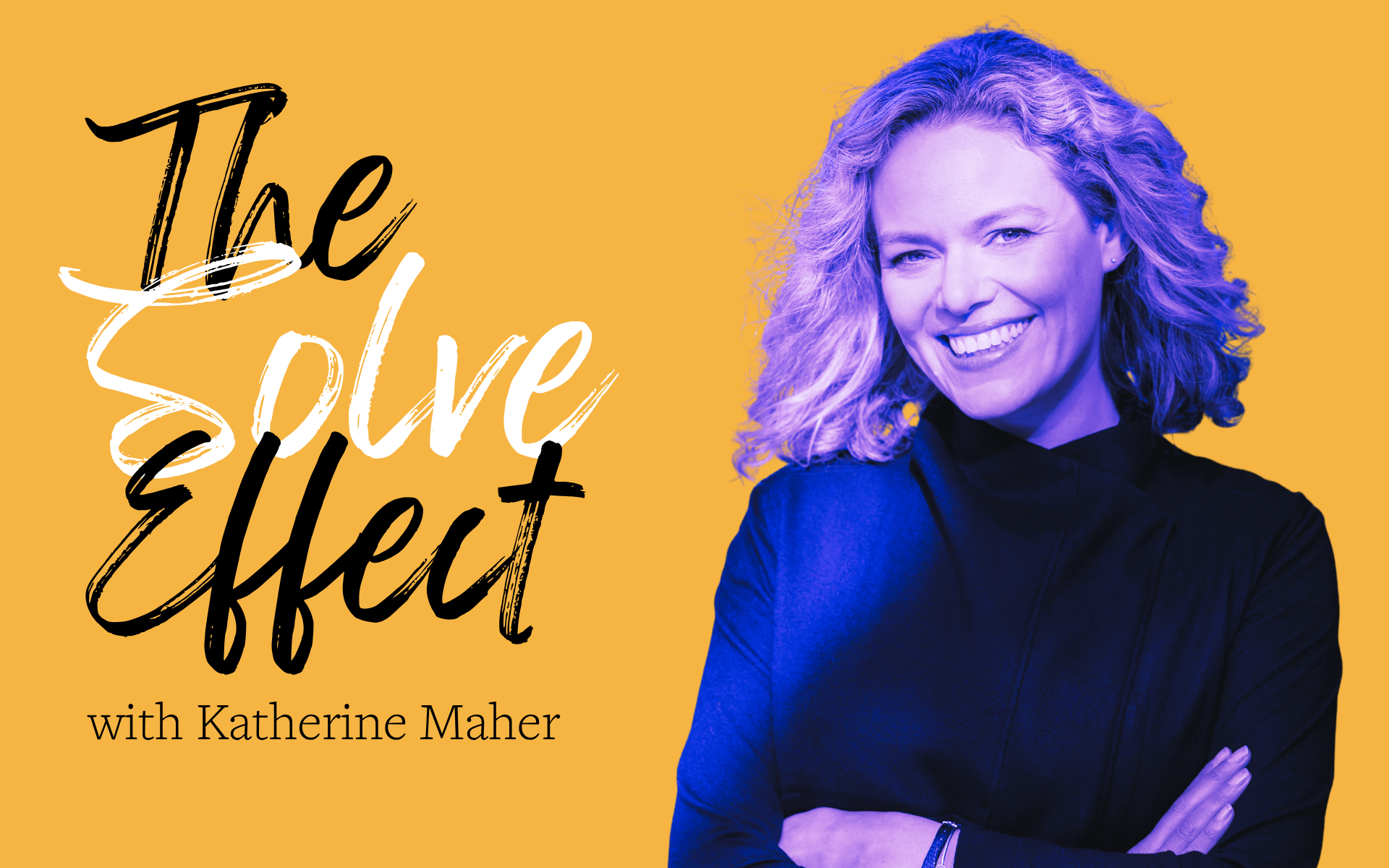
This is a transcript of Episode Eighteen of The Solve Effect, edited and condensed for clarity. Listen on Spotify, Apple Podcasts, or Amazon Music.
Hala Hanna
Welcome to The Solve Effect, where we explore how people are tackling the world's toughest challenges with boldness and imagination. I'm your host, Hala Hanna.
Over the last 20 years, we've gained an extraordinary abundance of information, more voices, more platforms, more ways to know, and yet we trust each other less. And that turns out to be a problem for democracy, because every society leans on a few invisible institutions that help us make sense of the world together, answering questions like, what happened? Who can I trust? What do we owe one another as citizens?
My guest today has spent her entire career building and leading exactly those institutions. She's led Wikipedia, the internet's greatest experiment in collective knowledge. She sits on the board of Signal. And today she leads National Public Radio, NPR, as public media fights for its life.
But this isn't really about one organization. It's about whether public interest institutions can still earn trust in an age of fragmentation, whether trust is something we discover together or consume alone, and what it takes to lead when the ground keeps shifting right beneath you.
It's one thing to have a Wikipedia page. It's quite another to have the New York Times write an entire profile about you.
Katherine, welcome to The Solve Effect.
Katherine Maher
Hello, it's great to be here. Thank you for having me.
HH
So I was trying to make sense of your career. And one place I think I landed is that it feels like one long project around a single question. How do millions of strangers come to trust one another enough to share a common reality? How does that land with you?
KM
I think that feels right now, though I wouldn't think that it felt right when I started doing this work, because when I started doing this work, it wasn't really a question about whether we could achieve a shared reality. Instead, I think my work started from a place of how, what does human flourishing look like and feel like? And what are the prerequisites for that to exist?
HH
I don't know if you seek out hard problems or they find you, but you end up being the custodian of institutions that people depend on, don't really understand, but are so necessary.
KM
I do like hard challenges. I am interested and drawn towards complexity and difficulty and the idea of prevailing against the odds.
There's also an element of, I also believe these institutions should exist, must exist. And I want to be part of ensuring that they do for generations to come and remain a valuable and important part of our landscape and lives.
HH
And you said you wouldn't be sitting where you are today if it wasn't for one of those driveway moments, the ritual of staying in the car.
KM
That's right.
HH
So can you take me into that car on your way back from school?
KM
Yes, yes, absolutely. So I grew up as what NPR refers to as a “backseat baby.” That's the kids who listen to NPR because their parents listen to NPR. And then probably initially didn't necessarily find it that interesting, but grew to appreciate it. That's sort of a common journey for children. And I remember listening every day on my way to school about what was happening in the world. I really loved the international correspondence, the way that they brought color and life to their stories, the soundscapes. And in particular, I was very interested in what was happening in the Middle East.
It was through NPR's reporting I started to hear not just about the sort of question of what the future of the Middle East could be, but also the people in the region, because NPR plays such a great emphasis on hearing people's voices and understanding the circumstances of their lives and how the events of the day affected them.
And so I decided that I was going to move to Cairo and that I was going to study Arabic. And that led me into traveling and learning about a world that I never would have seen had it not been for that driveway moment.
HH
Thinking of young Katherine in Connecticut and public radio, getting that sense of curiosity, empathy, citizenship, you know, and this is how we became friends, right?
KM
Yes, exactly.
HH
And now the little girl in the car is running NPR, which is very, very cool.
But just going back to that point about you fighting for information access throughout all of these jobs, often in places where access to information was literally a question of life and death. Are you seeing something similar in the moment that we're in?
KM
Yes and no. When I was at Wikipedia, I worked with people all over the world who very much saw access to unbiased information (unfiltered, uncensored information) as a matter of principle of life and death as a fundamental right. We worked with people in countries and in cultures where they could face very significant consequences for even editing Wikipedia or accessing Wikipedia. We have two Wikipedians who were sentenced to multi-decade prison sentences in Saudi Arabia for editing Wikipedia. They are people whom I know; they are people whom I've worked with, and they remain in prison today.
Information is something that is sacrosanct, and it is something that we build together as humanity. And people go to great lengths to protect its integrity and do so in ways that have real consequences for their life and their well-being and their freedoms.
And so is this the same moment for the United States or for the Western world as it is in other places that have really struggled with these questions? Not exactly, but are there life-and-death consequences? Yes, I think there are, simply by virtue of what information we base our decisions on. And those consequences may not be as direct as finding oneself behind bars or in court, but they certainly can be indirect in the way that we choose to make decisions, whom we elect, what sort of policies we support, and what that means for other people's lives.
HH
One of your most debated ideas from your TED Talk is about that…are there different truths? Because we've merged the facts with our beliefs and experiences. And I think most of us heard intellectual humility when you said this. And some others heard other things.
Elon Musk criticized you, which is an achievement. You should probably add that to your Wikipedia page. But at Wikipedia, being wrong in public and corrected in public, that's the whole design. And then you walk into an institution which the entire brand is: authoritative fact, being wrong, it's public, is actually really damaging. Did you unlearn something? Like how do you think of those two worlds and how they come together?
KM
When I spoke in this TED Talk, I talked about the fact that truth has become, I think, a little bit of a meaningless word. And I don't mean that there is no such thing as truth. There are facts, and then there are the greater truths of life. You know, what does love feel like? What does loss feel like? What is our purpose and our meaning in the world? And I think that many people continue to explore those truths, whether through the arts or through trying to understand sort of the fundamentals of our biology and how that might align with spirituality. There's so many ways we can explore truth.
However, what I was speaking to, in that moment, was this idea that we have singular truths in our discourse of the day. And I just don't think that is accurate.
The point that I would make there is that we need to have the humility to be able to say that our truth may be very meaningful to us, but where we should probably start from in conversation are what are the facts that we can agree upon. And then we can build meaning around that collectively or as a group as we try to come to decisions.
As far as that relates to coming from Wikipedia, a living dynamic resource in which it is encouraged for people to make corrections and it is welcomed when we find an error, I think that is really what that is, an expression of humility.
Journalism is at its best when it also starts with humility. A humility of: what are we trying to understand in the world? I've heard editors that I respect and admire say, “You know, when you think you have the story, you probably don't.”
HH
That reminds me of, we had on the podcast, Audrey Tang, the previous digital minister of Taiwan and currently cyber ambassador. And she talks about building campfires instead of wildfires. So wildfires are algorithmic, they're fast, polarizing, attention seeking, and then campfires are the places where people gather, make meaning together. And I was thinking, you know, is public media one of the last standing campfires?
KM
I love that analogy. I'd not heard that previously, but I think that's absolutely right. There's such a great deal of understanding now about how important local media is in healthy communities.
Across the United States over the course of the last 30 years, we have lost an extraordinary number of local newspapers and local media outlets. Things that, when I was growing up, my local hometown, about 20,000 people, had two newspapers. Now it has half of one. That local paper covered the issues of the high school. It covered the issues of zoning. It covered the issues of traffic. It is the most granular understanding of our lives in that town. I can trust those journalists that they have captured my town accurately. And so then when they go out, and they report on something a little further afield, perhaps, something in the next town over, something at the state house, something that's going on with proposed pieces of legislation, I may trust them as well because I have this transitive trust from the thing that they did that I could make sense of.
As local newspapers have gone away, the lowest rung of the ladder of trust has been kicked out from how we actually build and achieve trust from the local to the national conversation. Local issues have become nationalized because we don't have a lens through which we can understand them in context to our community. And so now when we talk about the Board of Education, we're actually having conversations around national, political, partisan debates around books and around beliefs, as opposed to, this is my neighbor and I understand why they have this perspective and I have this perspective and how do we find some degree of alignment or compromise or ability to live together and set community understanding of how we want our school library to be populated.
So that's those little campfires as opposed to those wildfires.
HH
A big part of this destruction of that rung has been technology. And at the same time, I'm wondering how much can technology help in rebuilding that?
KM
How do we rebuild healthy discourse in American society? We're starting with the communities that we already serve. We are investing very heavily in that network of local institutions. And we are looking at how we can use, to your question about technology, we can use the scale of a national network to accomplish things that we wouldn't be able to do as 200 separate, small organizations.
And that's where technology can be really helpful. For us in particular, it allows us to say, “What is the total catalog of conversations that we're having across the country? How can we identify those conversations and what they have in common? How do we, when reporters are covering issues of similarity, how do we identify those trends?”
So recently we did a story on data centers across the nation, and that story at NPR relied very heavily on the reporting of local journalists reporting on data center conversations in their own communities, that sort of aggregate ability to sift through information and conversation is really valuable. We also know technology can put us in conversation across great geographies and time and distance and help us understand sort of broader themes about what people care about.
All of that matters, but again, all of that is sort of how does scale come alongside to support conversations that are actually far more fundamentally local in nature? I think of it as, you know, you run a local radio station, it's a little bit like the show “Parks and Rec,” if you've ever seen that. A lot of it is trying to find the right stapler, a lot of it is trying to make sure that the right plug is in the right socket. Something goes off the air because someone accidentally tripped over a cord. I wish that I was kidding. It is a lot of running around patching holes.
What I think technology can do is alleviate some of the friction of managing the infrastructure of running a radio station so that we can invest more in the people behind the microphone, the people who are in the community, so that that becomes a stronger piece of the public service that we're offering.
HH
You're steering this 56-year-old institution, 200 stations, and there's so much that needs to change. How can you bring the agility of a startup, which is a lot of the folks that we work with, or does the institution always win? How do you balance those two things?
KM
One of the things I learned at Wikipedia and just working in open source more broadly is that innovation always comes from the edges, and so I actually think that agility is a little bit of an inversion of the way we work. Yes, of course, we can work to be agile and creative at the national level, but where we're going to have the greatest success is in working with partners who are on the ground, who are resource constrained, who are experimenting and trying new things, and they're seeing what works and what gains traction.
And then I am a believer that the role of a larger institution with more resources is to take those wins and to help spread them across a network and to help scale them up so that they are more robust and sustainable over time.
HH
Well, speaking of sustainable, what does sustainable public media look like four years from now?
KM
We have a brighter future than I think folks may be aware of. There was a lot of concern with defunding at the federal level that it would be the death knell for public media. And I want to say two things at once. One is that it is really bad. We have lots of small stations across the country that are in real financial distress. These are stations that, through no fault of their own, they are well-run, they are well operated, they provide an essential community service, but they may serve a community without a lot of resources. They may be in places that are remote and very difficult to reach, such as coastal Alaska, in which that community relies on that as an essential piece of their public infrastructure,
That was why public media was federally funded, was because of the public safety and public health elements of that. I absolutely believe that we would benefit from a restoration of that funding, not just because we're public media, but because it's an important part, as I've said, of the civic infrastructure of how we live in America today.
Also true is that public media is robust and healthy and thriving and has tens of millions of people who listen to us on a weekly basis. We are one of the largest media organizations in the country today. We receive donations from tens of millions of people across the country. Those donations have been generous at the individual level and generous at the major gifts level. And we are using that investment to really think about what does public media look like in the future. We were set up 56 years ago at a time when broadcasting technology was the technology. And so, of course, we were designed around broadcasts. Today, technology is not just bidirectional; it's multi-directional. So we're really thinking about what does that look like going forward? What is the network of public media for the future?
HH
If this was to be redesigned from scratch, what would you build first?
KM
I would probably start with a digital platform that allows for local stations to file and publish to a platform, to a database, that would be accessible through various different user endpoints to audiences, not just in their own community, but around the country. There's all of this great work that's happening. You might be telling a story, you might be taking a photograph or a series of photographs that tells a story, you might be filing a story over, you know, an audio recording. We want to have that in a centralized place.
Maybe that's on a smart speaker, maybe that's on their phone, maybe that's over the air on a broadcast, maybe that is listening through a podcast. The ability to take information and make it on demand, ability to take information and remix it, the ability for us to say, “You grew up in Lebanon and you are interested in stories about the country, but you also are a parent who lives in the Boston area and you're interested in what's happening in Massachusetts and you're interested in what's happening in your own community.”
HH
That's a really compelling vision.
KM
I often read the Public Broadcasting Act, which is like this incredibly nerdy piece of legislation from 1967, but it's beautiful. It talks about taking creative risk. It talks about excellence. It talks about diversity. It talks about addressing issues of national interest and local concern. And I think that is what we are here to do. We're not about a particular technology. We're here to serve a purpose. And that purpose is healthy civic life. And that purpose is responding to the needs of communities and the country and all of the conversations that are necessary in order to do that, especially as the country has grown more diverse, more complicated, and in many ways much more interesting over time.
HH
You describe public media as civic infrastructure. You call yourself a public servant, which is very unusual in tech. And I know that your mom, Ceci, right?
KM
Yes.
HH
She was elected to the Connecticut State Senate a few years ago. And I'm just wondering, I mean, where, in addition to listening to NPR and that opening your eyes to the world, what did you absorb at home about, you know, owing something to your fellow humans?
KM
My parents were very good at reminding us that we were very fortunate that we had a roof over our heads and that we did not lack for, you know, safety and security. They had a really strong emphasis that we needed to be able to give back in some sort of way, whatever that meant. I am now in this role. My brothers are a firefighter and a therapist, and so I think we all took the message that helping folks really matters. I credit my parents with that and with being very interested in the world themselves. When I told them at eighteen I wanted to move to Egypt, I think they blinked and then they said, “Okay.” So I think that kind of support was really important.
HH
Eighteen is young. You've sustained all of these coordinated attacks, and I wonder what that episode taught you about the gap between having a voice as a citizen and having to kind of...subordinate it to an institution. It's something that I think a lot about in the context of my position and what's happened in the Middle East, since 2023, for sure. How do you think about that?
KM
As an individual, for example, I have the right to vote. As the CEO of NPR, I don't put a bumper sticker on the back of my car about who I voted for.
When I took this role, I did so with an understanding that this organization exists to serve everyone, and my personal views are subordinate to that mission and that service. It doesn't mean that I can't exercise them in my private life. Everyone has a right to do that. That's really important. But in public life, my job is to ensure that this organization serves people as best as it can, and in doing so does not have an editorial perspective on the news of the day.
What we can do though, and what I think allows me to do this work well, is we can stand up for things that are pretty fundamentally already aligned with the values that I believe in, which is freedom of expression, freedom of information, the right of a free press.
I always find it fascinating that journalism in the United States sort of takes the approach of this neutrality, but inherent in that neutrality is actually a series of assumptions that democracy is good, that constitutional rights are a given, that the Bill of Rights is really important, and that we can, in fact, advocate for those things. So yes, there is an inherent distance from personal view, but there is also an embrace of a certain set of values that I think are both very fundamentally American, but also very aligned with my own personal values. And I think that that's what makes that possible.
HH
I'm wondering how much AI is going to pose a threat to that. So much of your career, whether it's Wikipedia, Signal, Access Now, it's building institutions that help people have access to open information. AI is actually trained on exactly that, the commons, right? As a citizen of that open knowledge movement, how does it feel to watch AI consume the open web?
KM
Ugh!
HH
I mean, to some extent, it is free to consume, free to use, but I'm guessing it's, to the death of it.
KM
We have that conversation internally now quite frequently. Is this the end of the open web, and what does that mean? Because it has strategic implications, not just from a news perspective. I think that as someone who came from the open web, who really believes in open standards, open protocols, the ability for people to put things out under open licenses if they choose to, it is devastating to watch the end—what feels like the end—of the open web.
It feels as though it is a reversal of all of the opportunity for creativity and individuality and interoperability that came along and the flourishing of that moment in time. It is deeply concerning, I think, for anybody who is involved in any creative pursuit of the arts, and certainly for those of us involved in journalistic pursuit as well.
What I worry about with that, and this harkens back to Wikipedia a bit, is that if you undermine the financial model for creating new knowledge, ultimately, what we find ourselves with are models that are trained on models, on models. At some point, the distortions start to feed themselves.
So I worry about that, absolutely. But I will tell you, I just read this morning that a new poll found that Americans actually rank AI chat services as one of the least-favored places to search for news about the day.
HH
I'm probably going to ask you a question that allows us to wrap it all together, because you spoke at the very first Solve Challenge finals in 2017.
KM
I remember!
HH
You were here at the beginning, and now it's our 10 years.
KM
Congratulations.
HH
Thank you. And as you said, there's just so much kind of kindred spiritness between what we do. I'm wondering, also, what have you learned about whether and how a mission-driven institution can out-compete the market for trust and attention, and not just fight for survival alongside it?
KM
I think that mission-driven organizations absolutely can out-compete the market.
One of the things that was so exciting and fun about being at Wikipedia was being at an organization that punched above its weight in every way. It was one of the top websites in the world. It was extraordinarily popular, but it was also highly trusted at a time when other organizations, whether in organizations of information or tech platforms, were not. And the reason that we were able to do that was because we had a model that was very much based on the contributions that a community could make. And so very lightweight infrastructure. And it was very much based on a disclosure of what we did and didn't get right. We weren't spending money trying to convince people that we were perfect. We were actually spending time encouraging them to use that imperfection to make us better.
Now, at NPR, I think that there are similar analogies. We are actually a relatively small media organization. We have just under 600 people working in our newsroom. We cover the entire world. We're 24-7. And you can take different surveys, but we are at the top, if not the top, most trusted news organization for people who seek out news. That is us going a really long way on not a lot of resources.
We have taken something which is incredibly powerful, which is the human voice. And have used it in ways that deepen and amplify the impact of our reporting itself. I always like to say that when we're doing our job right, we are able to capture the humanity of an individual and the way a story affects them, such that you can totally disagree with how they may interpret that story, what they may believe, but you cannot deny their fundamental humanity. And that is the source of this sort of empathy that builds trust, that builds understanding, that builds dialogue and bridges.
HH
You brought it home, Katherine.
I need to do a rapid fire, just for fun.
KM
Yeah, sure. What do you got for me?
HH
Why is the word “content” cringe?
KM
Content is such a cringe word. Okay, the reason why is that content is merely a vessel. Like content has a useful, functional term. But is it comedy? Is it drama? Is it reporting? What are you doing there? We work so hard to create these things as people. We work so hard to ensure that we are understood and that we are understanding. We do so much with our words. We do so much with our expression. We are creating things. It is not “content.”
HH
Okay. Neutral, impartial, or apolitical? Pick one for NPR.
KM
What a great question. I am not punting. I don't like "neutral" because it—
HH
It's another vessel word, right?
KM
It's a vessel word. “Apolitical” implies that there is something political about all that we do, which I don't love either. And “impartial” feels very distancing. And I don't like that because I think, as I just said, one of the beauties of audio is that it's not distancing; it's connecting. We often say "nonpartisan." I think that's fair, but it still feels political in nature.
I don't think I have a single word.
We are without fear or favor—that expression—without fear or favor. We report where it takes us, and we recognize that there are consequences often to that reporting, and we do not favor anyone in the way that we take on the topics at hand.
HH
Without fear or favor.
A story that gave you a driveway moment recently?
KM
This is like maybe a year and a half ago, but it's just, it struck me as like such an NPR story.
It was about an Iraqi musician who had his instruments destroyed by ISIS or ISIL, and built an instrument anyway at home to continue to play, despite being in the midst of a war and despite the consequences. He could have lost his life had he been discovered. And he created a symphony, and that symphony then led him to a fellowship here in the United States to further his music work. And the story played some of his original compositions, and it told the story of an event that was both politics and policy and human and the arts and was rich in sound, both of war and of music and it felt so fundamentally human and ultimately also extraordinarily uplifting because what it did was it explored what we all have in common, which is an aspiration to beauty and curiosity and resilience in the face of hardship. It to me was like, it was, I just, I stopped, and I just listened.
HH
The little girl in the car in Connecticut
KM
Yes.
HH
Thank you, Katherine, so much.
KM
Thank you for having me.
HH
A little girl in Connecticut in the back seat of a car, listening to reports of war and humanity on her local public radio station. Today, she runs the whole thing.
Katherine reminded me that when a piece stops us in our tracks to listen, it’s because someone has handed us a piece of the world and trusted us to hold it.
The campfire is still lit. Pull up a chair. And send this to someone you’d want to sit cross-legged next to.
I'm Hala Hanna. This is The Solve Effect.
If you haven’t yet, please subscribe to The Solve Effect wherever you get your podcasts.
This episode was produced by Bridget Weiler and Elisabeth Graham.
Audio engineering by Kurt Schneider at MIT Audiovisual Services.
Music by Tunetank.
For more information about MIT Solve’s tenth anniversary, check out solve.mit.edu
Tags:
- Podcast
Related articles
-
Stacy Brown-Philpot on TaskRabbit, Trust, and Doing Hard Things
-
Bonus Episode: LIVE from Solve Challenge Finals 2026
Go behind the scenes at Solve Challenge Finals in this bonus episode of “The Solve Effect.”
-
10 Years, 10 Solvers: From 14 Days to Under 60 Minutes—Revolutionizing Radiology Reporting with Rology
Ask Amr Abodraiaa what Rology looks like from the patient's side, and the answer is: nothing at all. Invisibility is the design goal. What the patient gets is the result.