This year marks Solve’s 10th anniversary. It is a moment to reflect on how both our community and the broader field of social innovation have evolved. Over the past decade, the tools available to innovators have expanded dramatically. Advances in digital infrastructure, mobile connectivity, data systems, and artificial intelligence have expanded what is possible across sectors and geographies.
To better understand these shifts, we analyzed what technologies applicants were using from more than 6,700 applications submitted to Solve’s Global Challenges between 2023 and 2025—years chosen for the emergence of mainstream AI usage. Applicants identify the technologies they use from a set of predefined categories (ranging from blockchain to robotics and drones), with the option to select multiple. This allows us to see not only which tools are most widely used, but how innovators are combining them to address complex challenges. Across three years of data, a clear picture emerges. Innovation is becoming more layered, more contextual, and more interconnected.
The Rise and Normalization of Artificial Intelligence
Artificial intelligence stands out as one of the clearest trends in the dataset. Used here as an umbrella term that includes both machine learning and generative AI, its presence in solutions has grown steadily year over year.
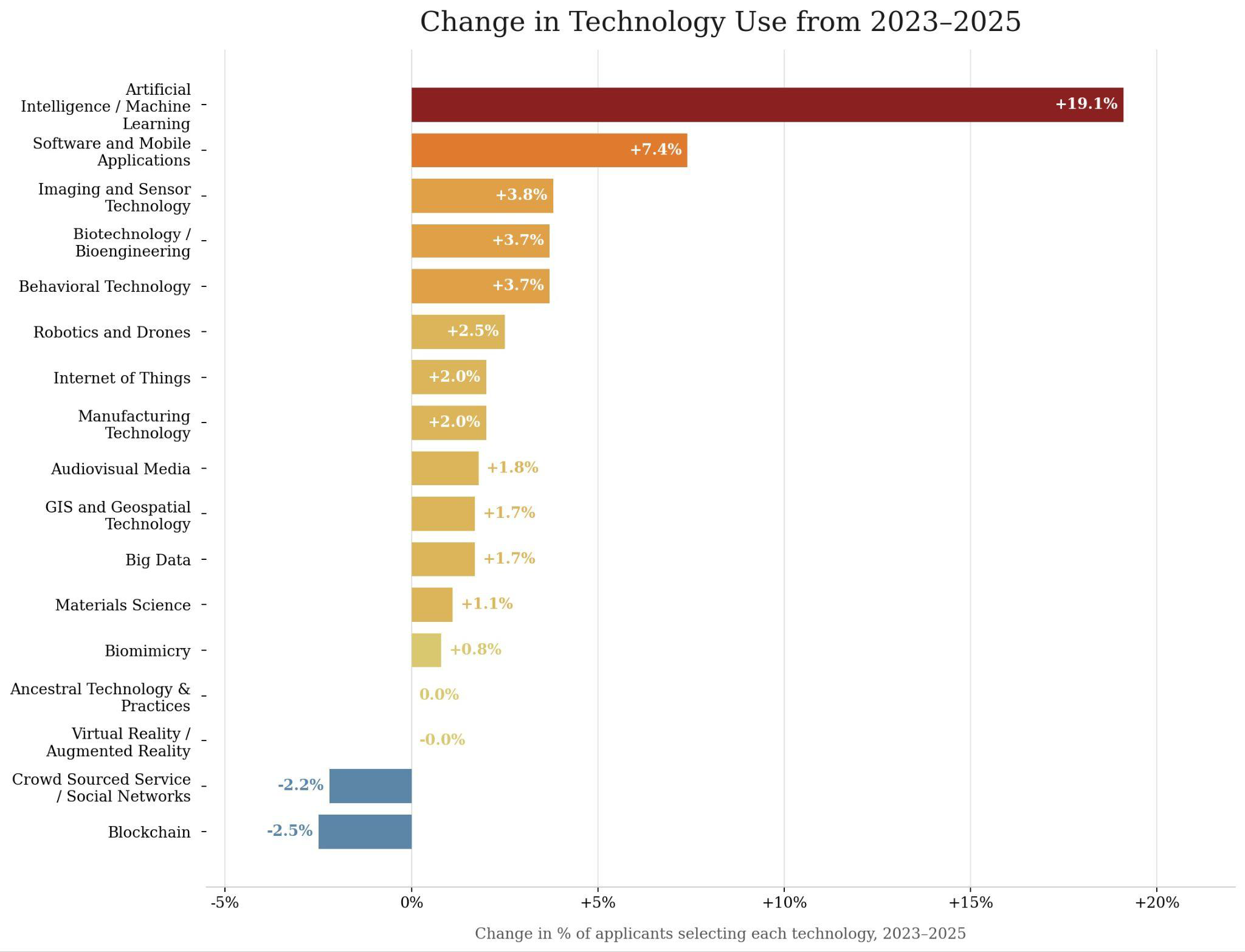
In 2023, just under 40% of applicants reported using AI. By 2024, that share had grown to nearly half. In 2025, it surpassed 57%.
This trajectory mirrors broader global trends. A 2024 global survey by McKinsey & Company found that more than 75% of organizations report using AI in at least one business function. As AI tools become more widely accessible, adoption is accelerating across industries.
At the same time, AI’s rise does not come at the expense of other technologies. The overall landscape remains diverse, with most categories holding steady or growing alongside AI. One notable exception is blockchain. Once widely discussed as the emerging tool for entrepreneurs, its representation declined from just under 10% of applications in 2023 to approximately 7% in 2025. This illustrates how quickly momentum can change within entrepreneurial ecosystems over time.
Different Problems, Different Toolkits
Software and AI appear at high rates across all five of Solve’s pillars (health, learning, economic prosperity, climate, and Indigenous communities). Beyond those anchors, the mix of supporting technologies varies depending on the problem being addressed.
The climate pillar stands out as the most technologically diverse pillar. Alongside software and AI, applicants frequently draw on manufacturing technology (35%), Internet of Things (29%), materials science (27%), and GIS and geospatial technology (23%). The breadth likely reflects the complexity of climate challenges, where sensing, mapping, materials innovation, and manufacturing often intersect within a single solution.
The Indigenous communities (IndCom) pillar tells a different story. Ancestral technology and practices appear in nearly 64% of IndCom applications. In contrast, AI appears in just 27% of IndCom solutions, the lowest among all pillars. This distribution reflects a different approach to innovation. Indigenous knowledge systems serve as the primary lens. Even as AI is adopted, it is often secondary to, or integrated within, these foundational ancestral practices.
Other patterns reinforce the relationship between problem and technology choice. Blockchain appears most frequently in economic prosperity at 17% (roughly double its share elsewhere), aligning with its use cases around financial access and decentralized infrastructure.
Virtual and Augmented Reality is most concentrated in learning at 13%, where immersive technology has found its clearest early application.
Overall, one insight stands out. The technologies innovators use are shaped by the demands of the problems they are solving.
A Global Landscape, Not a Uniform One
A regional view of the data reveals another dimension. Technology adoption is not uniform.
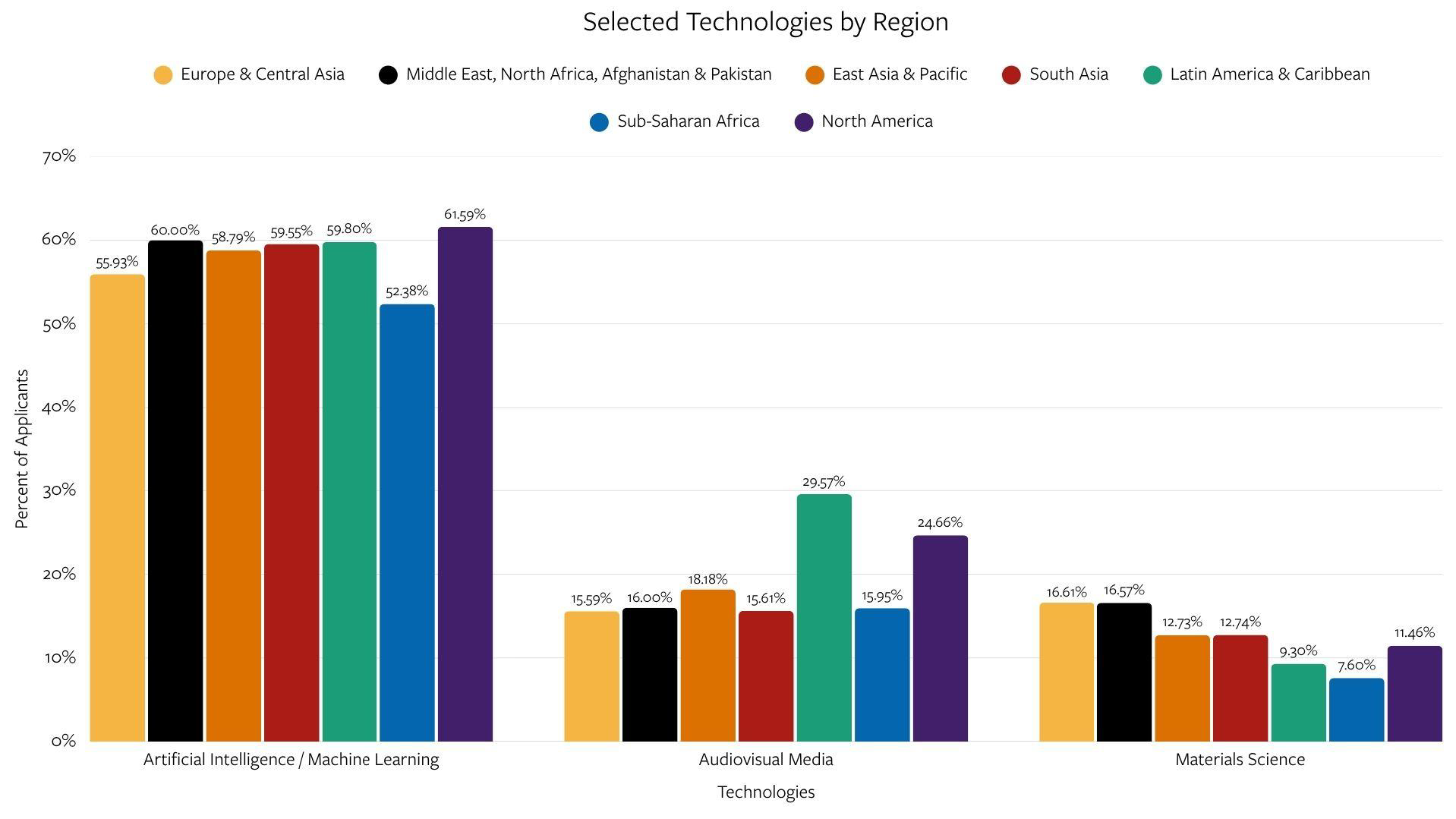
Artificial intelligence appears in roughly 60% of applications across most regions, including North America, East Asia and Pacific, and South Asia. In Sub-Saharan Africa, however, the figure is closer to 52%.
The gap is not dramatic, but it reflects broader dynamics. Recent research on global AI adoption suggests that while machine learning is broad-based, the high cost and infrastructure of advanced AI can create barriers to adoption in lower-resource settings.
Other technologies highlight sharper regional contrasts. Nearly 30% of applications from Latin America and the Caribbean incorporate audiovisual media. This is roughly double the share seen in Europe and Sub-Saharan Africa. Materials science appears more frequently in Europe, Central Asia, the Middle East, and North Africa. This likely reflects the high startup costs and specialized infrastructure required for deep tech innovation. Unlike software, materials science demands heavy capital and long resource and development cycles, barriers that are more frequently overcome in regions with strong industrial policies and high-risk investment.
Taken together, the data suggests that while some technologies are spreading globally, the overall mix remains shaped by regional ecosystems. That diversity is visible in Solve’s community itself, which spans innovators working in very different technological contexts around the world.
How Technologies Combine
Looking beyond individual technologies, another pattern becomes clear. Innovators rarely rely on a single tool.
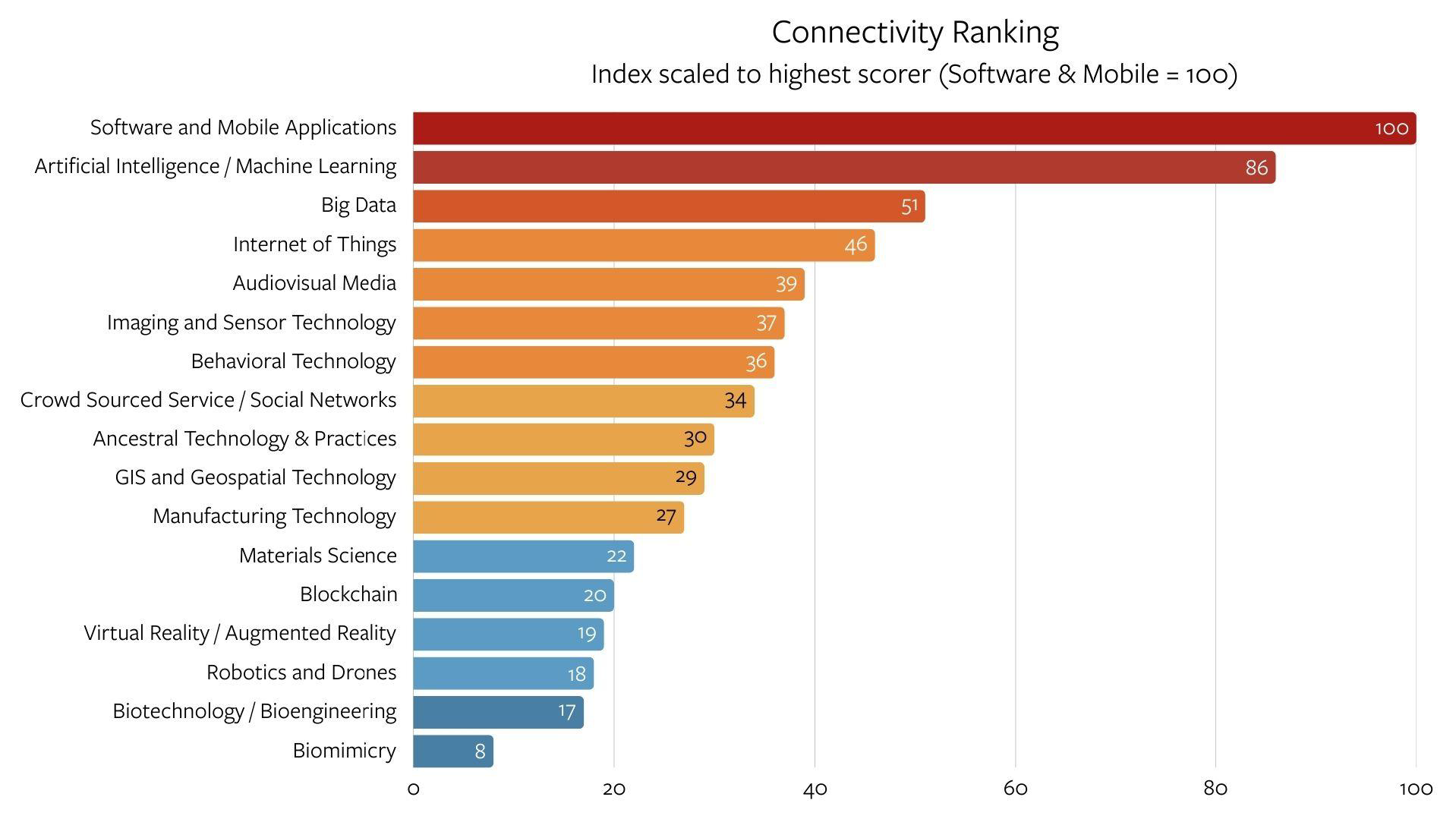
Ranked by average co-application frequency. Higher scores indicate technologies that consistently appear alongside others.
Software serves as the foundational layer. It appears in more than 75% of applications across 11 of the 16 other technology categories, enabling and connecting a wide range of solutions.
Artificial intelligence appears to be following a similar path. It appears in more than half the applications across 11 of the 16 other categories. Like software, it is likely to be used as a complementary capability rather than a standalone.
Looking Forward
The trends in this dataset reflect how innovators are working today. They are combining tools, adapting to local contexts, and building solutions that respond directly to the challenges they face. As Solve enters its second decade, the technology landscape will continue to shift. What will remain constant is the ingenuity of the innovators and how they apply the tools available to them.
Tags:
- Tenth Anniversary
Related articles
-
Rejection, Reconsidered: When Feedback Fuels Reapplication
Reapplications to Solve’s Challenges and why applicants keep returning.
-
10 Years, 10 Solvers: Namya Mahajan on Educating 6 Million Children for $1.50 a Year
Rocket Learning wasn't meant for daycare workers, but it has completely changed how 50% of children are taught in India. Learn more.
-
From Global Capital to Local Impact: What Solve’s Funding Data Reveals
How MIT Solve's funding methods prioritize global initiatives.