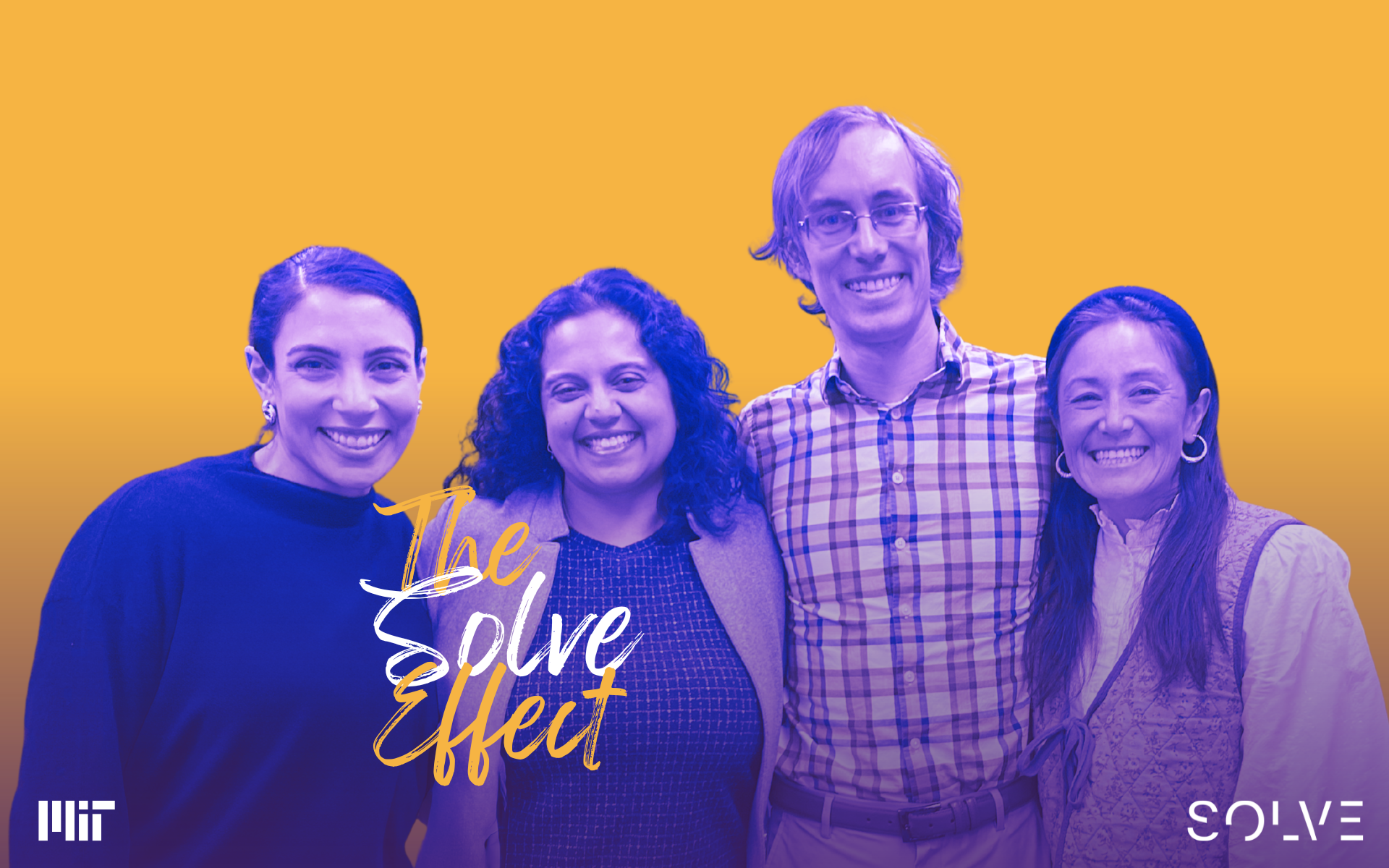
This is a transcript of Episode Ten of The Solve Effect, edited and condensed for clarity. Listen on Spotify, Apple, or Amazon Music.
Hala Hanna
Welcome to the Solve Effect. I am your host, Hala Hanna.
Ten years ago, Solve was an idea with a hypothesis: that the best solutions to global challenges are everywhere. And if you build the right platform, the right incentives, the right partnerships, you can find them, fund them, and help them scale.
It wasn't really obvious at the time that this would work. Open innovation sounded good in theory, but in practice, it meant asking philanthropy to loosen its grip, asking corporations to think beyond PR, and telling innovators in Nairobi, Sao Paulo, Detroit, Dhaka that their ideas belonged on the global stage, and then proving that we meant it.
When we started Solve in 2016, we were hoping to prove the concept. We had no furniture, no funding, no processes. But what we lacked in structure, we made up for in ambition and in an unrelenting belief that open innovation would unlock global change.
Reflecting on 10 years, I am proud of so much. And we will get into some of that in this episode. But the one thing that is truly a highlight is the people that I get to work with. So to mark the occasion, I've invited three of my wonderful colleagues to talk about what it actually takes to build something that lasts and what the next decade will demand of us.
Because if the first 10 years were about proving the model, the next 10 are about raising the bar.
So please join me in welcoming to the Solve Effect my co-conspirators, my enablers, my truth-tellers, and my dear friends, by now, Pooja Wagh, Solve Director of Operations and Impact, Alexander Dale, Solve Director of Global Programs, and Sara Monteabarro, Solve Director of Strategic Partnerships and Philanthropy, who has lost her voice.
HH
I want to start with a moment. I'm going to ask you to think back to your first week at Solve, which coincidentally is almost the same for all of us. That's January 2017. What was it like? What did Solve feel like when you first walked into the room?
Sara Monteabaro
I remember feeling an overwhelming sense of imposter syndrome. I had never quite been in a working environment where I was surrounded by such esteemed colleagues. And then because it was such early days, a lot of what we were doing is just building things from scratch. So whether it was literally physically putting together desks that we had to assemble from IKEA or wherever we may have gotten those from, or it was setting up our initial CRM, our website, our platform, just the back end of every little thing, I started to realize, “Okay, we're all in a level playing field at least. We're all building these desks together. We're all kind of building things from scratch as a collective.”
Alexander T. Dale
This is what I remember coming in, and Sara was the expert that had been there for a while and was managing the platform. I had no sense of how long she’d been there.
SM
Five days.
ATD
That sense of like, oh, great, you're the expert on this. I think the other space for me, echoing some of the furniture building and build out on the digital side, I had come from the EPA, the Environmental Protection Agency for the US government. So very much a policy bureaucratic space with thousands of people and lots of procedure. And to come here and be like, here's your laptop. You can do whatever you want.
HH
It's empty.
ATD
It's empty. There's nothing here. It was a total shift. And particularly since that was a moment where I was coming to this innovation-forward, global-facing piece, looking at climate at a moment when Trump had been elected the first time. And so shifting from DC to Boston was this really interesting moment. And it felt so full of possibility, mostly because we didn't know what anything was going to turn into.
Pooja Wagh
Walking in, there was some real cognitive dissonance. It was this beautiful office with like the best view of the Charles and the Boston skyline, but then there would be like six of us in the office, all sharing space. It felt like what I had wanted to do for a long time was come back to MIT, work here on something that really mattered, work with innovators. But then at the same time, like these guys have mentioned, we were handed a laptop and realized there was just nothing that existed yet. We had to build it.
Coming from the research space, that was just a huge adjustment for me. And I remember in the beginning getting so much counseling from our Executive Director at the time that it's okay to experiment. It's okay for things to not be right the first time and just to try stuff. And those were lessons that were just so important to learn, and I think has really made us a resilient organization now.
HH
I do have to give a shout-out to Alex Amouyel, who hired all four of us sitting here. She was the founding Executive Director of Solve and a thought partner on so much of it. It was the dissonance of this huge, very inspiring vision. And then, actually, nothing yet. And there's something exhilarating also about that.
But there's also that, a fragility to beginnings. There's a version of Solve that never makes it, right? That stays a promising idea, and I wonder what the thing is in your view in those early years that either nearly broke us or kept us from unraveling.
PW
For me, it was the people. I think because of how chaotic it was, that really wasn't an environment for everybody... and so I feel like for years, we were just hiring. That was the piece that felt really unstable in the beginning, figuring out who was going to be okay with that chaos and join us to build what we have now.
HH
It's quite telling that, actually, two of the four of us are engineers, that's Pooja and Alexander. Alexander, what are you thinking?
ATD
I'm thinking about like fragility and... we had to, when we came in, and we started with, there is a Challenge closing in three weeks. There are not many applications. There is a member community, in theory, that does not exist. We have zero members. And there's a whole reputational piece of when you get to start a new organization, you've got this halo effect for a little bit. And all of it felt very fragile if we didn't get enough things right in the first six months, eight months, that we'd lose that halo, and we wouldn't be able to keep going. And that sort of energy and momentum, which I will say, all of us have now had kids since then. And I can't imagine putting that much energy into a new effort.
SM
I would echo what both of you just said, but I do think that we would not have made it to where we are now had it not been for this sort of constant learning and iteration mindset that we had as an organization. For any organization, large or small, unless you're able to kind of adapt, pivot, learn from potential mistakes or failures, and figure out ways to just keep going, find the next opportunity, make the next connection. That without that mindset that permeated across the entire staff from start to finish, I don't think that there was a single person that we've ever hired that didn't kind of embody that ethos.
HH
Three kind of big things:
The first one is finding the people with the same crazy, roll with the punches, roll up their sleeves, and just get to work.
The second is just doing. Just doing. Like we never stopped. And it's really resonant, moving from zero to one is actually not a linear process. You feel like you're at it forever, and then suddenly things take off.
And then the last is learning and iterating. You have to stick long enough with something for it to work. And at the same time, you have to know where to pivot and just let it go so that you get on to the next thing.
If you can each share something that we used to do in those early days that would absolutely horrify us today, and what teaching we get from it that we shouldn't forget.
SM
I remember vividly one Friday leading up to our first Solve at MIT, where the entire staff of maybe 14 colleagues at the time spent the entire day, every single person on the team spent an entire day working on a mail merge to send out a round of invitations to Solve at MIT. That is unfathomable today.
[laughter]
PW
We didn't know how to do mail merge.
ATD
We also didn't have a database. Our database was a Google sheet that we wrote some script code against so that different people saw different email visibility.
SM
Yeah, and we popped a bottle of champagne at the end of that day because it was such a feat for us to get through.
PW
One of the memories that I have too is just of cold calling. Every single one of us was cold-calling pretty random people to see if they would give us any money. And I remember this was like a real moment of vulnerability for me. I called somebody that gave me a lecture that I shouldn't be asking for money if I can't even explain what I do. And in my head, I was like, we don't know yet what we do. I can't explain it.
ATD
Our first event, Solve at UN, the thing that we did at that point was take all the judges and put them in a broom closet so they could do a broom closet test. And we had the pillar leads stand in front of the whole audience and take questions or moderate questions from the innovators. And so this whole idea of we should have staff in the room to facilitate the deliberation. No. We should have the decisions made in a low-stress, like with time, environment. No. We should have the judges have seats. No. None of it.
[laughter]
PW
But we should put the judges in a closet and close the door.
HH
They can't come out until they've made a decision.
[laughter]
PW
To their credit, though, they were bought in. That first year, people were registering to come into the event in the rain. They had to go through the security at the UN. And everyone was like, " You guys are going to do great things.”
HH
Let's talk about building the thing.
Alexander, you run programs. Open innovation is a phrase that can mean almost anything, which is both its power and its problem. What did we get wrong about it early on, and how do you think our definition has evolved to the model that it is today?
ATD
Solve certainly came out of, in part, the kind of CoLab space here at MIT, which was very community-architected solutions. We had a few different pieces of it on our platform. One was that anyone could apply. Another was that at that point, anyone could comment on anyone else's solution. And a third was that anyone could theoretically join teams, have discussions, and create it that way. Those are models that exist in other spaces. They don't work as well for our global sourcing process.
And so definitely those iterations are, we've kept the anyone who can apply. That's a really important piece of our process. We don't want to rely on nominations. We don't want to rely on just being accessible to specific communities that see us that also still sits to this definition of open innovation, where the best ideas are out there in the world. They're not something that's coming from an internal R&D lab. They're not something that's even coming from an MIT professor's lab. And so we know that there are better ideas when you get them from more places and when you bring together a cohort of good ideas. Those pieces stay. The community commenting, the community voting, these other pieces have fallen off because we've seen them as much less important for the model.
HH
Also, because the internet ruined it with bots, right?
ATD
The internet has ruined a variety of things and a variety of tools for sure as well.
[laughter]
HH
Sara, as the head of partnerships, you sit at the intersection of what we do and then the people who fund it. Philanthropy has changed enormously in the past decade, and in some ways it hasn't changed enough, right? I'd love to hear from you, where it's genuinely evolved, where it really meets the moment, and where maybe it still sucks, has a way to go.
SM
Innately, philanthropy is personal. So whether that's personal to an individual or to an institutional funder, it's always going to be personal to that funder's values, to their mission, their goals, what they want to see the world as, how it helps them, their business, their family, their community. That’s both innately one of the greatest assets of philanthropy as a sector, and then also it's one of the things that fragments the sector as well.
Where I've seen the most promise is in these pockets of philanthropy over the years that have found ways to build communities, think about ways they can be more effective together than individually.
And where I feel like there's still promise and potential for growth within the philanthropic sector is really in figuring out how to find and support nonprofits, for-profits, social good organizations, tech innovation, whatever it may be, how to do that truly effectively, that comes back to that personal mission.
HH
It's building on those individual values and interests to build coalitions and communities so that the sum is bigger than the parts, and then directing that capital and that interest towards where it makes the biggest difference—which what we see from the work that we do—is to proximate innovators who are familiar with the problem, who are using technology to scale what they do, and who are able to do it in the communities where they are in a way that is sustainable and really meaningful.
Now, there is a moment in Solve's life, where it takes a lot of trust for folks to consider us partners. When did it become easy to pick up the phone and say, “It's Solve, let's talk?”
SM
There's a great amount of trust in the MIT brand and in the Institute at large. But where I felt like I finally saw the shift from having to say, “We are MIT Solve” to just “Solve,” was after our third or fourth year running our annual global challenges, where I went to a conference in Dubai. And I remember introducing myself and someone saying, “Oh, I've applied for the last three years. I really hope I can be successful this year.”
I was shocked that they even knew who I was. But on the applicant front, from the innovator's point of view, our reputation started there first. It was the greatest validator.
HH
And I feel like we should never forget that, right? That’s the reason we exist, the reason we were created is to serve the Solvers, the innovators, and then they give us the legitimacy to then come to the partners.
Now, Pooja, I'm going to come to you. You run operations and impact, one is about getting things moving fast, being very effective and efficient, and the other is about accountability and, you know, being very thorough. When did Solve start, actually, deeply understanding the numbers that we were counting?
PW
One thing that's interesting is I don't feel that our ethos when it comes to monitoring and evaluation has changed since the beginning.
We have always felt that it's so important to keep the load on our innovators as light as possible. They have much more important things to do than report results to us, right? That's part of why the funding we give out is unrestricted, doesn't require any financial reporting, and we try to keep all the metrics they report back very light.
We're also really careful about how we talk about causality, because these innovators they're out in the world. I think what's been amazing as time has gone on is we have been able to measure, first of all, longer-term outcomes. And our portfolio has grown so that we can actually now say things about, for example, the Sustainable Development Goals, right? We've collected data always from teams about the specific work that they're doing around the SDGs and different outcomes within the SDGs. And now that we have hundreds of innovators, we can aggregate that in different ways to say really important things about actually how many school-aged children are being affected. How much carbon is actually being removed from the environment, et cetera.
We also can see these really cool longitudinal results. I think one piece that we're really proud of is that we can look at years of data, and we can say things like, over the last five years, the teams we've selected, 97% of them almost are still operational, which for this space is pretty good. And that says a lot about who is coming to us to apply, who we're able to select, and how excellent they are. And now that they've been operational for that long, we can say things like our portfolio of for-profit and hybrid teams has raised over $1.1 billion, which clearly is an indicator of how they have been able to scale.
HH
What do you think are some of the things that you've done that have made the biggest impact that maybe were leap forwards?
PW
I'm particularly proud of the process that we put around selection. Standardizing the way that we handled the whole process in terms of how, like the scoring rubric, in terms of doing judging at Solve Challenge Finals versus remotely. There have just been so many really fun operational decisions that we've taken that have made selection stronger and also easier for the team.
Now we actually are using an AI tool to help us with screening. This past year, we had almost 3,000 applications just for our global challenges. so we actually built this tool that can do some of that screening in an automated way without taking the human out of the loop. Any solution that has been submitted that really has no chance of progressing, for example, because it's not in English, is automatically removed. And any solution that looks great and it has a very high likelihood of being successful is automatically advanced so that humans can focus on the middle section that really requires a lot more judgment to make a determination about.
HH
One of the things that I find really hard to answer is the question of scalability. Because scalable gets thrown out a lot. It's the holy grail. And there are lots of myths around it at the same time.
When you look at a solution now, what are some signals that it can travel that it's, you know, not just brilliant in one context, but truly replicable?
ATD
Yeah, this is certainly one of the hardest questions One of the pieces that we've learned is that there are a lot of solutions that make sense at a particular scale level. Some of them make sense because they're really tied to a community. And so the approach there is, how do you go really deep, really complete in that community? Others are something that fits at, you know, a city level, but you're going to need to replicate that in a lot of different places. And others are something that should change standard practice for a field in lots of different places.
Trying to understand what is scalable is probably twofold, then. Because sometimes when we talk about scale, we mean your organization becomes a unicorn. If it's worth a billion dollars, it's going to get really big unto itself. We're interested in that.
We're also interested, if you do want to take that replication path, and we have some teams that are saying, we're able to support entrepreneurs at a local level who are doing brick presses, who are doing housing construction, who are doing medical facilities, and we're able to support them in making this innovation spread out. Or it can be, you know, the innovation scales by becoming part of institutions. And so for a lot of nonprofits, for a lot of very hybrid organizations, their path is not necessarily them being the sales actor, but working with much larger entities.
One final aspect there is figuring out what is scalable means, understanding what their readiness to scale is.
HH
Right. Yeah, that framework for scale that we've developed over the years, it's helpful both for selecting the right teams and also helping the teams that we select move up the scaling ladder in a way.
So if the first decade was about proving the model, I feel like we actually have a harder job ahead almost, which is to level up and push it further.
What's the risk Solve needs to take that it perhaps hasn't yet? Is there a move we're being too cautious about?
SM
The risk, if I look at ourselves in 2036, another 10 years on, I'll be disappointed if we didn't talk about ourselves a little bit more, put ourselves out there, pitch ourselves, because I think the last 10 years have demonstrated that we are an extremely effective and influential partner for anyone in our community, and we can be that tenfold in the decade ahead and beyond.
ATD
I think looking at how do we set up global innovation ecosystems that percolate down is the thing that we are in a really unique position to lead on. There are lots of incubators, lots of accelerators, relatively few of them are impact-first versus business/VC focused. We have a unique space there. And we know that as more places get them, there are still holes in the map.
We had a really interesting delegation from a university in Malawi a few months ago. And I think one of the most interesting parts for me was they have a scouting program, essentially, so that anyone with a good idea in Malawi can come and get support from the university to help develop that idea. And if we're looking at how do we close equity gaps, one of the biggest gaps is there are lots more ideas than people have the time and capacity to work on. How do we give people that opportunity?
We have a unique ability as MIT to go bring people together and to be a linchpin of that global system with a lot of different topics, with a great global network that spans all these different funding areas.
PW
So this won't surprise you, but I think the big risk we should take is really intentionally investing a lot more staff time in AI. This is going to be how Solve scales in the next 10 years. If we do it right, it can mean almost unlimited resources for Solve for our innovators. It can mean that we can build what's closer to a frictionless marketplace as we move money from other philanthropists to our innovators. It can mean for our staff that they are really able to focus their time on the things that they love and care about and are passionate about, and that humans should be working on. I also think as Solve, we are part of MIT, and one thing that I really love about the ethos of MIT and the ethos that we've adopted at Solve is that we share what we learn.
We're willing to take some risks that maybe others are not in a position to be able to take. Some might say it's a risky investment, but I think it's a smart one.
HH
So the future is about scale for us, about replicating and supporting regional ecosystems, about raising funds for perpetuity, all powered by AI, used responsibly, and sharing our learnings and showing the way. Thank you. That's those are some good marching orders.
SM
I've made this joke with Pooja time and time again, but it still feels like we're working on a group project for 10 years. We just haven't turned in the assignment. But you know what? We have another 10 years ahead of us, and I can't wait to help build this next chapter of Solve with you.
PW
For me, I look back on the last 10 years, and obviously, so much has happened within Solve, but our external environment has just been bonkers. I mean, bonkers.
We lived through a global pandemic. That's not normal. We've lived through multiple contractions of the foreign aid sector, of philanthropic funding generally. Attitudes towards social good have changed and evolved so much over the last 10 years.
Oh, I didn't even mention the advent of AI, right? Like, there's just been so many things that have changed the world completely. And despite all of that stuff, I honestly have never wavered in my confidence in what we could do. And it's because of this team.
HH
There's so much more we could talk about, building an amazing culture, about reacting to everything that's happening in the world. So maybe there is a part two! But in the meantime, thank you so much for joining me for this celebration of Solve’s 10-year anniversary.
ATD
Thank you so much for having us.
HH
This was Alexander, Sara, and Pooja, everyone.
Ten years.
Three colleagues who became a lot more than that.
And a reminder that the most important thing we've ever built at Solve isn't a platform, or a portfolio, or a process. It's a culture of people who actually believe the work matters.
If this conversation stayed with you, share it with someone who's building something.
I’m Hala Hanna. Thank you for listening to The Solve Effect.
This episode was produced by Bridget Weiler and Elisabeth Graham.
Audio production by Kurt Schneider at MIT Audiovisual Services.
Music by Tunetank.
For more information about MIT Solve’s tenth anniversary, check out solve.mit.edu
Tags:
- Podcast
- Tenth Anniversary
Related articles
-
Stacy Brown-Philpot on TaskRabbit, Trust, and Doing Hard Things
-
Bonus Episode: LIVE from Solve Challenge Finals 2026
Go behind the scenes at Solve Challenge Finals in this bonus episode of “The Solve Effect.”
-
10 Years, 10 Solvers: From 14 Days to Under 60 Minutes—Revolutionizing Radiology Reporting with Rology
Ask Amr Abodraiaa what Rology looks like from the patient's side, and the answer is: nothing at all. Invisibility is the design goal. What the patient gets is the result.