This is a transcript of Episode Twelve of The Solve Effect, edited and condensed for clarity. Listen on Spotify, Apple Music, or Amazon Music.
Hala Hanna
Welcome to The Solve Effect, where we highlight extraordinary people tackling the world’s toughest challenges with bold, innovative solutions. I’m Hala Hanna, Executive Director of MIT Solve.
Solve is celebrating its 10th anniversary this year, and to mark the occasion, you’ll be getting two episodes a month. One of those will be our special series with guest host Alexander Dale, Director of Global Programs at MIT Solve.
This series will highlight 10 Solvers from the past decade who embody the spirit of Solve: innovation, grit, resilience, and impact. Enjoy!
Alexander Dale
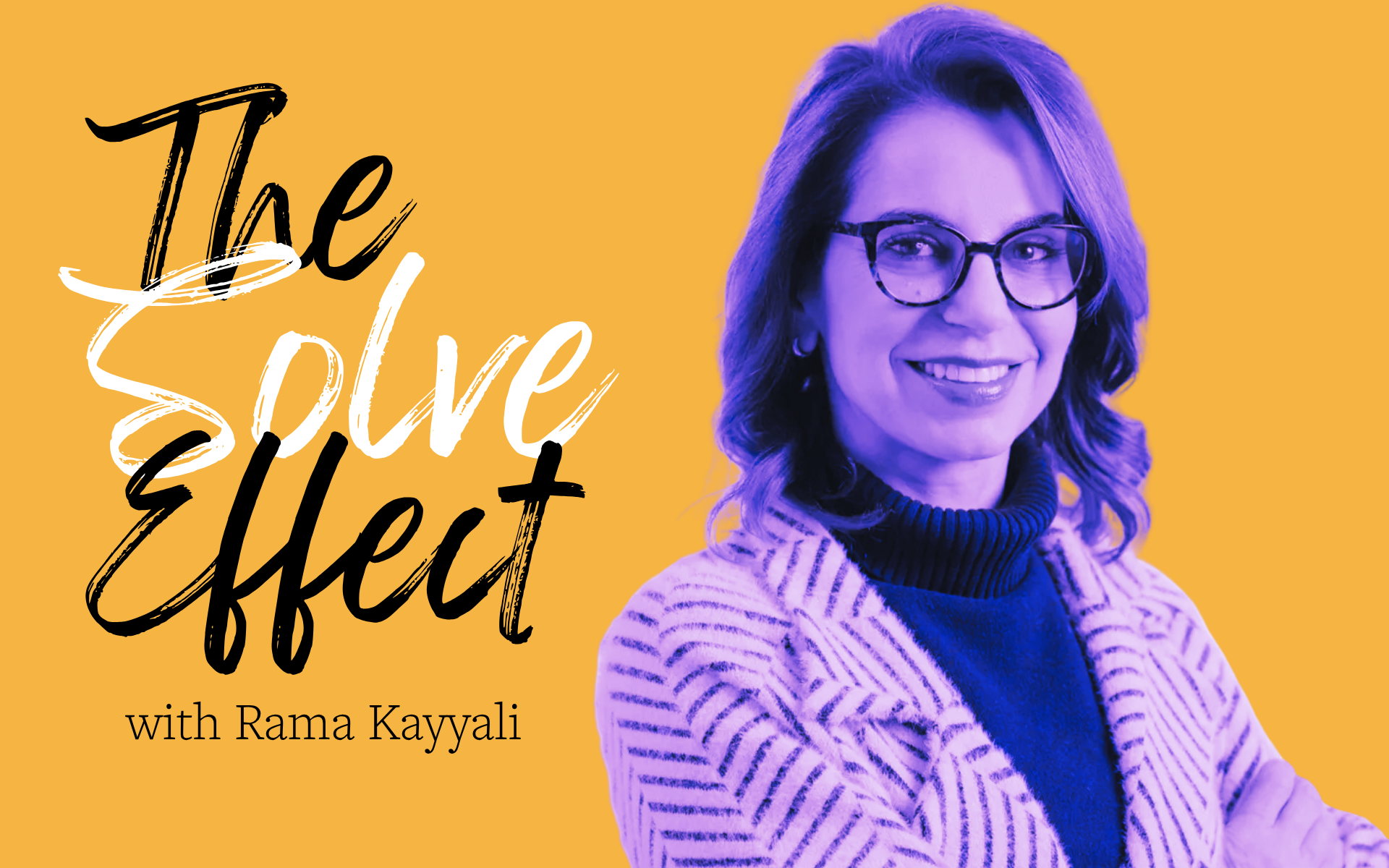
Hello, I'm Alexander Dale. Today's guest is Rama Kayyali, who co-founded Little Thinking Minds in 2006. Ten years later, she created I Read Arabic, a platform that improves Arabic literacy by creating comprehensive and gamified content. Over 400 million people worldwide speak Arabic, and one in four struggle to read or write it. Rama's platform reaches nearly half a million students in 10 countries, being used everywhere from private schools to refugee camps. In Jordan's public schools, children went from reading just one book a year to 100.
Since being selected as a Solver team in 2022, Little Thinking Minds has been acquired by Seesaw Learning, a US-based PK-12 EdTech leader.
Today, I'm excited to talk to Rama about how Arabic literacy has changed in the past decades, her own 20-year anniversary, and what this acquisition offers in terms of greater impact.
Rama, welcome to The Solve Effect.
Rama Kayyali
Thanks, Alexander. It's great to be here.
ATD
I want to get started by asking you to take us back 20 years and tell us a little bit about what the landscape for Arabic literacy looked like in 2006. Talk a little bit about how you landed on this approach to addressing the problem.
RK
It's not a very linear story. So I studied filmmaking and journalism, and I worked in documentary filmmaking in the US and then in Jordan, and I wanted to tell positive stories coming from the region.
Then I got married, and I had my son, Sharif, in 2003. I was approached by my friend and later co-founder, Lemia, who was living in the UK at the time, and we were both expressing our frustration how there was nothing in Arabic for our kids.
She was noticing that in the UK there was so much content in German, in French, in Japanese, in English, of course, everywhere, but nothing in Arabic. And it was the same in our region, of course. Everything that was available in Arabic was either super expensive or very low quality, very uninteresting, or unengaging.
At the time, there was this big videos that were floating called Baby Einstein. Very simple videos for kids in English. And we thought, “Why not tackle preschool literacy for children in a similar model in Arabic?”
And so we literally brought our kids, plopped them in the garden, all our friends, our family. And we were filming them in our garden. We went to our aunts and uncles and asked them what were the songs they used to sing to us when we were kids, give us all the nursery rhymes in Arabic. We worked with a local puppeteer, local musicians, and we came up with a very, very simple movie about animals. And actually our first-first production was a VHS tape. I don't know if you can see it.
And it's like literally...
ATD
Oh gosh. This brings back memories.
RK
And we decided, you know, this was fun. This was nice. Let's show this somewhere where we can invite our friends and some of the kids we filmed and their families. So we invited them and our cousins, and we put out flyers in preschools. And we expected a humble showing of 50 people. . .300 people ended up showing up.
ATD
Did they all fit?
RK
Well, we had to show the movie three times.
And when we were chatting with the moms, they all had the same pain. There was such a thirst for Arabic language literacy products for preschoolers. And that's when we knew we were onto something.
And so we set up Little Thinking Minds. At the time, it was a lifestyle business. I had another job. Lemia was living in London. We were doing this on the side, trying to figure it out. And we went from VHSs to DVDs. And for the next five, six years, we were just doing these DVDs and distributing them to Virgin Megastores in the region.
Lemia by that time had moved to Dubai, meaning that Dubai was a huge market. So we were getting a lot of visibility and brand awareness. And at the same time, our clips were being shown on YouTube. And we had millions of views on YouTube. But we found our DVDs being pirated in Lebanon, in Egypt, in Jordan, and being sold for a dollar. We found them, we found torrents online.
So it was very frustrating. I mean, in one way, it was good. We knew mothers loved what we do. We knew they would do anything to get their hands on what and our work. But we also knew that we didn't have product-market fit. This wasn't exactly what is going to work for us.
2012, it was the beginning of entrepreneurship, and there was a big craze in the region. And Jordan had the first incubator/accelerator called Oasis 500, modeled after 500 Startups in San Francisco. And so we joined that program. We went through, you know, at the beginning, we're like, we don't know anything about business. What are we doing? We don't understand. But then we said, you know what, we have nothing to lose. Let's just see where this can go, because we have 40 million views on YouTube. So there must be something that we can do with this.
ATD
You'd been selling videos for several years at that point. You've been entrepreneurs, whether you thought of yourselves that way or not, I think.
RK
Yeah. Not in the cool-tech-entrepreneur world.
So we had major imposter syndrome. But we said, we're just going to go and see what we can do with this. And so we went through a boot camp. We went through after three months, we then pitched to angel investors. And surprisingly, we were able to raise funds. And we were thrilled. And the idea was we were going to turn our DVD business into a digital business. We started to create apps for kids, B2C apps. So we were targeting parents to buy apps online.
The Arab world wasn't banked. So parents couldn't necessarily buy easily applications on the App Store and Google Store. And then in 2015, we were at a crossroads again. And we said, do we keep going or do we close shop? You know? And then we were seeing our kids. They were already in high school in middle school, primary school. And they had these amazing apps in English—reading apps and literacy apps. And they were eating the books up. But their Arabic books were so boring and so outdated, and they hated the Arabic language. And that's when we got the idea to start creating products for schools. And that's when I Read Arabic was created. And that's when the company took off.
ATD
I know Arabic has a lot of different dialects based on the different countries. How did that show up in the content that you were creating, if at all?
RK
Yeah, I think. . . an important question people ask me is why are you creating Arabic why is there an Arabic literacy problem? Everybody in the Arab world speaks Arabic. It's true. We're 22 countries, 400 plus million people. We all speak Arabic, but we have different dialects.
So a child in Morocco will not understand a child in Dubai, or a child in Saudi will not understand a child in Egypt. So the Arabic that is spoken and written is called Modern Standard Arabic, or Fusha, and the language we speak, there's only 70 %overlap.
So in a way, it's as if the kids are learning. . . like a second language. So the Arabic they speak, and then the Arabic they read or write. And as a result of that, the diglossia of the language, the language ends up being very weak. And what we do is we create content that is in Modern Standard Arabic. We create the content that is taught in school. We create the language that children can use to read and write to enhance their Arabic language and literacy skills.
ATD
What was the hardest early assumption that you had to throw out when you were starting to move to the I Read Arabic model and platform? As that was coming together, you're starting to look at some of the examples that maybe exist in English that your kids are excited about. What are the and you're trying to build some of those examples within an Arabic setting, what assumptions did you make that you had to shift and pivot on?
RK
According to the World Bank, 60 to 70 %of children in the Arab world struggle with learning poverty, meaning they read below their age level. And this is very high globally, very high statistic and it's because of the the diglossia that we just spoke about.
Another thing that was a bit, an assumption, you know, when we were fundraising at the beginning it was easy to raise money, but at the end of the journey, it became much harder.
ATD
Can you tell me a little more about what you mean by that: beginning and end?
RK
At the beginning when we were first fundraising, people were very excited. “Yes, Arabic and you guys are cool and the women start up in the Arab world.” But then, you know, EdTech in general, it's slow-growing.
It's not, you know, you don't get the 10X multiples, and you don't get the hockey stick growth, and you don't get all these flashy numbers that investors look for.
We were pitching to VCs, especially, you know, two, three years ago, it was, you know, we had a lot of invested VCs that said, “You guys are great. We love what you do. You have hundreds of millions of views on YouTube. You reach half a million students. Your impact is tremendous. You're an MIT Solver. You're, you know, you have all these amazing credentials and awards, but it's not sexy. It's not sexy enough. It's not growing fast enough. We're more interested in fintech. We're more interested in health tech. We're more interested in AI.”
ATD
You've done a lot of pitching to a lot of different people. Are you able to share the worst pitch you ever gave?
RK
Oh my God, yes. Yes, I pitched once to a fund in Jordan and the IC—the Investment Committee—they were 10 men. They were all men and I don't know why there were 10 of them. It was crazy. And it was me and my co-founder. And usually I've done pitching so much that I've got it. And when I walked into the room, it was a small room. It was claustrophobic. There were all these guys in suits. And I started to, I had a panic attack. And I was speaking and I started to shake. And my hands were shaking. My voice was shaking. I was sweating. I never, ever had a panic attack, ever. And I just completely froze.
I wanted to die.
And I looked at my co-founder, and she looked at me, and she got it. And she completely picked up and kept going until I caught my breath. And I then came back in and presented the last two slides, very composed. They were doing very well.
But I was furious that there were 10 men in this room. And after this pitch, I went and spoke with them and I said, “This is not acceptable.” A, you have to have women in the room. There has to be women. And this is what made me believe more and more why we need more women on boards. Why we need more women in these positions. And there shouldn't be 10 people full stop. I mean, this is ridiculous.
ATD
You were selected both as a Solver of the 2022 class and also under the LEAP Challenge, which was focused on. . . that evidence and evidence accumulation to try to improve learning outcomes. And that selection was also in 2022. So you had two different selections within that same period, which we were really excited to see.
RK
And we were very grateful for, because, you know, when you're running a startup and you're hustling and you're trying to scale and you're trying to fundraise and you have so many things going on at the same time, you don't necessarily have the luxury of having researchers or having, you know, like really, really top subject matter experts from Harvard, from top universities in the U.S. and Canada. I mean, we were really lucky with the team we had. We were working with social entrepreneurs. We were working with, you know, amazing, amazing team of advisors through both LEAP and Solve. And this really gave us a push and enabled us to have to slice up our time and say, okay, this is something we want to focus on because we were selected by MIT Solve and LEAP. And so we dedicated time. But had we not won these two awards, I doubt we would have had time to look at that because we have so many competing priorities at the same time.
ATD
You're at this moment you're losing money you're really struggling through all these different pieces: How did you get that idea to build I Read Arabic and have that come to fruition and get through the pivots to find a product-market fit?
RK
We were selected by All Children Reading. We were one of 12 companies globally to be selected. Part of the program was that we were working with a San Francisco-based impact evaluation company called School School Research. They came to Jordan in September and we did an early-grade reading assessment exam for grade two students and then they came again, nine months later, in May.
Children at the time were reading one book a year as you had said in the introduction. The ones who use our platform read a hundred books on average at the beginning.
We had created 25 books thinking they will last them six months.
Two months later, the school called. They said we need more books. We went, we wrote, we digitized. We were talking to the ministry because we had to get minister approval. Then we created 50, then we created 25 more. We ended up creating 150 books, and children on average read a hundred books.
Their mothers would tell us when we did the surveys how their daughters would braid their hair in a specific way so they can put their headphones and not mess their hair. We finally found our product market fit. We were onto something.
We decided to buckle up: we fundraised, at the time, around two million dollars from regional VCs—so from VCs in Saudi Arabia ,in Egypt, in Jordan, and in Dubai and US, it was a gender lens VC. We started our beachhead market was the UAE, and the students and the teachers just ate it up.
We went from a team of five to a team of 70 in two years so we started to aggressively work with governments in the region.
Working with governments is very arduous. It's a very long sales cycle. It takes a lot of convincing, but what we what ended up working for us is once we enter a market and we say, “Look, we have a hundred schools in Saudi or we have a hundred schools in Jordan or we have this many schools in Lebanon.” The government starts taking us more seriously and that's that really helped us.
ATD
It's such a fantastic journey of scale, getting the traction and moving across a lot of things very quickly.
I would love to just hit on one piece on that scaling from a few people to 70 in two years and if you could just talk a little bit about some of the struggles there—which are very hard when you're moving in organization that fast to that much growth—and also maybe if there were one or two key things you learned that you want to share with others that are going through that same kind of growth trajectory.
RK
The first thing we did is we brought in the tech in-house so we were becoming a technology company. We were creating you know a platform for schools that had to have certain security standards and privacy standards, and it had to be done very very carefully and very mindfully. And we didn't want to alter our technology. Maintaining company culture across geographies was also you know something we were very careful about. How do we make sure that we have a very healthy company culture? We're 60 percent female in the company, because we have flexible hours, we focus more on KPIs.
One of the key things we did is we had an amazing HR person. So we went from having no HR to having an HR department and HR person focused on hiring the right people, making sure there's a culture fit and making sure that as a team we work collaboratively together. I think another lesson would be, you know, always raise more than you need, because that way you can hire better people.
Being a social business: I think that's what made a lot of the team really love what we do, because they shared the same pain. They also felt there was demise in the language and their kids were suffering, and they wanted to build something that they can be proud of.
ATD
How many people on the team have kids?
RK
I would say 90%, most of them.
ATD
Everyone's kids are going through this same struggle and able to use the platform. You have a lot of easy test subjects that too for new things.
RK
Yeah, exactly.
We use them for testing. We use them for our films, for like our promotional videos. They become our ambassadors when their kids go to schools. They're pitching our products to their schools and to their cousins’ schools and their siblingss. So it they become kind of our ambassadors also across the region.
ATD
You build I Read Arabic, you get it into schools across the region, you've got half a million students learning on it and loving it, and now you're at this point where it's. . .what's the next piece? And what's the next round of funding to go to the next area? Tell me how you landed on acquisition as the exit strategy or the next step.
RK
Our business was thriving. We were growing. We were scaling. We were entering the public school sectors, which was very important for us and very interesting for investors because really that's where the volume is. I mean 60 or 70 percent of students in the region attend public schools. And in the region, the government spent their spending on education is higher than other places, globally.
What happened with us is around 2024, post-COVID (and COVID also was a very interesting time for us because schools then had to really invest in platforms online and the Microsoft teams etc). And so they didn't actually spend that much on Arabic.
So we went through a rocky period at the time. Our investors were great. They supported us. We lost some some clients. We gained them thankfully back after COVID. But it was just a huge learning experience for us.
But people always think, oh, you're EdTech. You must have done so well. Yes, we had a lot of reach, but schools wouldn't pay for it.
ATD
And you actually had competing pressure because rather than being able to invest more in your platform, they were investing more in other platforms.
RK
Exactly. 100%.
So by 2023, 2024, I was, you know, it was time to fundraise again. We wanted to invest in AI. We're always enhancing and improving. We had plans to also invest in AI, to have more adaptive, personalized paths, and in generative AI to have much more content that's localized and that is adapted to every country because, you know, the content that students see in Saudi Arabia, sometimes it's different than the content that children see in Lebanon. So we had to generate a lot of content that is very localized to the markets we're in.
I spoke, I think, to 40 VCs in the region. The Saudi investors said, “We'll invest and you move to Saudi.” Emirati investors, same. A lot of other investors said, “You know, you're too old. You've been doing this for too long.” Investors said your growth is too slow. Investors said it's not the time for EdTech. EdTech is still hasn't proven itself. We want to invest in FinTech.
So there was no appetite from investors. So I had to jump through hoops at the time. We went after grant funding. We went after awards. We went after impacting finance instruments. We went after venture debt. So we were trying to find ways to keep financing and stabilizing and, you know, being able to keep going without having to shrink the team, without having to, you know, let go of our goals and just to keep going. And we were focused a lot on profitability because, you know, at the time, before the focus was grow, grow, grow at any cost. Doesn't matter if you're losing money. You don't have to be profitable. Keep going, growing like Uber, like Facebook, all these companies.
They're not; they're losing money.
ATD
They just burned their VC money for a while. We'll figure out profitability.
RK
Exactly. And we were under . . we were from the same school. That's what we were seeing. That's what we were taught. But then we realized, you know, we need to... no one's going to save us. And so we bootstrapped. We became cash flow positive. We became profitable. But we were not able to raise the money we wanted to grow.
And at the same time, I was getting tired. Entrepreneurship is a very personal journey. It's been 20 years. I want this company to fly. I definitely believe in what we're building, and I wanted to grow very fast. There were many competitors coming into the space. They were offering their products for free. There were price wars in the region in our space.
We were talking, we were having a like an honest conversation with our investors, and we said, “Look, you know, we always talked about exiting. This seems like the right time.”
And my board said, “Great, we're all for it. But companies don't get bought, they get sold.”
I started to attend more education conferences. I started to become more vocal, get more airtime, more stage time, more panel time, just to get our company more seen and known in the space.
And then that's when we met Seesaw.
We had a couple of calls with them. There was really good chemistry. I mean, look, ideally, honestly, I would have much rather have sold the company to an Arab company because it's an Arabic-language product. It makes sense to be, you know, housed in an Arabic company. But there aren't too many, sadly, in the region. And when Seesaw came onto our radar, we really had aligned vision and mission for what we saw, education is, literacy.
We felt this was the right place for us.
There were a few things that I really cared about. I cared about the brand, staying the brand, keeping Little Thinking Minds. And they definitely agreed because we have good brand visibility. People have known us for 20 years. And I cared about the team not leaving, like not letting anybody go. And they were very much for that. I mean, they said, “Look, we think your team's amazing. They built great products. And if anything, we want to invest more.”
One of my big imposter syndrome things is that I never did an MBA and never went to an Ivy, fancy Ivy school to do an MBA. I'm a filmmaker. So I always felt, you know, am I really in the right place? Do I really know what I'm doing? I always had to prove myself in a way. But building a company is the best MBA I could have ever done.
ATD
Tell us what's next for Little Thinking Minds.
RK
Seesaw have an amazing platform in English that's used by 25 million teachers and students globally. We created Seesaw in Arabic, and there's Seesaw AI in Arabic, as well. We are also able to provide a holistic solution to teachers. Usually they would have I Read Arabic, which is a literacy program. Now with Seesaw in Arabic, they have a tool that can, where teachers are able to create lesson plans, question banks, use YouTube videos to also create questions for students. Seesaw closes the learning loop of parents, teachers and students. All of these is going to be able to give students more personalized paths for them and will be a big push in improving their literacy gains.
ATD
It's really nice to see that whole journey from your kids in the garden and you taking films of them all the way through a comprehensive platform in Arabic that is able to guide them on this whole learning journey.
I want to finish with some very rapid-fire questions.
Take one big risk? Take lots of small risks?
RK
Lots of small risks.
ATD
Early mornings, late nights?
RK
Late nights.
ATD
Coffee or adrenaline?
RK
Both.
ATD
Needs a combination. Hope or courage for the future?
RK
Hope.
ATD
Tell me a little bit more about hope. It’s a hard moment for hope.
RK
Yeah, it is. And it's been a tough time in our region for many, many, for the last three years and now.
It's endless, endless images and visuals of war, destruction, injustice. So it's been tough.
But at the same time, I feel there's an awakening, and we can choose to see the glass half empty or half full. I choose to see it half full.
And I think that change is possible. And I finally see that actually change is... that there's a crack and the crack's growing and things can change, and things will change.
ATD
I think throughout this conversation that's come through in spades of the importance of the problem, the nuance of the problem that made it tricky to solve, the way that you've built the start of an entire sector within the Arab world context, and the many, many hats that you've taken along that journey. So I really appreciate you helping to share that with us across this whole conversation. Thank you so much for joining us on The Solve Effect.
RK
Thanks, Alexander. I really enjoyed our talk. Thank you for hosting me.
ATD
I’m so grateful to Rama for being our first conversation in this series.
It’s the perfect way to kick off these spotlights: an innovator with a deeply personal tie to the problem they wanted to solve and a commitment to creating a solution. Through determination and iteration, Little Thinking Minds (and by extension, I Read Arabic) have become a global platform for educating students on common Arabic language skills.
The tech changed from puppets on VHS tapes, kids in the garden, to games on personalized platforms, but the mission remained solid throughout.
Are you close to the problem that you want to solve? Tell us about it in the comments, and let us know how you would want to solve it. While you’re at it, subscribe to hear more amazing, nonlinear stories from Solvers across our 10 years as an organization.
I am Alexander Dale. Thank you for tuning in to The Solve Effect.
Tags:
- Podcast
- Tenth Anniversary
Related articles
-
Stacy Brown-Philpot on TaskRabbit, Trust, and Doing Hard Things
-
Bonus Episode: LIVE from Solve Challenge Finals 2026
Go behind the scenes at Solve Challenge Finals in this bonus episode of “The Solve Effect.”
-
10 Years, 10 Solvers: From 14 Days to Under 60 Minutes—Revolutionizing Radiology Reporting with Rology
Ask Amr Abodraiaa what Rology looks like from the patient's side, and the answer is: nothing at all. Invisibility is the design goal. What the patient gets is the result.