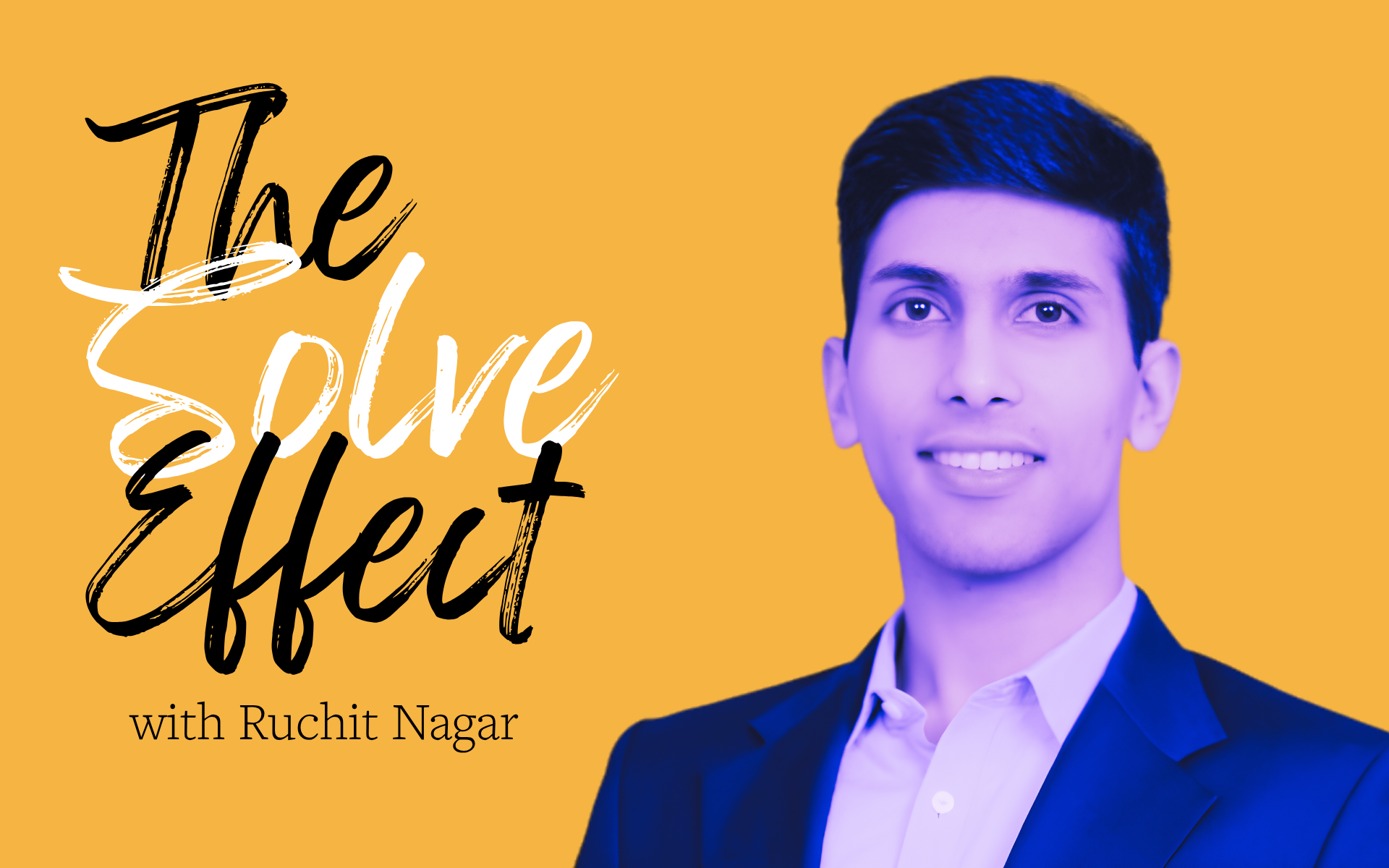
This is a transcript of Episode Fourteen of The Solve Effect, edited and condensed for clarity. Listen on Spotify, Apple Podcasts, or Amazon Music.
Hala Hanna
Welcome to The Solve Effect, where we highlight extraordinary people tackling the world’s toughest challenges with bold, innovative solutions. I’m Hala Hanna, Executive Director of MIT Solve.
Solve is celebrating its 10th anniversary this year, and to mark the occasion, you’ll be getting two episodes a month. One of those will be our special series with guest host Alexander Dale, Director of Global Programs at MIT Solve.
This series will highlight 10 Solvers from the past decade who embody the spirit of Solve: innovation, grit, resilience, and impact. Enjoy!
Dr. Alexander T. Dale
Hello, I'm Alexander Dale. I'm excited today to be talking with Ruchit Nagar, the co-founder of Khushi Baby. Even in a world where childhood mortality has dramatically dropped over the last decades, an estimated 4.9 million children under 5 died in 2024, largely from preventable causes. And that's why Ruchit started Khushi Baby.
In 2019, Ruchit and Khushi were selected as a solver for their wearable pendant, which provides healthcare workers digital access to a child's developmental history up to age five. It's something they can carry with them regardless of where they go, and it helps directly address those early losses.
Today, Khushi Baby has gone from that initial product to a fully developed platform. Their community health integrated platform, CHIP, is one of the largest community-based digital health platforms in India. It's used by over 75,000 community health workers across 48,000 villages. CHIP has tracked the health of more than 50 million people and identified over 10 million individuals with vulnerable health conditions. It's been really inspiring to watch Ruchit's story and impact evolve over the last seven years, but before we get to those tens of millions, let's go back to the beginning. Ruchit, welcome to The Solve Effect.
Ruchit Nagar
Thanks, Alexander, for having me. It's wonderful to be here.
ATD
It's great to have you. Can you take us back to the very start of where this came from?
RN
We had this course at Yale called Appropriate Technology for the Developing World. I was a pre-medical student at the time.
The question that we were presented with on the first day of class is that a million and a half children die from vaccine-preventable disease and what can you do about it? So we then went across an almost 16 week journey of thinking through what does the problem landscape look like, apply a human-centered design framework to identify potential opportunity spaces, and then turn those opportunity spaces into prototypes that you could actually take from the classroom to the field.
ATD
So you ended up with a pendant. What were some of the other prototypes that you thought about and discarded?
RN
So the pendant actually didn't come out of the classroom. The pendant came when we were able to go to the field and start to speak to users and see what were people wearing, what were people using, what had cultural significance within the communities, and that's when we were able to kind of take this technology that was being used in a different context, which was near-field communication, and then marry that technology with the tradition that was already available in these communities, which was this pendant with the black thread. That black thread was to signify protection of the child against the evil spirit or the evil eye.
ATD
The meaning you can embed in simple objects within that design.
You get to work with a lot of different people in the field and try to understand and learn from them. Can you share a little bit about what kinds of things you learned from the field and maybe a specific example of a time when you saw some unexpected tension and took some particular moment away from that?
RN
We learn a lot by sitting side by side with the community health workers, with the nurses, with the community members. We see the difficulty that it takes for the community member to attend that health camp. We see the struggle that the nurse faces in terms of having to give care, give counseling, record what happened, motivate a mother that may need to go for an urgent checkup at a higher level facility.
ATD
Which has a bunch of travel involved, presumably, to get to.
RN
Which has lots of barriers involved.
And, even things that we know work or recommendations that we feel will improve outcomes, right? Like you have, for example, a child who is severely malnourished. They've been identified by the system, digitally tracked. A follow-up team has been deployed. The community health worker goes with our team member. And then you get to the house and the mother has no one to accompany her to take the child to the hospital for nutritional rehabilitation. So what do you do? You're going two, three, four times. And it actually shows that there is very much a human element involved in this whole healthcare journey, social determinants that are involved in ensuring whether or not somebody gets care.
So technology really is just one part. It helps add some layer of transparency. It helps us show where the problem is. And its best case, it can help empower those who are involved in this health service delivery chain. But at the same time, it's not enough.
ATD
From having study, from doing this field work, what was the point at which you turned Khushi Baby into an incorporated organization and said, like, “We have an organization, we're trying to raise money, we're trying to put out a product, we're trying to be our own entity more than a research project?”
RN
We were about two years into our journey when we received our first major research grant that allowed us to move from public health students volunteering for this organization in our free time to formally incorporating in India and hiring our first full-time team members.
ATD
And what year was that?
RN
2016. We, like as founders, deferred salary for the first four or five years as we figured things out, and had to live on a very frugal budget. There are periods of time in the early years where you really were not sure how you were going to sustain, and going from grant to award, you were hoping that you could make it to the next six months or the next year. But it was really important to make that commitment to incorporate, to go full-time, to have people on the ground full-time.
ATD
And at what moment did you have a product that you were designing and starting to manufacture and starting to distribute through these different networks?
RN
From the onset, we had a software-hardware product, you could say the software being the community health worker application, the hardware being this digital record that would travel with the patient. That was the kind of initial concept. And after two years of studying this at the district level, we had positive results that this digital health package could actually improve adherence to the vaccination schedule. vaccination rates for infants improved by 12 percentage points, which was significant. We took this evidence and we went to the state level saying that, okay, we want to now see if we can track maternal and child health across the state using this type of platform.
But the product had to evolve as we went to state-level scale. And as we made that jump in scale, we had to shift away from hardware dependence. Ultimately, what we ended up doing is focusing more on the software to see how we could make a Android-based app that could be used across almost all versions of Android phones that were in the hands of community health workers and scale that way.
We live in an era where there's a lot of data coming in, but it's messy, and the information that we were able to extract from it is poor. So how do we actually now look more at insights and converting insights into action? That's really where our focus is moving towards.
ATD
I want to pause here probably to note that Khushi Baby is in various forms, and along that journey is the most selected team, to my knowledge, that we've worked with at Solve. You were selected in 2019 for that pendant, in 2021 for through the Trinity Challenge for your COVID-19 response, which Solve helped run, and then again in 2023 for a climate, health, and vulnerability mapping, which I think gets to that data analytics layer. So it's been really interesting to watch that set of solutions evolve over the way.
Can you talk a little bit about what Solve's role has been?
RN
You think of Solve as kind of an early incubator that's disguised as an award. It really forces you to put together an application that is quite comprehensive, go through a structured vetting process that allows you to then engage with peers that are making really interesting innovations for the same topic. And then interface with really world-class experts who ask tough questions and push you to refine your idea even further.
And then on top of that, getting to become a finalist or an awardee in of itself is a huge recognition and gives you a big platform, but Solve has also done a great job of expanding our network of opportunities.
I think that one thing that is unique about Khushi Baby is our evolution and our journey. We started off with kind of this initial focus on childhood immunization over a decade ago. But as we've come to learn about what the problem is, how workflows at the community health worker level are all integrated and interlinked, what we found ourselves trying to solve was much more complex than what we initially intended.
ATD
Can you tell us a little bit about like the maybe a recent specific kind of decision that you've been able to make with some of that climate health vulnerability mapping, putting that tens of millions of people's health data combined with climate vulnerability data, what kinds of new governmental public health decisions are able to be made as a result?
RN
We're at the very early stages, but we've moved from kind of a global vulnerability mapping to now more disease-specific vulnerability.
I'll give an example of heat. So heat-related illness right now is underreported in India, and at the same time, you know, the temperature max every summer is going up. Over 85% of people across the country are exposed to extreme weather We're partnering with one group called Mahila Housing Trust that does cool roofing. They're a local iorganization on the ground that is trying to help reduce the exposure to heat.
But where do they need to apply their intervention? They've got limited resources. We can not only tell them where is it going to be historically hot, but we can also overlay things like where are there different pockets of population health vulnerability on top of that heat exposure. So that way they can work in a more targeted way.
ATD
And how do you manage the ethics of that given those different vulnerabilities, those different like very location-specific data?
RN
Exactly. And you can imagine similarly for air quality related illnesses, depending on the underlying vulnerabilities, there might be different types of interventions required, whether that is addressing, you know, exposures coming from local pollutant in a factory, , advising people to be wearing masks,. All these interventions are being tried out, but there's no clear way to measure the impact and relate it back to the health outcomes.
ATD
Very different from where you started, where you had a randomized control trial from the beginning of your pendants.
RN
So now instead of trying to build our own intervention and measure it through this kind of traditional, randomized control trial approach, we're flipping the script a little bit where we are saying that we have this data platform available with different types of data sets. We have data from the community health workers who are your eyes and ears on the ground. You have remote sensing data. You have unstructured data. We're putting it all together.
ATD
Would that look like figuring out where those interventions took place and then figuring out whether the health outcomes were better for those populations as a result?
RN
Exactly. And the health outcome tracking would come through what's already being reported by the community health worker.
ATD
No new data collection needs to be put on top of that.
RN
No new data collection required.
ATD
How many people are in a district on average in India?
RN
It varies by district, but you can have, so in Rajasthan, for example, there are 80 million people and 40 districts. So 2 million.
ATD
When you got to work with the government of Rajasthan and get their buy-in to go to this kind of statewide piece, that's clearly been really instrumental in getting to these later stages of your work. What advice would you give to innovators who are really interested in partnering with those larger governments, bigger institutions as an earlier stage organization?
RN
Governments are complex stakeholders to work with because it's not just one person. There are people that have been there for years that have been working in these kind of well-established pathways.
I think for us, what helped was identifying a champion who was a key decision maker within the health department, who's actually the top decision maker, who happened to have an interest in meeting with young teams, startups, NGOs, to get an outside the box perspective on how he could better manage the public health department.
I would just encourage others to get out there and meet with stakeholders. Really try to understand the pain points because that is the kind of recurring thing that will come up. is the solution that you're proposing actually solving the pain point of something that's real?
ATD
Solution generation is very easy. Problem identification can still be very hard.
RN
And then even execution of the solution. I mean, that becomes the next phase. Like, there are many good ideas, but the stakeholders will also want to see proof that you are there to stay, that you have done the hard work, that you've got the dirt under your fingernails.
ATD
Can you take us forward from now. We've looked at this evolution from hardware, hardware, software, software, data analytics. What comes next?
RN
Our next big goal for the, I mean, upcoming five years or, you know, ten years, it's now scaled at impact.
So we call this our DIA framework: data, insights, actions.
We were very much inspired by the collaborative process that we saw during COVID-19 when you would have these interdisciplinary embedded teams working across boundaries to collect data, integrate insights, and then quickly act, removing red tape at different levels.
So our ultimate goal that we are looking at in the next five years. . . we will probably help track the health of 100 million people, but the number that matters more to us is can we help close the loop of referral care for those who are high risk for about a million people? Can we help improve the health for about 100,000 people?
ATD
I've seen a study from folks here at MIT that they've done some very nice work with machine learning. They can detect risks of heart attack and be able to refer people, but one of the challenges that a lot of these diagnostic technologies, because a lot of different ML things are very good at diagnostics, but the ability of the system to absorb people for actual care when they're referred is actually quite limited still.
RN
Yeah.
ATD
So I wanted to ask about scale, and maybe that has to do with some of your orders of magnitude. When you are using that data, finding those insights, asking about that step to action, is the system able to handle the referrals that you want to be making right now, or do you need to rewire that, too?
RN
That's a really great point. I mean, there is this idea of this care cascade. Every step along the care cascade, you lose like, you only get a tenth of the people that you started off with. So if the care cascade starts with identifying people who are at high risk, right? And then how many of those people got referred successfully? And how many of those people got diagnosed? And how many of those people were put on treatment? And how many of those people on treatment finished treatment and now are at a better health status?
We have one example that we are working on right now that is cognizant of this very challenge and this very gap, and it's in the field of maternal anemia. So 12 million mothers every year across India, about half of all that become pregnant will be anemic. And anemia is reversible. And also, if left untreated, can affect, negatively affect the mother's health as well as the future baby's health, leading to even death, malnutrition, many different poor outcomes.
If somebody's found to be anemic, they will double the number of iron tablets that you're prescribed to take during the course of your pregnancy as a first step, and then they'll refer you so that you can get further testing to figure out why are you anemic.
That's already been put in place, but actually screening is one of the limitations because in order to screen the pregnant woman, you have to wait for her to come to this health camp once a month.
We are working on an AI-based screening algorithm that looks at just taking a photo of your inner eyelid, and based off the color of the eyelid, it gives you information about how anemic that mother might be. And based off that assessment, you can imagine that the community health worker, not the nurse, but the community health worker who visits ten houses every day in her village, could start to do that more frequently than once a month. The anemia could be suspected at an earlier stage. The referral could be made at an earlier stage.
ATD
I love that example. And it's also, we have a solution from our 2024 challenge that's doing the same retinal scanning, eye scanning, anemia detection. So just make sure you're in touch.
If you could give your early career self some piece of advice, what would that be?
RN
I think that there are lots of moments where you will find setbacks, personally, professionally, in your organization. and this journey. And you have to try your best to compartmentalize and keep a positive outlook. I think there's something to be said about manifesting your dreams and your vision, but being flexible to adapt along the journey. So I think you have to remain hopeful because the journey is not easy.
ATD
Thank you for sharing that. Ruchit, thank you for all of the work that you've brought to this for over a decade now, because certainly we've gotten to watch some of this journey, but every time I talk with you, I feel like we get to learn more pieces and see some more of these different examples and to think about how much scale you found in terms of the number of people you're able to reach and the way that you're really trying to rewire this public health system at a very large level. So thank you so much for taking the time to talk with us today on The Solve Effect.
RN
Thank you so much, Alexander. It's been my pleasure.
HH
If you haven’t yet, please subscribe to The Solve Effect wherever you get your podcasts.
This episode was produced by Bridget Weiler and Elisabeth Graham.
Audio engineering by Kurt Schneider at MIT Audiovisual Services.
Music by Tunetank.
For more information about MIT Solve’s tenth anniversary, check out solve.mit.edu
Tags:
- Podcast
Related articles
-
Stacy Brown-Philpot on TaskRabbit, Trust, and Doing Hard Things
-
Bonus Episode: LIVE from Solve Challenge Finals 2026
Go behind the scenes at Solve Challenge Finals in this bonus episode of “The Solve Effect.”
-
10 Years, 10 Solvers: From 14 Days to Under 60 Minutes—Revolutionizing Radiology Reporting with Rology
Ask Amr Abodraiaa what Rology looks like from the patient's side, and the answer is: nothing at all. Invisibility is the design goal. What the patient gets is the result.