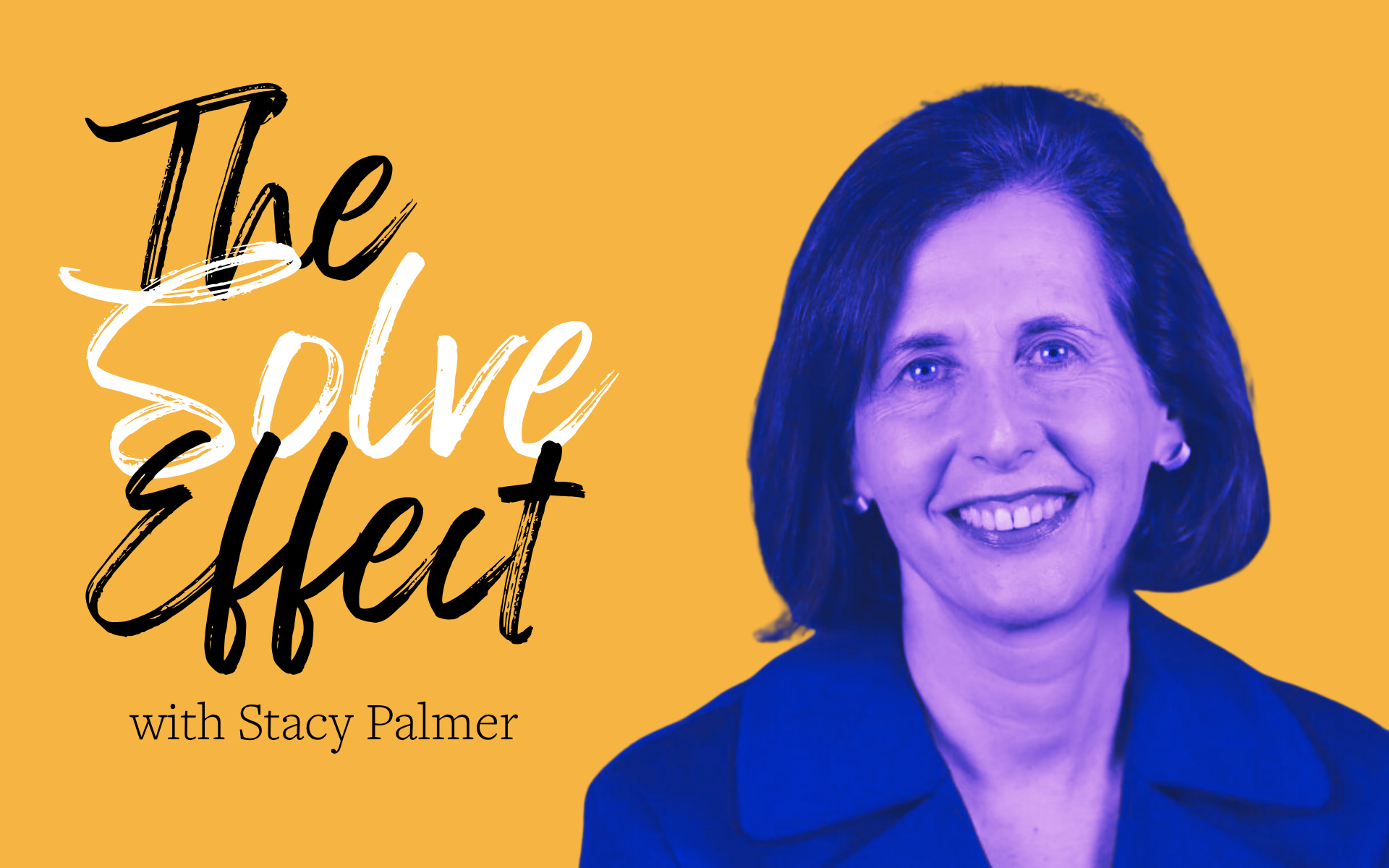
This is a transcript of Episode Thirteen of The Solve Effect, edited and condensed for clarity. Listen on Spotify, Apple Podcasts, or Amazon Music.
Hala Hanna
Welcome to the Solve Effect. I'm your host, Hala Hanna.
When a billionaire makes a pledge, or a foundation announces a strategy, or a non-profit shares a leap forward, we often focus on the headline, the gift, the program, the impact. But behind every headline is a set of choices. Who holds the power, who sets the agenda, who's accountable when good intentions fall short?
For nearly four decades, today's guest has been asking those questions and more. Stacy Palmer is the Chief Executive Officer and co-founder of The Chronicle of Philanthropy. This is now a multimedia digital platform that has reported on the promises and contradictions of philanthropy.
A couple of years ago, Stacy guided the Chronicle through its transition to an independent nonprofit, shaping its next chapter at a moment when trust and transparency and accountability in philanthropy and media matter more than ever. Philanthropy is one of the few places where private choice becomes public consequence, and a lot of it happens out of sight.
And Stacy has been holding a light on this world for decades, close enough to understand the nuances and independent enough to name the hard parts.
Stacy, welcome to the Solve Effect.
You've spent decades chronicling how wealth moves from private pockets toward public problems or public goods. If I rewind the clock to the moment you realized that philanthropy needed that reporting, what did you see that made you think that this generosity is a force that shapes society, and someone needs to be doing this work?
Stacy Palmer
Well, about four decades ago, we were looking at the fact that philanthropy was very under-covered and that no journalists were really paying attention to it. And the reason it became important was that during the Reagan years, there were a ton of budget cuts. And it's going to sound a little bit like it does today in terms of when we see that nonprofits that count on government money to provide services, everything from education to food to healthcare, all of those kinds of things, they saw a huge number of budget cuts. And so all of a sudden, they had to raise private funds. And so, 40 years ago, there was this real boom in the number of fundraisers who were asking for money.
It wasn't just colleges anymore; it was healthcare institutions, it was food banks, it was everybody looking for private money. And so a lot of private dollars were starting to flow into philanthropy. And, at that moment, it seemed like an incredible boom when I compare it to where we are now. The dollars were tiny. But it was the beginning of this idea that private philanthropy would play a very big role and that organizations would get very good at asking both the super affluent to give money, but also to raise money from everyday donors.
HH
That's really interesting to think of this government cut in funding as actually the pendulum that has swung back and forth. You have such a long view with the Chronicle of Philanthropy, and you've watched donors respond to, you know, these crises like 9/11, the 2008 crash, the pandemic, and now this. I would love to hear from you where this moment ranks in terms of how disruptive it is to the ecosystem.
SP
It's always hard to tell when you're in the middle of history happening, but it's pretty significant compared to some of those other crises that we've seen. The 2008 financial crisis was very difficult for organizations. COVID was difficult for organizations. And when I say that, there's almost always a mixed opportunity where some groups collapse and cannot make it, and others have tremendous innovations. So we're seeing that again in this moment.
Trillions and trillions of dollars come from the federal government into nonprofit organizations. So about half their revenue overall comes from government subsidies. And so we see some donors responding, some foundations are responding. They're giving more money, but there's no way they ever have as much money as the federal government has. So there's going to have to be some reshaping of how we go about doing things in society.
HH
We are probably coming at more than a year now of the retreat of US foreign aid. And we're grappling with that harsh reality that you just described, that private philanthropy was never designed to fill a gap that's built to be filled by government, and that both in the size of it and the intentions of it. Can you tell us a bit about what gets permanently lost in your view when a government obligation has become a donor's choice?
SP
Philanthropy is all about private decisions and voluntary giving, and sometimes it's aligned with things that the government is thinking about, but there's no reason it has to be. So certainly we see some examples of responses from private donors. In the foreign aid area, there's been fascinating responses.
Bill Gates decided to accelerate the spending of his foundation, giving the money away faster. And then at the other end of the spectrum, donors who are small-dollar donors but are giving very generously from their own budgets. A lot of the organizations that do international aid did emergency fundraising drives. They knew it was going to happen. But what we don't know is who is left behind, because there's no reporting, because there's an absence of aid.
And so certainly we have seen journalists talking about some of the stories of the number of children who die of disease or malnutrition. We're really just beginning to calculate the toll of that.
HH
Let's talk about the rise of mega donors. You've mentioned Gates, Mackenzie Scott, Melinda French, the Giving Pledge cohort. It's generally reshuffled the sector, and at the same time, as we were just discussing, it's concentrated enormous decision-making power in those few hands.
What do you think of these concentrations? In what ways is it good for the field, and maybe in what ways is it crowding out something else that's essential?
SP
So let's talk about those mega donors in a second, but also, before we do that, some context, which is even as wealth has grown tremendously in this country, and we have more billionaires and more dollars clustered, from what we can tell, many of the very richest folks are not giving away lots of charitable funds. You don't see foundations named after them.
One of the things we do is look at the Forbes 400 and say how many of them appear on our ranking of the 50 donors who give the most in a year, just as a measure to say what's happening. And often what we find is... maybe 25 of the 400 are giving generously. That means the rest of them are not giving that kind of money. So we can talk about the ones that stand out, and this issue of how much power they have and what that means. And that's really important. But I think the bigger question is, why are more of the wealthy not giving? And what can we do as a society to encourage them to give more in other ways?
HH
This is such a good way to flip it on its head. Let's measure people by how much they give versus how much they're worth. Of course, it's about money and impact, but underneath it's about the values, and power, and legacy, and ego.
If folks are not giving, what do you think they should be thinking about that they're not thinking about?
SP
One thing to keep in mind is, when you see these very big gifts being announced, it's often to a college or university or to a hospital for healthcare research. And those are the kinds of ambitious projects that need a lot of funding, but they also have great fundraisers who are out there talking to these donors about the reasons that their cause matters.
What you don't have is an army of fundraisers who are as sophisticated as able to get access, who come from other causes that are more social justice causes, grassroots, neighborhood causes, environmental justice groups. How could we get more of those groups to be able to have access to the very wealthy to say, “Here's what we're doing.” They don't even have a chance to make the pitch in the same way that Harvard, Yale, Memorial Sloan Kettering, all those organizations, worthy organizations, but try to take that kind of fundraising power and put it in the hands of more people, because that's how money gets raised.
The other real challenge is: most of the giving that happens in this country is clustered in big cities. It's on the West Coast, it's on the East Coast. And so there's a vast part of the nation that's what we, and some others in the field, are starting to call “philanthropy deserts,” sort of like food deserts, right? Where there just is nothing happening because there are not enough wealthy people who are interested in supporting more rural areas. They're not close to them. They don't have them. And so the inequality gap is vast. And if I were a wealthy donor, one of the things I think I would do is hire some folks to go find out who's being neglected, who's got the most innovative ideas, and then finding some ways to have competitions or open calls or something that encourages access to more people.
That's the way most donors get really excited when they see a nonprofit that knows how to make a difference. We just need to make that transaction happen more often.
HH
I don't know if you meant to kind of serve me this one on a silver platter, because that's exactly what Solve does. That is our theory of change. That, you know, ingenuity is equally distributed. Opportunity is not. Just like there are these philanthropic deserts in the US, so is there in the entire world, in those places, you know, where there are, you know, problem solvers who know exactly the context they're in, the problem, and they actually have the solution, and they have a prototype that works, and they have a pilot. And yet, when they don't have the deep pockets in their community to be able to replicate it and spread it and scale it. And so those amazing innovations get stuck.
We do open calls, we do global competitions, so that we change who gets discovered and kind of level the playing field when it comes to using technology to reach those who need it the most and not just the most profitable markets.
SP
And technology is exactly the case where, if there was more investment in nonprofits of all sizes and causes, for the most part, most nonprofits have tiny technology budgets. They don't have access to expertise.
Compared to business, for example, businesses spend 6% to 8% of their budgets on technology. Nonprofits spend about 3%. Well, if all of the billionaires wanted to get together and make a big technology investment, just think about how the nonprofits could use that to leap forward. Let them figure out what to do.
I do see a lot of excitement is certainly what Mackenzie Scott and Melinda Gates are doing in terms of transforming how giving happens. So we're starting to see some things change in the world. And I don't think it's a coincidence that it's two women who are making a giant difference.
HH
Why do you think giving is so different? If I were to compare the list of the 50, you know, richest versus the list of the 50 who give the most, I bet the gender representation on those two lists is flipped.
SP
It's not yet, because men still hold most of the resources. In terms of percentages of income, for sure, women do give more, and they also make the decisions often in couples about where the money is going to give. The dollars are absolutely influenced by women, but we're only just now really seeing women who earned their wealth having as much, as many resources and as much power.
I think, in the next decade, we're going to see even more of that. But they absolutely are inspired by people like Melinda Gates and Mackenzie Scott. Both who give so differently. Mackenzie Scott goes after, finds groups that usually aren't getting much support, causes that don't get support. She's the model for what we were talking about before, of looking for the kinds of things that nobody else wants to give to. She's absolutely looked at some of the groups that have been cut in the federal budget cuts, and those groups have gotten very generous grants.
For example, teen suicide groups, mental health problems, are a tremendous issue. That is not a cause, unfortunately, that a lot of philanthropy gives to, but she's giving to those kinds of organizations. She doesn't ask for proposals for the most part. She has one program that does that. She scouts out, and she gives to the groups that make a difference, and she does it with no strings attached. She trusts the organizations, and she says, “Do with it what you need to be done.”
Melinda Gates, on the other hand, has taken a number of different approaches. She's much more metrics-driven. But she's also given some of her money to people who are already experts in the field and said, “You give away the money. You're an expert on health care.”
And so I think that model of saying, “I've got resources, these are the kinds of causes I think are most important and where I care.” She cares obviously a lot about healthcare is where we've traditionally seen her giving. And so she's enlisting the great experts and having them make the decisions, not feeling like she needs to control every bit of it or put her name on everything.
HH
You're talking about trust-based philanthropy, which I know you're a proponent of, like do all of your due diligence up front and then trust the partner to spend the money in the way that maximizes impact on the ground.
SP
I mean, if you're going to give to a group, you shouldn't give to one that you feel you have to micromanage. Why are you giving it if you think that every dollar has to be spent according to a specific budget? That gives nobody any flexibility. Life happens. All kinds of things are happening. We're in the middle of a war now. Nobody expected that a couple of months ago. We need to prepare for the unexpected.
HH
Right. Where do you think that comes from? This talk of systems change, or all of these guardrails, are code for just risk management. How do we structure incentives so that folks are taking more courageous and generous bets?
SP
One of the things that we do in our journalism is we go back and look at where did some big donors or foundations make investments 10, 20 years ago and say, “What difference did it make? Did it work? What happened with it?” So there's a measure of accountability, so I think having more of that long view is really important.
The other thing we need to do, and this is harder, but I think it's critical, is that nonprofit leaders have to be seen as innovative, serious, good managers, good leaders, good advocates—all of the things that we expect in a business leader. They're in control of huge sums of money. We count on them. The Red Cross, for example, is who we count on to provide humanitarian aid in a lot of cases.
If we could have a campaign that introduced these terrific leaders to the people who have the money, so that they would have more faith. You're a great leader. You're going to do wonderful things about it. I'd love to hear about it, but I'm not going to hold your hand and tell you how every dollar must be spent. We would never do that in a business organization.
HH
And certainly your coverage has helped shine the light on some of these examples. What else do you think would help change the culture around how we see nonprofit leaders?
SP
I think in some ways, the donors need to get just exposed to them more often. We need to find settings where people can have great conversations and understand each other.
The media also needs to do a better job of portraying how nonprofits are run and get away from these stereotypes that these are just voluntary groups that are tiny little efforts and don't make a difference. If we had more journalism that showed the serious ways in which nonprofits contribute, I think the public profile would be higher.
And so, you know, we started to see when all of those federal budget cuts happened, all of a sudden people said, “Oh my God, things like Meals on Wheels aren't delivering. What's happening? Oh, I really care about that.” Well, of course they did, because that's such an important part of the community and a service, but we need to make sure people know about that every single day, not just when a crisis happens, but to know that that's part of the fabric of the community.
HH
You've had this front seat watching philanthropic bets play out to the ones that paid off, that maybe didn't get that much coverage, to your point, and then the ones that have failed without making headlines. What's your view on what actually separates the giving that changes things from the giving that just feels good?
SP
In a large part, it's that the donor has really looked at the cause, the leadership, and made an investment. One of the donations that we featured recently is a group that cares about public service, making sure that great people are in government. It's a very nonpartisan effort. And it has made quite the difference, thinking about those causes that just don't get the attention, that need to be elevated, that make our society work in various ways, to me, that's the special ingredient of those foundations and donors who have that foresight to say, “What are the things that not everybody else is thinking about giving to and that we could elevate in society?” People who listen to this podcast may be fans of Michael Lewis and know the book that he wrote most recently about—Who Is Government? Well, that's that organization, really featuring these people who made a difference.
HH
And it's the same principle as in business: hire good people and get out of the way, whether it's for your grantees or for your, the executive director of the organization that you want to fund.
SP
I think the other important thing to realize in philanthropy, and it's true in all of life, but it is in philanthropy, is that some things are going to fail. If you're taking risks, some things are going to go wrong. But you do need to try new ideas, give sufficient time, test it, realize that that's part of experimentation. It's not that you made a bad decision.
Philanthropy would be better if there was, at least part of the portfolio of a donor was, giving to risk. Give to the causes that you care about, that you trust about, but then give another portion of your funds to something else that maybe will make a great difference Maybe not, but you have every reason to believe it.
HH
You've given a lot of really good guidelines for anyone who's listening and who have the capacity to give, and that's definitely more people than we think of, right? So if you're not giving, just give. Give to your local organization, and also, go and find the unsung heroes that are doing amazing work. Give with trust.
What kind of advice would you give to heads of organizations that are actually raising the funds?
SP
Those people have a really hard job. They face challenges every day. One of the things that I think is very hard for nonprofit organizations is to be great storytellers. And that's what you need to do to be able to raise money, to be able to get donors to care about something. And that's both the everyday donor, somebody who's making a decision about what I'm going to do with my weekly or monthly donation, and then the very rich as well.
But unfortunately, nonprofits are penalized for spending too much money on things like communications, because it seems like overhead. And, oh my goodness, I want all my money to go to, let's say, feeding the children. Well, part of feeding the children is telling the story to other donors about how they can also feed the children. And we need to count that as part of, that's program work, it's educating.
The other thing that people in philanthropy, really the people on the fundraising side, don't have time for, but we need, is the ones who have tremendous trust, usually in their communities. We need them to come together and say, these are all of the charitable social good organizations that are making this community work. And together collectively, we need funds, we need volunteers, we need government policies, because there's power in numbers, and we won't build trust if it always seems like every organization is just out for its own. A collective effort can make a real difference.
HH
You've obviously built an organization that is now marking 35 years. It's providing so many of these services that you're just talking about. How do you story-tell better? How do you fundraise better? You've had this front row seat to so much of what has happened over the past decades. Are you more hopeful about philanthropy's role in the world than when you started today?
SP
I am more hopeful because there are tremendously more resources available than there were. I witnessed that level of philanthropy coming into being during these 40 years that we've covered philanthropy. That's how new it is to have these real mega donors. There are tremendous resources and there are also tremendous people in the field.
We did a study of how organizations are dealing with all of the challenges of the past year, and it was amazing to us how optimistic they were about the resilience of their organizations, that they were going to be able to... To make a difference and overcome all these challenges, but when you ask them to list all the challenges they had about their resources, all of the things that are the ingredients of making sure your organization is going to survive…they were pretty pessimistic. Their ability to keep fighting and going is amazing. What we need to do is temper that, however, with some reality, and make sure that the resources are really there.
We shouldn't think that it's just going to all work out, and that just being dedicated to the social good, it's not enough for an organization to survive. And that's where the donors can play a really big role in making sure that they're thinking hard about their responsibility to the communities where they made money, where they grew up, where they made a difference.
HH
Well, Stacy Palmer, thank you so much for doing the work that you're doing, for being at the forefront of so much of it, and for sharing with us so much of your wisdom today. Really, really appreciate it.
SP
Thank you for such a great conversation and for the important work that you do, too.
HH
Speaking with a media veteran like Stacy provides perspective that we have been here before: Government funding gets cut. Private citizens are tasked with filling the gap. Nonprofits feel the pressure and adapt.
The pendulum swings, and it will likely swing again.
What's constant is the question Stacy has spent her career asking: when private decisions become public consequences, who's watching?
And the answer, it turns out, is all of us. That means giving with trust, funding the unsung work, and being willing to let some bets fail, because if nothing ever fails, we're not taking the risks that matter.
For those of us doing the work, telling the stories of this work is our charge, too.
Are you also leading an organization that needs some storytelling inspiration? Share this episode with your team, and let us know what you think in the comments.
I’m Hala Hanna. Thank you for listening to The Solve Effect.
If you haven’t yet, please subscribe to The Solve Effect wherever you get your podcasts.
This episode was produced by Bridget Weiler and Elisabeth Graham.
Audio engineering by Kurt Schneider at MIT Audiovisual Services.
Music by Tunetank.
For more information about MIT Solve’s tenth anniversary, check out solve.mit.edu
Tags:
- Podcast
Related articles
-
Stacy Brown-Philpot on TaskRabbit, Trust, and Doing Hard Things
-
Bonus Episode: LIVE from Solve Challenge Finals 2026
Go behind the scenes at Solve Challenge Finals in this bonus episode of “The Solve Effect.”
-
10 Years, 10 Solvers: From 14 Days to Under 60 Minutes—Revolutionizing Radiology Reporting with Rology
Ask Amr Abodraiaa what Rology looks like from the patient's side, and the answer is: nothing at all. Invisibility is the design goal. What the patient gets is the result.