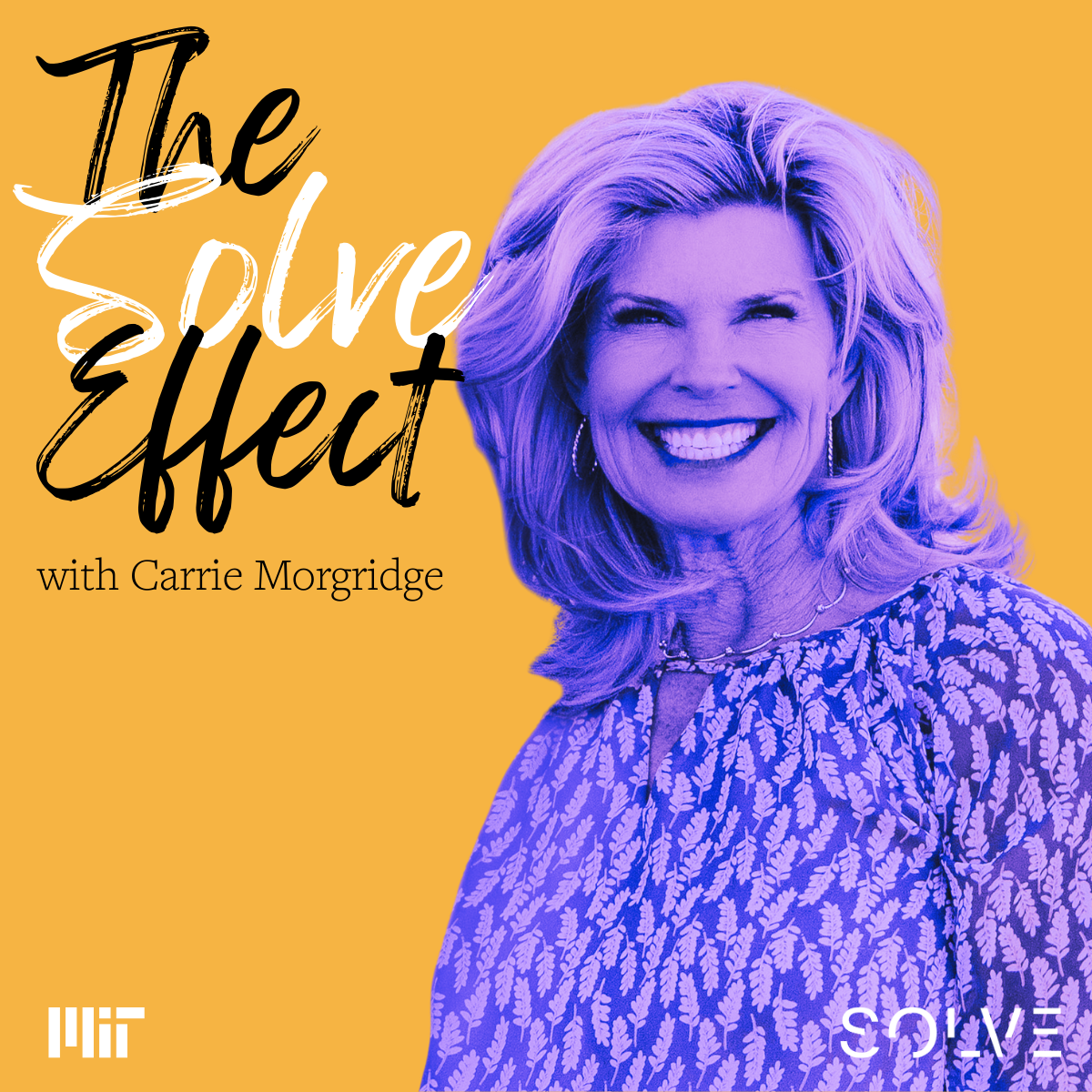
This is a transcript of Episode Eight of The Solve Effect, edited and condensed for clarity. Listen on Spotify, Apple Podcasts, or Amazon Music.
HALA HANNA
Welcome to the Solve Effect, where we spotlight extraordinary people tackling the world's toughest challenges with bold, innovative solutions. I'm your host, Hala Hanna.
We're living through a sea of change. And in moments like these, the question is not just, “What should we do?” but also, “Who has the courage to do it?” Today's guest is Carrie Morgridge, co-founder and CEO of the Morgridge Family Foundation, three-time author, and one of Solve's biggest and longest-standing partners.
Under Carrie's leadership, the Morgridge Family Foundation has granted more than $160 million to hundreds of nonprofits, supporting everything from literacy programs to workforce development around the world.
Today, we're going to talk about what it takes to give with intention in a world that's changing so fast. How do you choose who to back? How do you learn from mistakes? And how do you raise children to understand that being a philanthropist is not a privilege to take lightly, but a responsibility to take seriously and joyfully? Carrie Morgridge, welcome to the Solve Effect.
I want to go back to the very beginning, if that's okay, Carrie. You often said you are the low-income kid that you are trying to help today. Can you take me back to those early years and tell me what you see in yourself that you now see in the people that the foundation is serving?
CARRIE MORGRIDGE
So I grew up in a super loving family, and that was really helpful for my start, once I got involved with philanthropy. But my mom and dad, when I was nine years old, the two things that they always said were that A. I could be anything I wanted to be, and B. work hard, be nice.
When I graduated from high school, I immediately moved up to the Bay Area, and I met my husband of 35 years. His name is John Morgridge, and at the time, his father had just taken a company called Cisco Systems public. It is because of Cisco Systems, and it is because of that opportunity that doors started to open for us. And John's parents put him on their board, and then I backed my husband for many years before I had this great opportunity to become the CEO of the Morgridge Family Foundation. Knowing who I was from the beginning helped me become the philanthropist I am today.
My love for competing, I think, helped me look outside of the box and helped me think of different ways to explore philanthropy besides what had been done over and over and over again.
HH
Tell me more about what it means for you to not do what has been done over and over again.
CM
One of the tastes of disruption that we first got involved with was Catholic Charities of Fort Worth. And the question was, if we give the same family $100 over and over and over, which they've been doing for almost 150 years, how could we expect different results?
So their question was, what would it cost to front-load a family? How much would that cost? And to get them off of government assistance for the rest of their lives?
We ended up funding the research called the Padua Pilot. And the research was two big aha moments. So, one, the simple answer to the question is a family of four that really needs help needs $3,500 to $5,000, depending on their situation. The aha moment in the research is that if each family had a $500 savings account, they wouldn't fall off the cliff.
The Padua Pilot is still on their website and still relevant today, it's 20, almost 20 years later. And this research is still relevant today! So that was my first real taste of disruption, in that you really had to understand the root cause to get to the next level. So now, here's my MIT question: how do we use AI as a predictor to say, help us solve this problem in the nonprofit world?
HH
Right. There's a huge opportunity with AI to completely reinvent the nonprofit sector in what we do, how we do our work. There's such a deep empathy in what you do, and that is based on your lived experience, because you know what it feels like and what it looks like. In the same way your foundation has grown up alongside your family and your children, I'd love for you to talk about how you've lived through that and how you are rethinking it now.
CM
When I started in philanthropy almost 30 years ago, there wasn't a book that existed to help up-and-coming or newly minted philanthropists. So my first book, Every Gift Matters, really talks about that first section of our journey of getting started, where every small gift actually can change a life. And then our philanthropy grew as our kids grew up. Our kids had watched us grow with our philanthropy. And what we figured out in the last 20 years, and I put this in our Courage Money book, is to understand who you are. What is your relationship with money, which is incredibly important? And then what skills do you bring to the table? The other thing, that I had a conversation earlier with a really dear friend. She said, “What I admire about the Morgridge Family Foundation is that about every five years, we kind of change direction.” So we did ECE, and then five years later, we changed direction into high school, middle school, and then we changed direction again into workforce development. And now we're putting all of this together on how to maximize our giving.
HH
So you're really thinking about scale and what partnership can enable differently. There's a lot to learn from that journey and the fact that... you had to learn it on the job. You had to find your own way. Two questions. Why courage? And are there any mistakes that you wish you had avoided?
CM
Yes and yes. I'll answer each question individually. So, courage money came out of a Susie Buffett story. She was trying to help decrease teenage pregnancy. What I loved about her, the way she approached the thought process to the solution was what is the root cause of teenage pregnancy, and then how do we solve that? Susie tried to partner with an IUD company, but it was so expensive. It was like $3,000 a student. She knew that the cost was prohibitive. Do you know what she went out and did? She actually went out and started her own IUD company.
HH
I love that.
CM
Do you love that courage? And then she found a state, and believe it or not, it happened to be the state that the foundation is housed in, which is the state of Colorado. And she partnered with the government, and they allowed for a full year to do this test pilot. So it was only the teenagers who wanted IUDs who got them for free. And guess what happened a year later? Teenage pregnancy not only went down significantly, but college attendance also went up for women at the same rate. And I was blown away. In fact, I have goosebumps all over my body right now because Susie really took this on and she did it in a quiet, a quiet way. Maybe people don't want to talk about it.
So again, I kept asking myself, do I have the courage? Because it was a $25 million project. I currently give away $13 million a year. I could have used two years of my budget and worked on this project. Then here's the other side that I just thought was amazing, and we never talk about good government. Once Susie had the data and showed it to our state, because it was, again, the state was hand in glove on this project because they were following it, the state picked up the funding the year after. That also is a key component in courage money, which, to your question, your second question was, what do I wish I had known? If philanthropists would use their funds as risk capital or courage money and prove the data the way Susie did, then we could partner with our government to make it sustainable.
HH
I just love the Susan Buffett story and how you brought that courage back. Philanthropy is the perfect risk capital; you take bets on people and on problems, and you see where it goes. And then once you have the data about it working, you tell the story of the people, and you convert others, including the government, so that it can actually scale and become sustainable. I mean, that is how you change systems.
I hope people can hear it because I, knowing you, can feel it every time I'm in your presence. There is so much joy that resonates out of you. And I know that giving and the work that you do on a daily basis is a big part of that. What is the role of joy in your life and in your giving?
CM
So I will share a story about the Denver Museum of Nature and Science. It brings us great joy. And we went there as our family when the kids were teenagers, and we actually sat with them. So this happens to deal with generational giving. Before the kids were involved with the foundation, we actually took them to the Denver Museum of Nature and Science and said, “They're asking us for a mega gift.” And what we consider mega is $1,000,000 or more. So we took the kids, we did the behind-the-scenes, and then we sat, and we talked about it. This $8 million gift also pulled down $63 million of bond funding from the taxpayers. So it was this win-win situation that the Morgridge Family Foundation put their name on it at the same time the city pulled down. But the third win is so fun. We went from having a million people attend the museum to 2.2 million people now attending the museum. We did this when the kids were teenagers. Our children are now 32 and 34 with their own children. And to see our grandchildren going, begging to go back to the museum as members, begging to play with the other kids, begging to be sparked and inspired, just brings us so much joy. And also hope for the future. You've got to have fun.
And Hala, I would say that you and I have a perfect example of having fun together! So for our audience, Hala and I met in New Hampshire, and we went for a hike, which was unbelievable. We took all kinds of memorable pictures at the top. And then when we got down, we had chocolate and wine.
HH
Oh, it was just the perfect day.
That just speaks to you, also, and how you do your giving. I find a lot of joy in working with people like you and so much joy in the impact that we can have. And I wonder how you choose the people that you work with. I've heard you say that you chase specific types of leaders rather than specific problems. What do you see that makes you think, this is someone that I want to work with?
CM
In following just that lead, we discovered Michael Crow at ASU. We have MIT Solve, we have SNHU, we have Colorado State University Global, and we have NCAD, which is the National Center of Apprenticeship Degrees. What all four of these, and we have like 40 in our portfolio, what they all have in common is that the leaders said, “How are we going to change what we used to do 150 years ago and still deliver high quality? How do we meet our students where they're at?” Here's what I look for.
One, communication. It really, truly is that leader getting out every day and talking with people and really sharing their vision for the future. Then the follow-up. A great leader has unbelievable follow-up because they listened to what you said. I cannot tell you how many meetings I've been in where I will present like, oh my god, I have this great idea, and could we do it this way? Because that's my role, right? Risk capital. Can we do it? Can we change the status quo? Can we do it?
HH
Right. And sometimes the biggest gift you can give someone is to give them the no also on your end and give it early, which I've heard you also say is something that you do.
CM
So twice a year, we look at our budget, and we start talking about what we're not going to fund for the next year. Then what we did last week was I just like to do a really simple red light, yellow light, green light. And now we kind of have a new category, and we're calling it, “we're going to give them funds because it's the right thing to do.”
HH
Oh yeah.
CM
It's not here in our core. It's not courageous. It's the right thing to do.
HH
Is this a response to the massive cuts that we've seen in public funding?
CM
Yeah, that's a lot of that. Yeah. And we know that anywhere between $10,000 and $25,000 right now in any organization that we support actually can have a huge, significant difference. So we've started that new category, kind of like how we pivoted for COVID. At COVID, we broke our own rules. We put in a category called COVID, and we funded $4 million of grants we would have never funded. And believe it or not, two or three things really suck.
HH
You have the ability to pivot and to take your own decisions in a way, in such a fast and direct way that you really can plug those very painful holes for these organizations. And I'm seeing a lot of philanthropists who are taking those decisions, and some who are actually just stuck in the status quo.
CM
I think it's really important for family foundations that have legacy to understand. Legacy doesn't do anyone any good. And I have, I'm living proof that once we proved ourselves to the Morgridge family from Cisco and built their trust, because trust takes some time, but once we built their trust, they gave us our own foundation.
What I have seen, because they also signed the Giving Pledge, and they are pledgers, is that so often when we go to those meetings, it's like, how do we deal with the family dynamics? Because we can't pivot, we can't change, or we have to honor what our grandpa wanted to do.
And I'll give you a great example. Bill Daniels was a multi-billionaire in Denver, based on communications. I think it was Denver; he was in Colorado, Wyoming, and Utah. So he set up his foundation after he passed. They have no flexibility with artificial intelligence because it wasn't invented. They have no flexibility in some of this technology. But Bill wanted to do scholarships. And I love scholarships because I love scholarships because that's the individual I was talking about. But imagine if you had to give away 50% of your endowment just for scholarships, and you could never pivot from that again.
I'm going to end with that green light, yellow light, red light. Last week in my office, when we saw the red light, like, oh, we're not going to fund these…we immediately sent emails to those organizations saying, “We are so sorry, we've looked at this, we pondered on it, we talked about it.” So they know that we just didn't immediately say, no, it's not the right fit.
Get that experience, do your site visits, do your homework online, do your research online. And once you've done all of that, there's going to be a feeling in here that is imperative to your own foundation moving on. And that's another thing of understanding what your skills are and what you can bring to the table. It’s super important because you're going to look at it with a different lens than maybe your husband, your spouse, or your kids.
HH
Oh, so many lessons here. So counterintuitive. Like legacy doesn't matter. The billions that are sitting in donor-advised funds, what are they for? Have you thought of the debate between spending down foundations and keeping things in perpetuity or for multiple generations? Is that something you think about?
CM
All the time. Courage money. So again, your grandpa made a billion dollars. Understanding why we are here, why we are doing this, allows me to work each and every day. And a huge part of our why is that we can.
How lucky, how lucky am I to be able to sit on this side and say my why is, why not?
HH
Why not?
CM
So for people to really understand that and embrace that and accept it, and that's a part of accepting who you are. And then accepting who you're not, right? We've talked about the yes’s and the no’s. It goes both ways for what's in here.
So I know who I am, and I also know who I'm not, right?
I know that I don't qualify to go to MIT, but I value everybody there so much. It brings me so much joy when I get my MIT Solver. There's so much joy in that because they're so brilliant and they're so amazing, and I get to be around them. Okay, then, item number two about legacy and spending down. It is so courageous for families right now to ask their children, “Do you want this fund, or should we spend it down on our values? Do we have the courage to put $10 million into solving one problem instead of spreading ourselves super thin?”
HH
Carrie, you are such a force. There's a saying, you know, “I don't lose, I either win or learn,” and you're definitely that. And maybe that's what comes from your competitive spirit. Knowing you and knowing your work makes me hopeful. And knowing the work of our Solvers, I'm always hopeful. But I want to know what gives you hope, and especially knowing that you're coming up to your 6th decade, what are you planning?
CM
Funding projects that challenge the status quo. And with the coming of artificial intelligence is a whole new level of opportunity. And what I wish more philanthropists would look at is asking their nonprofits. If you're asking (I'm going to use round numbers), if you're asking us for $100,000 grant, what would $10,000, just 10% of that, do to move your artificial intelligence forward in your own nonprofit org? So that's where we're starting for 2026, is how we can take, this is what you would ask us for. Can we take a baby step back and either do 5% or 10% and fund AI with the grant? And let's just play.
Where a foundation like mine has a huge impact is just asking that simple question, “What if we put 10% of this grant towards AI and have you dabble?” Or if they have an AI plan, do you have the courage to fund it?
HH
I have to give you credit also, because our last work together was around AI. And through it, we were able, with Harvard Business School and MIT alums, we did this, we created this tool basically, and it's award-winning research that allows us to decrease our time of, the biggest time suck for us in all of our work is how do you get 3,000 applications and then, move it down to 30 in a way that doesn't have bias, respects every applicant, regardless of their level of English, all of that. And we've created this tool, and now we're writing a white paper to make sure every philanthropy can use, can do the same for themselves. And now we're like, okay, so how do we build it into our CRM so that we find more funders and more investors?
CM
Well, thank you.
And then your second question was, what is going to happen in my 60s? I am not giving up on competition. So it would be no surprise that I play tennis, pickleball, and ski. So that 2 million vertical, I'm going to try to hit it again this year. But in the long run, I would love to be the first woman to hit 10 million vert. Just the first woman, you know, and so it's a big, hairy, audacious goal, but it's a personal goal. And then the other thing that comes with my athletic goals is that I work full-time at the foundation. So I have to have grit like you cannot believe. So I have to get up at 5 am so I can work until 8, and then I ski until 4, and then I'm back working from 4 to 7:30 pm.
So there are lots of sacrifices to your goals, but when you hit your major goal, there is a euphoria that I can't explain that happens. And again, after I did my first Ironman, and then I did a half-marathon, and then a full three weeks later, nobody can ever take that away from you, that athleticism, that accomplishment. And I think that's the same in philanthropy. Every grant may not be a home run, but we took risks, and we can go to bed every night saying we did the best we could at the foundation, and we worked as hard as we could and as smart as we could. Sometimes working smart is better than working hard.
You know, in my 60s, I want to work smarter, so I don't have to work harder.
HH
We started this conversation by your loving parents telling you to work hard, be kind, and believing, and instilling in you the belief that you can be anything. And having the privilege, frankly, to know you, they must be proud.
CM
Thank you. They are.
And the other thing I do have to say is I have the most amazing in-laws. John and Tasha Morgridge are 92 years old. They are still kayaking in the summer. They are still going for their morning walks together. They have been the greatest mentors. And give with love. We forgot to sprinkle in love between being fun and being kind. But truly, you know. And it's just my love for humanity, my love for animals, my love for the environment, and my love for MIT Solve.
HH
Oh, Carrie, we love you back so much. Thank you. Thank you.
CM
Thank you, Hala.
HH
What stays with me after talking with Carrie isn’t an idea as much as it is a way of seeing. She looks at the world and notices possibilities. For her, philanthropy is a conversation, a chance to sit with someone’s vision and say, “I believe in you. Let’s build this together.”
I love this definition of philanthropy, not measured in dollars, but in the courage to trust others, to hand them the tools, the freedom, and the belief that they can change their own communities. Most importantly, the courage to fail.
Maybe that’s the real work of modern philanthropy—not to do the most, but to do what matters most.
I’m Hala Hanna. Thank you for joining us for this episode of The Solve Effect.
This episode was produced by Bridget Weiler and Elisabeth Graham, with audio engineering and editing by Chris McDonnell. Theme music by Max Natanagara. Subscribe or leave a review wherever you get your podcasts. Visit solve.mit.edu or find us on social media.
Tags:
- Podcast
Related articles
-
Stacy Brown-Philpot on TaskRabbit, Trust, and Doing Hard Things
-
Bonus Episode: LIVE from Solve Challenge Finals 2026
Go behind the scenes at Solve Challenge Finals in this bonus episode of “The Solve Effect.”
-
10 Years, 10 Solvers: From 14 Days to Under 60 Minutes—Revolutionizing Radiology Reporting with Rology
Ask Amr Abodraiaa what Rology looks like from the patient's side, and the answer is: nothing at all. Invisibility is the design goal. What the patient gets is the result.