This is a transcript of Episode 23 of The Solve Effect, edited and condensed for clarity. Listen on Spotify, Apple, or Amazon Music.
Transcript
Elisabeth Graham
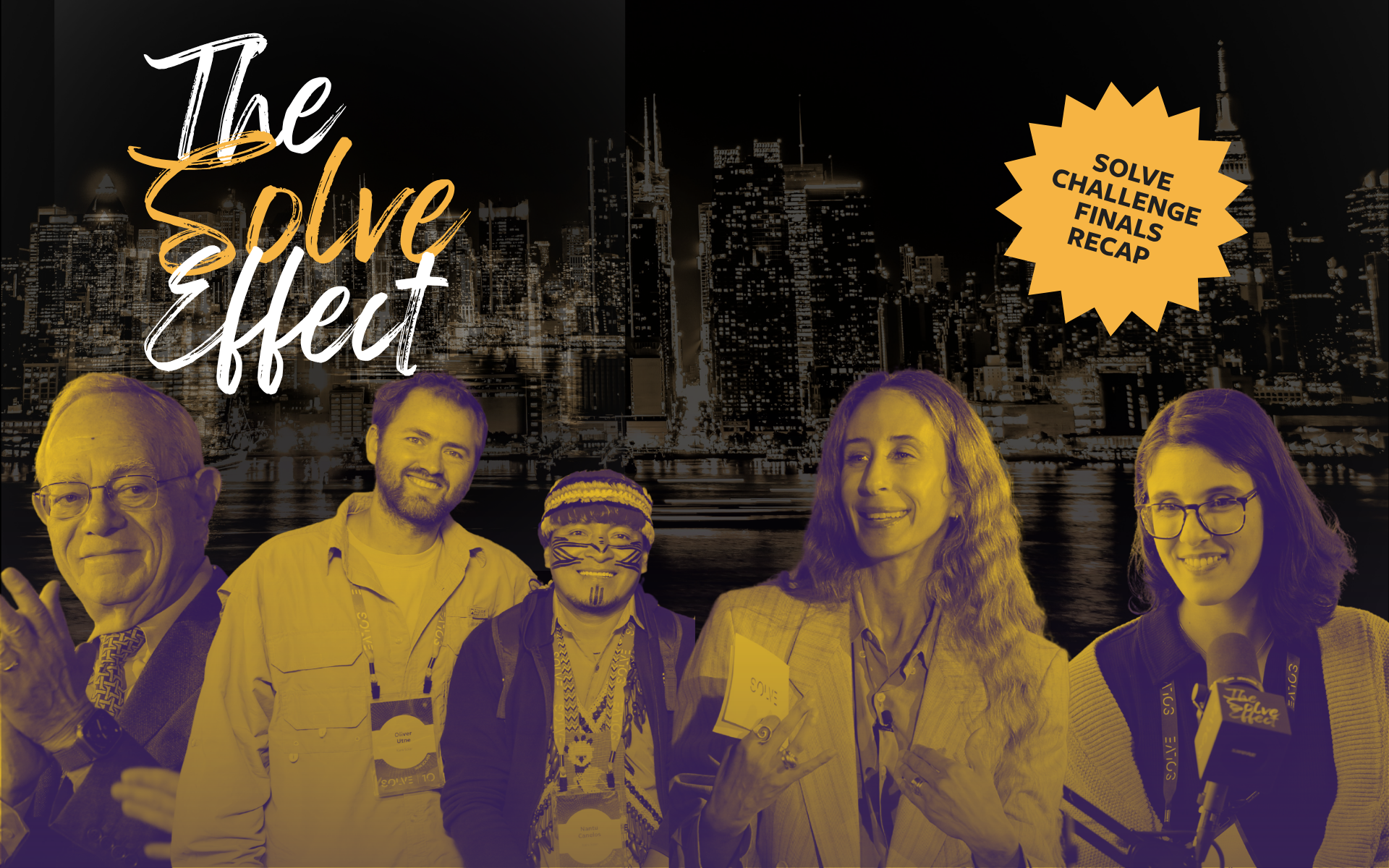
Hello, this is Elisabeth Graham, a producer on the Solve Effect. I'm excited to share a special episode with you. Last week, we were in New York City as world leaders gathered at the UN and activists convened for Climate Week. We hosted Solve Challenge finals in the midst of it all, celebrating a decade of solving the world's toughest problems with creativity, innovation, and optimism.
Between the plenaries, performances, and pitches, we caught up with solvers, speakers, and global leaders who traveled from all over the world to commit to building a better world together. Tune in for all the highlights.
It's Tuesday, September 22nd. It's about 6:00 in the morning.
We're just a few hours away from the start of the program, and the energy is high after Solver orientation yesterday when we brought the 2026 Solver class together in person for the very first time. They shared their stories, practiced their pitches, and connected with prize funders. Today, they take the stage.
But before we get into our Solvers, we're talking to Solve Innovator Program Lead Taewee Kahrs about what she is most excited about for our Solvers today.
Hello, Taewee.
Taewee Kahrs
Hello.
EG
How are you today?
TK
I am amped up, ready to go.
EG
I would love to hear a little bit about Solver orientation yesterday.
Can you tell our listeners a little bit about that experience and what Solvers take away from Solver orientation.
TK
I mean, Solve Challenge finals itself is such an energizing day, but I have to say for me, the orientation day that we hold before is the day that I look forward to the most. We at Solve, you know, we've been following the journey of these Solvers for months. We've been getting into the nitty-gritty of their applications, their technology. So to us, they're these superstars, right, and we always feel a little bit starstruck when they come. But the day is so wonderful because it unfolds around community. I always say that it's actually can be quite a big switch and it's a mental switch as well for the Solvers where the first part of engaging with Solve is competition, right? There's an innovation challenge, you're competing with other folks around the world, you're headed towards this prize. But the moment that the Solvers arrive at orientation, competition is over. Nobody in the room is your competition. This is your community. And we switch completely to a community-oriented mindset. And so my favorite thing actually on orientation day is getting to watch the Solvers meet each other and see like, oh my goodness, we are in this together. We're about to embark on something together.
EG
What else is different about this year and this particular cohort of Solvers for our listeners who might not be familiar?
TK
Of course. And it is really different, actually. I mean, a lot of core components of our programming stay the same, but it is Solve's 10-year anniversary. And so we went with a format this year where we selected only 10 exceptional Solvers who are all at a further along stage in their organization's maturation. So at least at a high level of growth or even at a scaling stage.
That's quite different because when Solve usually runs our global challenges, we invite such a diversity into our portfolio of folks who are starting from prototype all the way through scale and for our indigenous communities fellowship, even allowing concepts.
So actually, this is the first time in Solve history where we've ever had a cohort that are all at the same level of organizational maturation.
Another big change is that every single Solver in our 2026 cohort this year is matched with a specific prize funder, and everyone's going home with at least $100,000 to get them started. And that's, of course, non-dilutive funding that they get to spend any way they see fit for their organization.
EG
Thank you so much, Taewee
TK
Of course. I hope you have a great day. Let's do it.
EG
Guests are arriving. I'm heading upstairs to grab a croissant and a coffee, chat with some folks I haven't seen in a while. And let's see who we can talk to.
EG
I'm here with Carlo Charles from Flint Paper Battery. Carlo, it's lovely to see you today.
Carlo Charles
Hello, it's nice to be here.
EG
Wonderful. I would really love to hear a little bit more about Flint Paper Battery. If we had one of your batteries here right now, what would we notice? What would it look like?
CC
Well, the funny thing is that it would look exactly the same as the normal batteries would look like. The normal batteries that you can think of right now the ones inside your phones or the ones inside your TV remotes, it looks exactly the same. The main difference that we are making our change in is the chemistry inside the batteries, because that's where a majority of the impact can be done. So that is where we make our innovations. And it affects a lot of places, from the raw material supply chain, from the manufacturing process to the transportation to the end of life. It's all down to the chemistry.
EG
What does that chemistry mean for the future of sustainability and batteries?
CC
Yeah, well, if you look at a battery today, it's very dirty end to end in the supply chain. The sourcing of the raw materials itself is unethical in some places. Today, 80% of the world's cobalt in your phone, cars, and everywhere is actually sourced in unrestricted mines in Africa. And we have nothing else better than to just accept that fact today. And that's just one aspect of the battery.
You can imagine the manufacturing aspect where there's a lot of toxic materials used in them and a lot of energy, a lot of water required. So that's where we believe we can make our change by removing all these toxic and scarce materials. and making our chemistry in a way where we do not sacrifice a lot on the performance of the battery, while still staying true to our core of sustainability.
EG
I can't wait to hear more during your pitch today. Can you tell me what you're looking to take from Solve College Finals and this whole experience in New York City?
CC
Well-being with MIT Solve is a very long time dream of mine. I've actually applied three times.
EG
Congratulations, that's awesome.
CC
Couldn't ask for a better time to be selected because this is the 10th anniversary. So I'm very grateful for it. The network is the most important for me. I love meeting the people here because there's just so much knowledge and so much experience behind everyone's background, and I would love to be connected with everyone and just keep growing my network through MIT Solve actually.
EG
Fantastic, Carlo. It is a pleasure to meet you and congratulations again.
CC
Yeah, thank you.
EG
We just wrapped up our morning plenary, and before he had to go jet set to his next gig, I'm here with the 17th president of MIT, Raphael Reif, who just received the Solve Founder Award.
President Reif, thank you so much for joining us today, and congratulations on your founder award for Sovel.
L. Rafael Reif
Thank you. Thank you for having me. I'm very, very proud and happy and thrilled.
EG
I would love to hear about 10 years ago when you helped found Solve. What was that like? What got that idea in your head, and how have you seen it kind of evolve?
LRR
Well, I mean, the world is full of problems, full of problems that need to be addressed and need to be solved. And I've been at MIT for many years before I thought of Solve, and I realized that I enjoy the environment at MIT and enjoy the people of MIT. I enjoy how eager they are to learn and to advance knowledge and to solve problems and to try to make the world better. I enjoy that. I admire that and I'm part of that.
And then I realize, but it's so bad that I only see that in a few places. I see that at MIT and I see how much good that does. But the whole world is full of people like that. And I felt, well, how can we reach out to them? How can I have them have a little taste of trying to use their skills for people to make the world a better place? So I figured if we can create something that can reach out to many, many people with that aspiration and to connect them all and connect them with people who want to also make the world better but don't know how, those can actually make it happen. I think that would be a great thing for the world. And that's how the concept got started.
Eventually somebody thought of the name Solve, which is very appropriate, but that wasn't me. And I think that I'm thrilled for what has happened because ideas are relatively simple. What's really, really hard is to make them happen and make them happen successfully. And that's what this current team of Solve has accomplished. So I'm very grateful to them 'cause they make me look smart. They make me look like I had a very good idea. Actually, they made it happen.
EG
You know, a word that keeps coming up today is connectivity and connection. And it's really sticking with me because a lot of the world outside of this room now feels fractured, and maybe I feel a little bit worried about the future. But with an organization like Solve, how do you see the next 10 years?
LRR
That's an excellent question. And I see a very tight connection. It's true that the world feels more and more fragmented today, and very often it may lead to almost the feeling of hopelessness. Why am I doing this? The world is just collapsing, nobody cares. But what people need is to see a way forward, a way to see how things could be much better. And I think in that sense, Solve could be a great catalyst, a great contributor to provide hope for people, particularly those who have the skills and the motivation to use their aspiration to improve the situation for them and for many others. So I think having something like Solve It's such a positive force that can make people who feel like, why should I even try to realize, oh, they should try because there are many others like them. They are not alone. And I think that is part of the beauty of, I think, of something like Solve, to make people realize, I want to do something different. I want to make a difference, but how can it matter if that's just me doing it? No, you're part of a community of solvers, people who think that way, and altogether, all of us can make a difference.
EG
President Reif, thank you so much for taking the time, and I hope you have a wonderful rest of your day.
LRR
Thank you, thank you.
EG
So special to catch up with President Reif. Literally wouldn't have a job without him, so thank you. After that conversation, I also got to catch up with Mara Hoffman and talk a little bit about all things related to beauty. And I'm just so excited. Let's get into it.
EG
Mara, hello.
Mara Hoffman
Hi.
EG
Welcome to Solve Challenge Finals.
MH
Thank you. I'm excited to be here. It's an honor. Wow.
EG
So today you're going to be talking with Shelly Xu of SXD. And I would love to hear what you're thinking about these days with sustainability and fashion and what the future of this field really looks like.
MH
Yeah, well, I'm sitting right now at the two-year mark of closing my brand, Mara Hoffman, which I ran for 24 years. And at the 15-year mark, of that brand is when I made the transition internally to kind of rebuild all of my parts towards a less harmful and more, we're still using the word, sustainable framework. And so I've been on the inside of it and now I've had the vantage point of sitting on the outside of it. sort of taking stock of my own participation in it and the grander participation of fashion as a whole. At my core, I'm an optimist. I see still the deep challenges that many brands within the space are up against, those with the best intentions, those with the biggest heart, the desire for a true solution.
So I think we're looking at both. I think we're looking at an increase in, unfortunately, the things that we've been contending with for a long time as far as harm on an environmental level, on a human level. And I think we're also looking at the potentiality of solution-based models as new generations step in. And I think as humans start to feel the dire need for something to give and change.
EG
Something I'm thinking about a lot today is that we're a tech company. We largely sit in the space squarely of tech, but we're blending in the arts a lot into today. So how do you see your space as an artist aiding that vantage point?
MH
I love that question because I feel like I sometimes slip into this place of having to almost defend or bring legitimacy to being an artist or someone who is a devotee of beauty and understands how deeply essential it is to the healing and the antidote of what we're experiencing. And that once you separate them or see one as a frivolity, we lose our humanity. And so much of the medicine is in the art and in the thing that humans have this extraordinary gift for. It's what makes us so brilliant and beautiful is our ability to create. We are creators. And so we will create, you know, whether it's through upliftment, through inclusion, through collaboration. There's all these parts that are really part of the art of transformation right now within this space.
EG
Yes. I love what you said about being a devotee to beauty.
MH
And just to clarify, of course, but when I say beauty, I'm not talking about a big makeup brand or a beauty brand trying to sell people more things that they ultimately do not need. I speak of the beauty of relation to nature, to understanding oneness with looking out this window and seeing the water and the trees and the grass and what part that plays in our relationship to all. So beauty and also putting on a beautiful dress and also looking in the mirror and seeing yourself as an elevated, loved being, you know, like this is beauty too. So I just don't want to like mix those two of saying like if you buy this, you have achieved beauty. This is something that lives in our hearts and lives in our relationship to nature.
EG
Such an important distinction. It is something inherent. It's not something that's outside of us. It’s within us.
MH
Absolutely. But as someone who created for so long and created so many things, one of the most important parts I always say of my job was to help particularly women or folks that identified as women to look in the mirror and see that elevated state. And I did a lot in the activism space and what the brand was able to do and partner with through legislation, through farming work, through you know, supply chain work, all of those things. And I keep coming back to my bit of true work came when I would stand behind a woman who's looking at herself in the mirror and like fix a tie or put her in the right dress or understand an article of clothing that she could see herself differently in through the mirror and what that small like shift in her sight to herself will do on a global level.
EG
Thank you so much, Mara.
MH
You're welcome. It's been so lovely.
EG
Can't wait to have you on stage.
MH
I hope I can do this on stage.
EG
I think you got it. I think you got it!
All right, coming up next are our Solver pitches, where the 2026 Solver class selected through the 10th Anniversary Global Challenge share their solutions with a room full of current and potential supporters. Let's hear from a few of these teams one-on-one. Right now, I'm talking to Janet Lindow from the Rural Behavioral Health Institute with her solution, Screening Linked to Care.
EG
Janet, how are you doing today?
Janet Lindow
Oh, I am in such a great mood today. Thank you so much for having me.
EG
I'm so happy to hear.
You know, before we walked into this room, we were talking about how we're a little sleepy or caffeinated.
We're making it work.
JL
Yes, absolutely. Excellent.
EG
So your solution, Screening Linked to Care, it comes from this place of doing really rigorous research, but then figuring out what the gap is between research and real-world solutions. Can you talk to me a little bit about that and how you negotiate that gap?
JL
Sure. So I've been a lifelong researcher. I love it. I'm a data geek. I could go on and on about research, why it's important, and how it's impacting human health in very positive ways. But what I found doing mental health research in rural communities is that we have solutions that could provide a lot of help to those communities right now. And the one piece that I feel like we need to improve on in research is implementation. And there is a movement to do much more implementation science, but working with children in schools, it was obvious they need help right now. And so what we really do is ensure that we're taking evidence-based programs and making them available. And that's been a whole new challenge. It's been really exciting to learn how to do very practical science, but it's been the most satisfying thing I've ever done in my career.
EG
Oh, I can't wait to hear more during your pitch today and just really dig into your solution. But for now, what do you think you'll be taking away from these past few days at Solve Challenge Finals in New York City?
JL
Well, this is a tremendous opportunity for us. So working in rural America, rural America has been kind of left behind in a lot of ways, and I feel so honored to be able to represent it. I am from rural America. Like most of my life, I've lived in a rural place. And so I think what I'm taking away is hopefully connection to a lot of different people who can help us do what we're doing even better than we're currently doing it and help us scale it so that we can help more children feel their best.
EG
I love it. Connection, it's the name of the game.
JL
It is the name of the game.
EG
Thank you so much, Janet.
JL
Thank you so much. It's been an absolute pleasure.
EG
Connection, being together, what's better than that? It wouldn't be a day working at Solve if I didn't learn something new. Want to know what I learned today? The word kara means a dream come true in Achuar, the language spoken by the Achuar people of Ecuadorian Amazon. Oliver Utne,of Kara Solar, joins me to tell me a little bit more about how solar-based river travel is a dream come true for the indigenous people of Ecuador.
Oliver, hello. Thank you so much for being here. Could you tell me a little bit about your solution, Kara Solar?
Oliver Utne
Yeah. So Kara Solar builds solar-powered boats in the Amazon with indigenous communities, and we've been doing it for 10 years now. The first boat we ever built is called Tapiatpia, and we're celebrating its 10th birthday this year.
EG
What a coincidence.
OU
Yes, Tapiatpia means electric fish in Achuar. And the name of our organization, Kara Solar, is also in Achuar. It's a word that means a vision of the future. And so we started this vision back more than 10 years ago. And we've been building solar boats over the last 10 years, making many mistakes and learnings along the way. And more recently, we've started building electric motors, which we think is one of the key bottlenecks to scaling has been that the technology on the market currently is not built for the Amazon. The Amazon needs really robust and repairable technology. And otherwise, it can just turn into electronic trash really easily, which unfortunately was what a lot of solar projects become there. And so We decided to start manufacturing motors and that coupled with a lot of training and building of really capable technical teams is what we focus on now.
EG
So I would love to hear about, you know, this is an amazing solution, like on the ground with indigenous peoples of Ecuador. So what do you want people to know about what community-led technology looks like in practice?
OU
I think what we're most proud of is how deep and legitimate and real the intercultural collaboration that we built is. It's not easy. There's all kinds of misunderstandings and things get lost in translation, not just language, but cultural barriers. But in spite of that, over the years, we've managed to create an organizational culture where our team of those of us who are from the Global North, those of us who are from cities, are able to collaborate in ways with the team that's from the Amazon in ways that I don't think are happening in many places. I think that there's a level of mutual trust that we built over this decade plus that allows for exchange of ideas in both directions that we're really proud of.
EG
Oliver, thank you so, much for joining us for the podcast.
OU
Thank you so much.
EG
I'm here with Elena from BlueGea Group. Hello, Elena.
Elena Martínez Martínez
Hi.
EG
You just got some really exciting news. Can you please share?
EMM
Sure. So it has just been announced today while I was doing the pitch on stage that we are the winners of the Climate Curve Prize: Methane. And it's really exciting because it's the first year of this award because they have already another one that's with focus on carbon. And it's also pretty special because we knew the prize through Solve. So like a full circle.
EG
A true full circle moment. And just right, so you were selected in 2024 for the climate prize. I mean, just backtracking a little bit for our listeners who are maybe not so familiar, can you give me a quick, like, maybe one minute, what is BlueGea Group?
EMM
Yeah, so basically we are a group formed by two private entities, SOS Carbon and SOS Biotech and an NGO, the Terra and Mare Foundation. And what we do is harvest, so collect invasive seaweed in the water, and they create value from it. We extract the different bioactive compounds that the seaweed has to formulate, to manufacture agricultural problems, mainly biostimulants and soil amendments.
In 2024, we were selected through what was SOS Biotech, the branch that we were creating. And now we have evolved to this full value of the BlueGea group that is amazing also to be now showcasing here how much we have grown in two years and most of the work that we have been able to do honestly, has been thanks to the Solve ecosystem.
EG
We are so thrilled for you. know, we always say, once a Solver, always a Solver. And just you are all doing such incredible work and especially, you know, such a singular solution. Could you tell me a little bit about how did you get into this world of tech and specifically harvesting sargassum?
EMM
I'm an oceanographer. I'm specialized in applied technology and I have a PhD in biotechnology and biomedicine focused on the ocean. So I'm a pure, pure scientist. I love science. But I love applied science. I love when people can benefit from science because I love the knowledge part, but I know at the same time that what mostly matters about science is when people can be positively impacted.
So during my oceanography degree, I of course learned about seaweed and about how useful seaweed could be. During my masters, I get a little bit deeper into that and specifically how we can valorize residues because I was working upcycling agricultural waste for the cosmetic sector. And then Andres, my co-founder, contacted me through LinkedIn. It was really like peculiar. And he was like, look, I'm doing this here in the Dominican Republic. I'm seeking someone that could help me to build this. Specifically, he has an engineering and MBA background and he was seeking someone with a more like scientific R&D one. And honestly, it has been the best decision ever.
EG
We hear about that a lot with our work and with Solvers, right? We're all curious people. We want to solve global problems. And what's the best way to do that? What's next and what are you excited for?
EMM
So the thing I'm most excited I think is to see how people believe in what we do. The scientific part is really cool and it's important in the economy and to be able to make something real. But I always say that what is unknown does not exist. And that's truly, when the problem is unknown, it does not exist to be solved. When the solution is unknown, it does not exist to be supported. And during quite a time we suffered from that. We had a solution, we have something that was working, but we didn't have the proper backup to people believe us to understand that we were doing something significant.
Specifically, because I know when you hear the word seaweed, you will probably think like, oh, how problematic seaweed could be. Like how problematic lettuce could be, you know? But honestly, it's problematic when we are dealing with the amount that we are having to deal with.
So to have this backup from a so big community, it means a lot in many ways because it helps us also to get clients to gain credibility. Of course, the money is what continue funding our R&D and allow us to increase our developing. And most importantly, it allows us to continue scaling and showcasing that you can be a business and that you can make profit and the same time you are doing something positive I have realized that you do not have to choose: you can have all of it.
EG
Elena, thank you so much.
EMM
Thank you so, so much.
EG
Hey, I'm going to let you all in on a little secret. We've been multitasking here at SCF, Solve Challenge Finals. We just recorded one of our first 2027 podcast episodes right here on site. We'll have video and audio to share early next year. Have any guesses who we might be recording with? I'd love to see a comment or two.
All right, so we've wrapped up our pitches. Every team in the 2026 Solver class has now taken the stage. We're going to go into our closing plenary, but beforehand, I've grabbed a familiar voice for the fans of the podcast. Hi Hala.
Hala Hanna
Hi.
EG
It's very strange to be on the side of the mic from you and be recording for the podcast. But I'm so grateful for you for taking the time. How has Solve Challenge finals been?
HH
Oh, it's been so fun. It's now close to the plenary and it's always this moment where... We've worked so hard to get to this moment. And then we know, I know that as soon as the day starts, it's going to be over. And it's this balance of showing up with a full energy and just drinking up every moment because it's so special to have everybody here together.
EG
This is your 10th Solve Challenge Finals, from stuffing judges in closets at the UN to today. So could you give us maybe another story of a Solve Challenge Finals that you really love?
HH
I mean, when we first started, the day of was the day. All of the finalists were here. And so it was a true competition.
And so it was a very emotional day. Everything was happening on the spot. People were losing on the spot. And one of the reasons we changed the model is because it felt it was a very good event to have this kind of tension, but it wasn't so caring to bring people all the way, and then they have an incomplete chance of winning.
EG
This is you and your natural host abilities, just making that connection of just like, why are we doing this? We're doing this because we care about people, we care about the world, we care about our solvers, so let's make sure this is a great experience for everyone. All right. I think you need to go give a plenary.
HH
I do need to go.
EG
Amazing. Thank you so much, Hala.
HH
Thank you, Elisabeth.
EG
It's been two weeks since Solve Challenge finals, but I am still buzzing with inspiration.
I'm thinking about our amazing 2026 Solver class. We just heard from a few of them today, Janet, Carlo, Oliver, and Elena, but you can check out all 10 of our 10th anniversary Global Challenge Solvers on our website, solve.mit.edu.
I'd like to close out this episode by reading a poem that I actually got to rate for Solve Challenge finals 2026. This was printed out on the stairs as you ascended into the event.
To those daring to Solve:
your curious hearts
and restless minds
ripple out to the future
on a wavelength of hope.
Every shoreline on Earth
hosts a rising tide.
We waste no time asking
who will help.
It’s us, it’s us, it’s always been us.
To Solve is no simple choice:
it demands courage,
cultivates defiance,
and grits against the unjust.
It is never done well alone.
So we find each other here,
transforming inklings
into convictions, blossoming
into a world where we thrive,
rising to Solve, together.
I'm your host and producer, Elisabeth Graham. Thank you for tuning in to The Solve Effect.
This episode was produced by Bridget Weiler, audio engineering by the team at the Apella New York City, editing by Kurt Schneider at MIT Audio Visual Services. Follow The Solve Effect wherever you get your podcasts.
Tags:
- Podcast
Related articles
-
Stacy Brown-Philpot on TaskRabbit, Trust, and Doing Hard Things
-
10 Years, 10 Solvers: From 14 Days to Under 60 Minutes—Revolutionizing Radiology Reporting with Rology
Ask Amr Abodraiaa what Rology looks like from the patient's side, and the answer is: nothing at all. Invisibility is the design goal. What the patient gets is the result.
-
Nabiha Syed on Human-Scale AI and What We Shouldn't Build