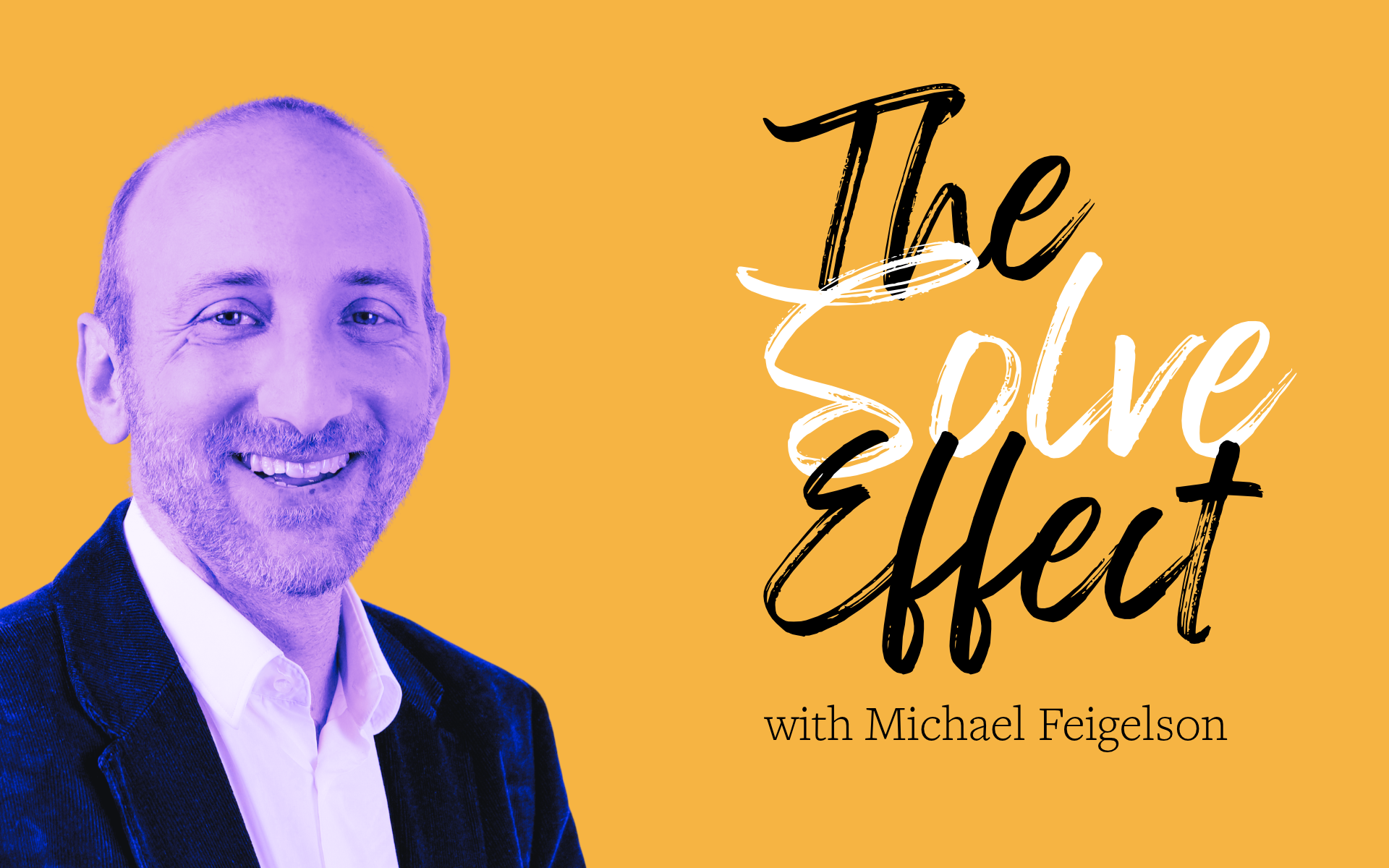
This is a transcript of Episode 26 of The Solve Effect, edited and condensed for clarity. Listen on Spotify, Apple Podcasts, or Amazon Music.
Show notes
Find the people first, then scale: Michael Feigelson, CEO of the Van Leer Foundation, explains how his team looks for government leaders who want to do something big for early childhood, then helps them move fast. The results include Criança Feliz in Brazil and home visitation and playground programs in Addis Ababa, plus Urban95, which has reached more than 500 cities.
AI and parenting: Hala Hanna and Michael discuss why parents need agency over how they use AI, why babies and toddlers should be protected from screens as much as possible, and why the big risk of AI (it’s available 24-7) is also its big opportunity.
The science of becoming a parent: Michael shares what he’s learned for his forthcoming book, including how pregnancy and infant care reshape the brain and how fathers’ brains and hormones change too. He also explains why owl monkey dads set an annoyingly high bar.
Transcript
Hala Hanna
Welcome to the Solve Effect. I'm your host, Hala Hanna.
Imagine pushing a stroller through a busy city after minimal sleep. You catch a reflection in a shop window, unsteady, rumpled, invisible to everyone rushing past. You feel like a ghost.
That's how today's guest described his first days as a father with his baby daughter. Now the twist is that he had already spent years at one of the world's leading early childhood foundations, so he knew the science. And yet parenthood still caught him by surprise.
Michael Feigelson has spent his early career working alongside children and families, facing some of the hardest circumstances from homelessness, displacement, violent conflict.
Now, as the CEO of the Van Leer Foundation, he is fostering inclusive societies where all children can flourish. The foundation can count on some incredible successes at scale in countries like Brazil, Ethiopia, India, the Netherlands, and many more.
Michael, welcome to the Solve Effect.
Michael Feigelson
Thank you, Hala. Nice to be here.
HH
What I haven't said is that you and I are longtime friends. I think we met more than 10 years ago at the World Economic Forum as part of the Council on Behavioral Change or Behavioral Science.
MF
And importantly, pre-parenthood. We met pre-parenthood, so we were in the before times, our other selves.
HH
Our other selves, and also when, you know, it wasn't really clear that behavioral change was a science.
MF
Or was accepted as a science. From before I lost my hair. I think. I can't remember. It's a blur.
HH
What were you like four weeks after Mila was born?
MF
I was on paternity leave. And Peter Bell had just died. He died a few days after Mila was born, actually. And a few days after that, I got a call that they wanted me to come be the interim executive director of the foundation. And I think four weeks in, I actually think I was traveling to his memorial for a few days. So it was the sensation of everything happening all at once in the world and also at home. Yeah, total overwhelm, I think.
HH
Where did it start for you? I find it so interesting that already in your very early career, you were working with children in those very hard circumstances. What was, you know, like the spark?
MF
I'm not sure, but one hypothesis that I like is…during my own adolescence. So I had the experience of being, as many of us do in adolescence, sort of inhibited or kind of insecure. But I always had this sort of jealousy or intrigue with these peers of mine who seemed like they were fully free. They were usually like singers or dancers or musicians, and they just—they looked like they felt totally uninhibited.
And I think I sort of was chasing that feeling of disinhibition for a long time. And at some stage I realized that hanging out with kids was the best way to be close to that because they're so disinhibited and they're so free and they're so creative. So I think that's what initially attracted me to working with kids; it unleashed a little bit of that feeling.
HH
So is that where you started working with kids, in adolescence?
MF
I started working with kids more in college. I used to teach spoken word poetry. And I spent some time studying abroad during college, studying education reform in South Africa after apartheid. And that's when I spent a lot of time kind of volunteering on the side, working with kids. But what sealed the deal was this thing called a Watson Fellowship that I did after college.
HH
Tell me more about it.
MF
Yeah. So it's an amazing grant that is offered to, I think, somewhere between 50 and 100 students a year in US universities. And you have to spend a year outside the country learning about something. And I, because of the experience I had in South Africa, proposed this project where I would take portraits and interview people that worked with homeless and working kids in Mexico and Romania and Ghana. So I spent a year learning about the life histories of people who did that kind of work.
HH
What did you take away from it?
MF
I think I learned that if you wanna find out what's going on, you have to hang out for a while. What might look like wasting time is not. You really have to spend enough time, and this isn't just with kids, with a group of people, until your presence is no longer novel, to get a real sense of what's happening. And this was particularly the case with these kids who were excellent at working the crowd, as it were.
The other thing is I learned that, I mean, these are kids living in very difficult circumstances, spending a lot of time in the street, sometimes living on the street. They were hilarious. Their sense of humor was extraordinary.
I spent a lot of time laughing after my presence was no longer novel. And it's such a different picture than the picture that's painted of them.
HH
In our jargon, we call it proximity, like, being proximate to the problem and being really so seeped into it that you start questioning it in a different way.
MF
The other thing that's now coming back to me is I was, I remember one day in Mexico City with one of the outreach street workers. His name is Enrique. I'm actually still in touch with him. And it had been a bad day. We had seen some pretty horrible stuff. We were sort of driving home in the truck, and I was feeling bad and had sort of, I guess, a sour face on. And he said, “What's wrong with you?” And I just said, “I don't know. I just feel so guilty, that I have the life I have and these kids have the life they have.” And I'll never forget, he said: “Your guilt adds no value to anybody but you.” And that was very helpful to sort of move past that early in my career, that kind of feeling.
HH
What did you replace it with?
MF
Love. Your favorite, your favorite word. I think I probably wouldn't use that word back then, but curiosity, just sort of leaning into relationships with people.
But I do this because I love it. I do it because it's joyful. And if I didn't feel that way about it, I wouldn't do it just because I felt like it was the right thing to do. I need to have both for it to be sustainable.
kids are very good at showing you the world. And I think that there is a lot of joy in their lives, even when they're going through difficult times. So I think the proximity to that is helpful.
HH
I'm wondering how your approach as a foundation, has evolved?
MF
Yeah. One piece of it is the focus on scale. So trying to do things that have a population-level impact. So a whole city, a whole state, or a whole country. That was something that we had done some of, but that I brought in as the primary focus of everything that we do.
HH
Can we stay a little bit with that? Because with our Solvers, that's where we see the most incredible and sustained impact is where there is that system-level change. Is there a rule book? Like, you know, what are some things that you look for when you're deciding that something has the promise to have a system-level impact?
MF
I think we actually look for people before we decide what the thing is that we're gonna scale. Because our primary pathway is government. And so we're looking for leaders in government who want to do something big in early childhood or to support parents. And once we found them, then we talked to them about what it is it that you would like to do. And we have a kind of menu of ideas that we've tried in different places. And depending on what they're interested in and what the context calls for and what the system can handle, then we'll land on something.
One example is about years ago in Brazil: a minister who we knew from his time as a congressperson he's just been put in this position, and he said, I would like to do a home visitation program. So when somebody visits the home of a woman when she's pregnant and afterwards and provides some coaching and support and connects them to different services, I'd like to do that for the 3.5 million kids under three living in poverty, getting a cash transfer in the country. And he said, I need to move quickly. I eventually will mobilize the budget to do this, but can you help me kind of move quickly so that I'm well positioned to do it? This program is called Criança Feliz, Happy Childhood. I think today reaches about a million of those kids every year. They hired something like 20,000 home visitors, and it's endured left-wing administrations and right-wing administrations and back to left-wing administrations.
HH
So find the person, move super fast within that window of opportunity. And then go as far as you can rather than look for the perfect.
MF
Definitely that. You do want to have more stakeholders bought in than just that person. That's why it survived multiple administrations. The other reason I think it survived is because it got so big so quickly that there are a lot of people who are invested in, it so it's much harder to cut.
Another example that took longer is the mayor of Addis Ababa. We had a team from Ethiopia go to Brazil, actually, and see this program. It took several years, but eventually they said, we want to do something similar here. And just in two or three years, she has hired, I think, 5,000 home visitors on the city payroll, also creating jobs for women. And they're visiting several hundred thousand kids a year. And she also wanted to build playgrounds because there weren't places to play near where people live. And so we helped her design some prototypes. In two, three years, she's, I think she's built, I don't know the latest numbers- 3 or 4,000 playgrounds. Just for reference, New York City, I think, has about 2,800.
HH
Wow.
MF
So yeah, find the person, get to know them. Figure out what could work in their context, present them with a viable kind of practical idea, and then put your head down for a little while.
HH
As you know we work with innovators, but also with a lot of foundations on the funding side. What did you wish you knew earlier?
MF
I do think that speed matters. Most of the ideas that we'll work on, have a pretty strong evidence base somewhere in the world. So we're not inventing something totally new. But I do think when you have a window, you kind of have to let perfection go a bit and get it up and running and kind of fix the kinks as you go.
I think the other piece is, you described our work as systems change. I'm not sure it is most of the time. Once in a while it is, I think we try to figure out how to make this system work for kids and families. So what can it handle? What can it do? Accepting a lot of the limitations of it.
HH
A definition of systems change that is, to your point, good enough is, are you changing the outcomes within a system or are you changing the way a system produces the outcomes? And I think even when you're building so many playgrounds, that really changes a kid's experience in their city.
MF
Not only that, I mean, the other thing that started happening was they were building so many playgrounds so fast that they needed people to build them, and small companies to design and make playgrounds started popping up.
HH
I've heard you talk about, like, seeing the world from 95 centimeters, which is what?
MF
It's a three-year-old. It's a healthy three-year-old on average.
HH
And it's like, and how much more polluted and overwhelming that perspective is, I think, is a really powerful reminder. But how do you decide when to do a global campaign? What tells you the world is ripe for a message?
MF
So I mean, we actually don't do very many global campaigns anymore. I lost a little bit of confidence in some of the global environments that we were working in, or global institutions, so we focus much more regionally or nationally or locally. But I think from an institutional point of view, if you can find something that resonates across a really disparate set of contexts, it can be quite powerful.
So the example that you gave of Urban 95 was one where we had this question in 2016 for mayors and real estate developers, architects, engineers, planners, and others who work on social services: If you could experience the city from 95 centimeters, what would you change? And that landed really well in everywhere almost. And so then we knew that we could run with it.
Today there's more than 500 cities doing this around the world. So that one really worked. I think it also had to do with the fact that it was a question.
HH
For such incredible wins, you're very kind of low key as a foundation. Is that on purpose?
MF
Yeah, I mean, we think that one of our advantages as an endowed foundation, so we don't have to raise funds, is that we don't need the visibility. And so our comparative advantage is to put the leaders that we work with more central to the story. Probably the best way to explain it is: when I took over, I wrote this story that looks like a children's story, but it was for the staff and for the board that articulates how we work and why we work this way.
And it's a story of a relationship, a partnership between a mouse and an elephant. And the mouse is us. And the elephant is sometimes government, sometimes it's business, but they tend to be institutions or people that have enough power and money to do this at scale. And that's kind of figuring out how to make that relationship work. What is it that the mouse can offer the elephant? I actually think one of the problems with philanthropy frequently is that we have one cartoon where the mouse is looking into a mirror and sees an elephant.
But we're all, you know, small. Even what the Gates Foundation does, it's commonly compared to the New York City public school system's budget for a year or something. So I think there's a lot of freedom in sort of owning the mouse as well.
HH
So what question is the mouse asking these days?
MF
We have a cartoon where the mouse is actually scouting, looking at different elephants in their natural habitats.
There's this kind of, just in the last five, six years, emergence of new species of maybe mini elephants whose weight is not measured in money, but in influence, in attention. And I think there's a question about, is there something we can do with folks who have the attention of lots and lots of parents in a way that we couldn't have done it five or six years ago. We add pages, there's one where the mouse and the elephants got a face mask on, COVID, and the zooming with elephants, and it keeps evolving. It's a cartoonist in Brazil. His name is Claudia, who has been a grantee of the foundation.
HH
I've played a mouse role in an elephant campaign that you're working on that I thought was super fun. Would you like to tell us about it?
MF
Sure. And we also wrote an article together about it.
HH
That is right.
MF
Everybody is talking about AI and technology, understandably. And so we were trying to think: how do we get the attention of people who are leaders in that area, in that field, to think about what they can do to support parents. And so we created, just a few, they look like ads. They're modeled around one of the tech companies' keynotes this fall, where they were talking, I think, about smart assistants. So you start watching it and you hear this voice, which is yours in one of the ads, and you think that they're talking about a smart assistant.
Your personal assistant gets things done just by asking.
But sometimes you need more.
So while the tech industry builds the next AI assistant, we're relaunching the original.
Mom.
She generates personalized stories on demand, provides interactive sleep support, and keeps operating even after battery power runs out.
And the idea was just to grab some attention and then hopefully to make connections with people to have a more substantive conversation about the good and bad opportunities related to AI and what folks can be doing to support parents
HH
Yeah. And that conversation is changing so much. Like it's hard to keep up.
I think there are a little bit... to oversimplify it, two camps. The first one would say, we've learned our lessons with social media. We have to be super, super careful. It's no AI for children under the age of whatever, five, six, until we've figured out what the impact is. And then the other would be more like, you know, we, well, since we have no idea, we got to be trying things and measuring and being thoughtful about it, but not being so categorical about it. Where would you land?
MF
So the first thing I would say is I think it varies as kids get older, even within that range. And the second I would say is I think we have to accept reality as it is, which is, in a lot of places, there is no way to sort of prohibit interaction with this technology. So I think that the thing that we actually need to be doing a lot more of is giving parents a sense that they have some agency over their choices about how to use this technology.
Something that helps people think about: how do I want to use this technology in the context of this village? So I've got my doctor, I have my nurse, I have my neighbor, I have my mom, I have my partner, I have, you know, AI, I have, so inside of that context, and to be helping, you know, parents make reasonable choices.
I guess in the two camps you described, I think when it comes to kind of babies and toddlers, we should try to protect them as much as possible from the screens. And they should be more supportive tools for the caregivers. And look, The big risk of AI and parenting is also the big opportunity, and it's that it's 24-7, right? That's why it's so appealing. And so if we really want to help parents make reasonable choices, we also need to give them more support that is not coming from a technology so they have options and they can place it in the place that feels right for them.
HH
Mila is 12 now, right?
MF
She is 12, yes.
HH
Congratulations, Dad.
MF
Thank you. We've made it pretty far.
HH
When you and her look back at this moment, like, what would you want to tell her your role has been in this kind of tech revolution?
MF
I mean, I guess I would want to say that we accepted, I kind of accepted the reality of tech in our lives and that it was going to be there. And we tried to do whatever we can to make sure that the way it was used was promoting and supporting a sense of human connection, especially between parents and kids and teachers and kids and healthcare workers and parents, et cetera, rather than eroding it.
How about you? What are you going to tell your kids?
HH
What I would like to tell the kids is that we found all the ways that tech was like, that tech was working better. And we tried to elevate and accelerate those.
MF
One of the things I've been thinking about is with AI being so dominant in the discourse, I think it's also forcing a conversation about what makes us human in a way that feels more urgent. And that there's some opportunity in that conversation. And in a way, and maybe perhaps because it's happening with the climate conversation as well, bringing us closer to other living things. I'm increasingly connecting with the micro communities, and non-human animals and plants and trees. I've gotten much more into this over the last couple of years.
HH
We have to talk about it. Why do you know so much about insects and animals?
MF
I am working on this book about the transition to parenthood. And in the process of doing interviews, I was talking to a woman named Sarah Blaffer Hrdy, who is an evolutionary anthropologist. She wrote a book called Father Time recently. Anyway, I was interviewing her, and she said, “You should talk to this guy, Eduardo Fernandez Duque. He studies owl monkeys, owl monkeys and Titi monkeys.” And I was thinking, okay, I mean, I don't usually do that.
So I talked to him about owl and Titi monkeys, who are probably the most committed mammalian fathers. We can talk about this if you want, but it's dangerous. I can't stop when I get started. And then Eduardo invited me to help organize a conference a few years ago about fathering in the natural world, father nature in a way.
And so I got to the conference, and there were like three or four of us who worked with human fathers, but everybody else was working with poison dart frogs or stickleback fish or owl monkeys. And that was my first exposure. And I just found it so fascinating that I've been kind of nerding out on it for a while now and making friends who hang out with these other kinds of animals.
HH
Okay. And if you had to choose which one to be?
MF
It's between the poison dart frogs and the owl monkeys. The owl monkeys are so cute, first of all. They're called owl monkeys because their eyes look like owls, and they're awesome dads. So after about the first week, they will then take care of the baby 95% of the time, just handing back to mom to breastfeed. And they'll do like pig, it's like a three month long piggyback ride in the trees, like teaching them all this stuff. They're very playful. They have a full head of hair.
I don't know, they're all awesome. I think there's a lot to learn from nature. And also that there is a father nature, you know, it's not just a mother nature.
HH
Okay. In my future life, I also want to be an owl monkey mom, so this way that owl monkey dad takes it all.
Did you want to talk more about your book, by the way?
MF
I'm still writing it. Maybe the podcast is better to talk about. It's about the idea that the transition to parenthood is a third window of accelerated human development. So, early childhood, you have high level of neuroplasticity, a critical window, you learn super fast. Adolescence, and it's the idea that this is also one. So it's the idea I'm kind of most obsessed with at the moment.
HH
Yeah, science has spent all of these decades studying what happens to the baby and, I love the tagline, when a child is born, a parent is born too. People should definitely go and listen to this, and I will put a link, but are there two or three main nuggets that maybe have organized some of the ways you think about the world and parenthood?
MF
I went on this journey because I, like, as you said, ran this organization, had a kid. was rough for like 5 years. She didn't sleep very much, and then came out of it. And I was like, what just happened to me? And so I started visiting the labs that have been studying this, which it's pretty recent, this kind of research. Anyway, one of them is about the maternal brain. And it's in an episode with Susana Carmona, who just published a book called A Mother's Brain. You would think that someone had studied this, but they hadn't.
HH
All I had heard was that the brain shrinks and you lose gray matter and all of the bad stuff.
MF
So interesting, so that's true, but it's not bad.
Okay, so in critical periods, the brain goes through a process of pruning. So think of it more like spring cleaning or fine-tuning, not loss. That's the sort of theory about what's going on. What she found among other things is that the impact of pregnancy and infant care, so I'm talking about women who have been pregnant and given birth in this case, it makes the brain reach a level of neuroplasticity. So neuroplasticity is the ability to change through experience. That is, in terms of sort of speed of change, greater than adolescence. Right? So she tells me I can't say scientifically that perinatal moms are the second fastest learners on earth, but personally, she's also a mom; she would agree.
So there's something just about the way that the female body is adapting to this that is quite exceptional. And there's a ton of potential there, but it's also metabolically exhausting. So just like, with our kids, we need investment, we need support in order to realize that potential. So that would be one. Now I walk around and I see my mom or I see my wife and I'm like, oh my God, you're like, a whole universe, like what is going on? I'm a little bit jealous, actually.
The other thing I would say, which is really important, is that while pregnancy is its own thing, we're all wired for this. So you don't have to be pregnant and give birth. Men are also wired for this. We may not have as plastic a brain as you get from pregnancy. But you do see changes in the brain and body of people through infant care. And the amount of change has to do with how much time on task. So Darby Saxbe just published a wonderful book called Dad Brain, talks about how the dad's brain changes. And Lee Gettler, who's in one of the episodes, talks about how men's hormones change, in particular how testosterone drops and oxytocin and prolactin rise when we're involved in infant care. And that's evidence of Father Nature. That's evidence that our bodies are wired to do this. But, you know, we have to do it through the work of taking care of an infant.
HH
It's like, yeah, we're built for this. Like, that is the whole point in a way.
MF
This experience, the deeper you go, it's a way of rediscovering the beautiful things in the world. So Alison Gopnik, she talks about grandmothers, but she has this way of talking about where she says there are kind of two forms of consciousness.
One is spotlight consciousness. So it's what adults have, and you put a spotlight on something and you focus on it, and you can block other things out. And you do that because you need to get stuff done, right? And then you have lantern consciousness. where the light's kind of just going where it goes, and stuff is just coming in. And that's what kids have, right? It's not necessarily task-oriented; they're just absorbing, they can't help it. It's also not dissimilar to what people in a deep state of meditation or on a psilocybin trip might experience. And this ability to just kind of absorb what's around us, whether it's a blade of grass or, a glance or a smell, which babies and toddlers do naturally. I think that going through this process gives us opportunity to go back there and have that experience of lantern consciousness. So that would be my third kind of hopeful point: it actually allows us to relate to the world and enjoy the world.
The one last thing I wanted to say, and it's related to the podcast, but it's also related to the science of the parental brain and body and to the science of early childhood.
I thought for a long time that the point of this science was to learn something and to change people's minds with it. And I've come to a different conclusion. I think the main point of the science, and I've come to this conclusion by talking to moms and dads about it, about the parental brain and body, is you basically are telling them something that they already feel. You're liberating them to truly believe what they feel. And that unleashes a lot of power. They'll then go off and do lots of different things, whether it's demand the support they deserve or interpret what's going on when they forget the keys as my brain is actually behaving incredibly, and that's not a priority right now.
So I think there's something important: as people get to know this science, it's almost more valuable as something that unleashes our ability to feel than it is to get us to think differently. And that took a long time to land on.
HH
Michael, thank you so much. Thank you for staying to talk to us.
MF
No, it's all love.
HH
We spend so much time asking how to raise children. But who's helping raise the parents?
Maybe science's greatest gift isn't another instruction manual. It's the confidence to trust the people we're becoming, and a reminder that we're not supposed to do it alone.
Although if you're looking for a parenting role model, apparently owl monkey dads are setting an annoyingly high bar.
I'm Hala Hanna, and this was The Solve Effect.
If you haven't yet, please subscribe to The Solve Effect wherever you get your podcasts.
This episode was produced by Bridget Weiler and Elisabeth Graham.
Audio engineering by Kurt Schneider at MIT Audiovisual Services.
See what else is happening this week in Global Development from Devex: https://www.devex.com/focus/this_week_in_global_development
Find the full version of this conversation on YouTube:
Tags:
- Podcast
Related articles
-
Stacy Brown-Philpot on TaskRabbit, Trust, and Doing Hard Things
-
Bonus Episode: LIVE from Solve Challenge Finals 2026
Go behind the scenes at Solve Challenge Finals in this bonus episode of “The Solve Effect.”
-
10 Years, 10 Solvers: From 14 Days to Under 60 Minutes—Revolutionizing Radiology Reporting with Rology
Ask Amr Abodraiaa what Rology looks like from the patient's side, and the answer is: nothing at all. Invisibility is the design goal. What the patient gets is the result.