This is a transcript of Episode Eleven of The Solve Effect, edited and condensed for clarity. Listen on Spotify, Apple, or Amazon Music.
Hala Hanna
Welcome to The Solve Effect, where we talk to people taking on the world's toughest challenges with ingenuity, courage, and, today especially, a willingness to make very powerful people very uncomfortable.
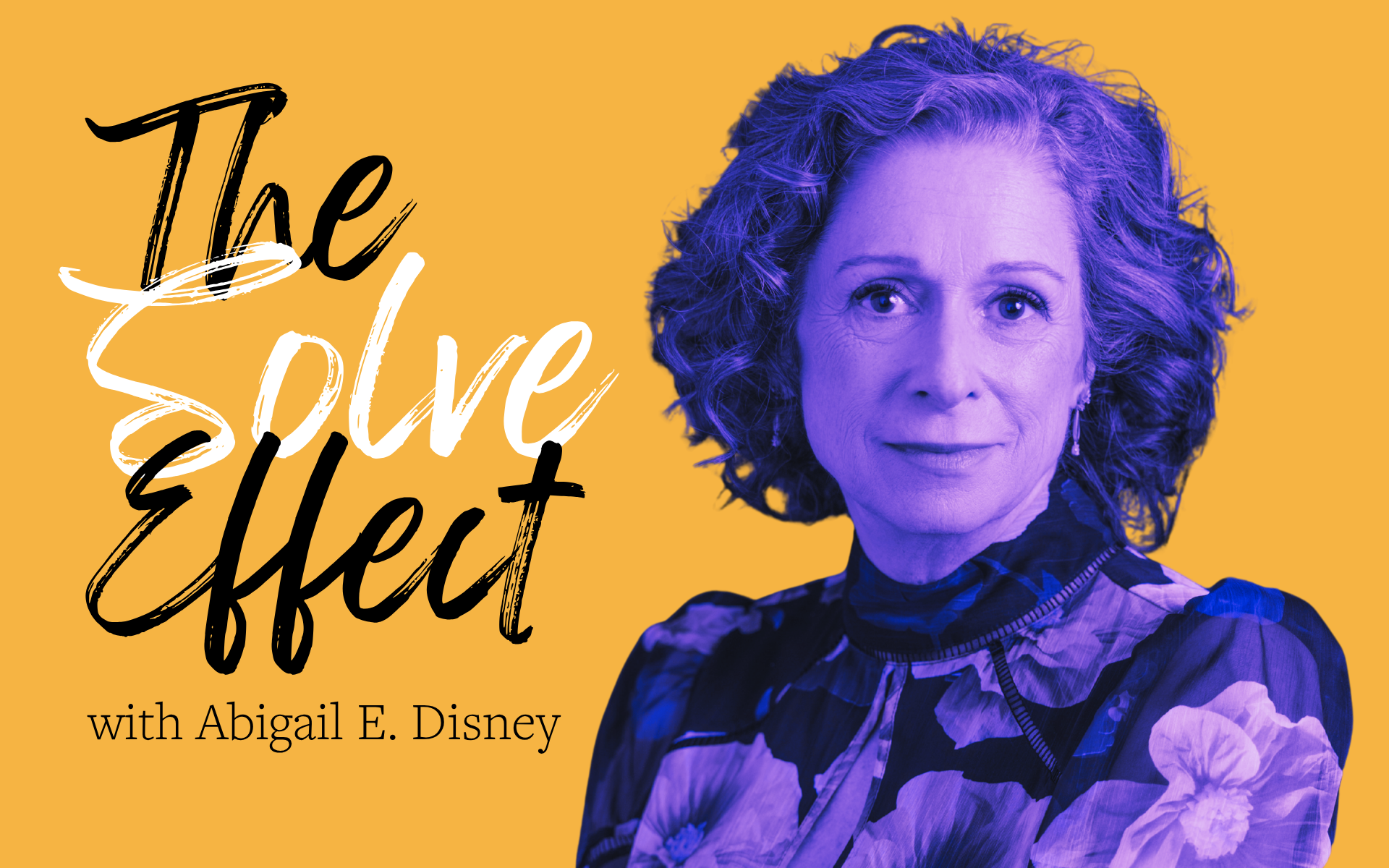
I'm your host, Hala Hanna, and today's guest is Abigail Disney, filmmaker, philanthropist, activist, and yes, a Disney: granddaughter of Roy Disney, Walt's brother, and co-founder of one of the most iconic family legacies in America.
Abigail is one of those rare people born of immense privilege who has actually spent her adult life interrogating that in public. She's been giving away her fortune since her 20s. She's made movies about peace, corporate greed, inequality. Her production company has made and backed hundreds of movies and documentaries, including an Emmy winner. She's testified before Congress, gotten arrested for protesting private jets, and is currently writing a book about wealth, power, and privilege. Always with moral clarity, always with a little bit of mischief.
Abigail, welcome to the Solve Effect.
Abigail Disney
Thank you so much. I like that introduction.
HH
There are some very clear red lines through everything you do. And I'm going to start with 2018. You went to Disneyland that year, the place your beloved grandfather Roy built with Walt Disney, and you met workers who were sleeping in their cars, who couldn't afford groceries. You've talked about that moment in public, and you mentioned that it took you a little bit of time, a little bit of pull to really dive into it. Why? What was that shift?
AD
It was very difficult to go all the way in because that was my father's zone. And I, never really was in the company or of it, always kind of looking on as a family member from the outside. So it was a little intimidating. I also knew, you know, I would be going up against people who were quite powerful and famously vindictive. And also I knew it would be public exposure. I had had some public exposure in the past, but nothing I'd really consciously sought out. But I knew that a piece of being able to make a change there would involve me having to step into the spotlight a little bit to instrumentalize my last name and all the power that it has.
HH
And what ended up convincing you?
AD
The people, the people themselves who, as a child, I can remember them, they are very special people because they choose this life at Disney. And they choose a little less pay than they otherwise could have in some other places because they believe they're doing an important thing.
And that sounds dumb, maybe, to people who don't understand what that place means to families. But if you really know the glue that holds families together, the way it gets all strengthened there, those people are doing a kind of almost sacred thing in the midwifing of this exceptional experience. So the people who work there take very seriously the benefit to other human beings of their work.
And I know that my grandfather really revered the people there. From the beginning, even just simply as a business principle, he understood that they needed to love their jobs, understand the value of their jobs, and their value as human beings.
What happened at Disney was a long process by which it was transformed into just another Wall Street company where employees are a cost, not an asset. And so the costs must be minimized regardless of the consequences to the human beings.
HH
And that moment of you deciding to, as you said, instrumentalize your last name, that moment became a movie that was released in 2022: The American Dream and Other Fairy Tales, and you succeeded at getting many of those people's salaries up.
AD
It was $11.25 an hour.
HH
To $24.
AD
Yeah, Anaheim is one of the most expensive counties in the country.
HH
What would you say made it a successful fight?
AD
We really just relied heavily on the peoples’ own story. You don't have to editorialize that. You don't have to trot out the violins and make people all sad. Just if you show people's actual lived experiences of trying to put a family together on $11.25 an hour, even for both parents, plus the 50 cents an hour extra you get if you work the midnight shift.
I know the way I fell apart when I first had my kids and had to do the all night thing. I kept trying to imagine any CEO, any board member, any C-suite executive I've ever met getting up at 10 o'clock at night, going to work, and then putting a vacuum cleaner on their back and cleaning that park to the standard that it gets cleaned to every single night. So, if you're not willing to do a job yourself, then at least respect the people you've asked to do it on your behalf.
HH
Which is the ethos that your grandfather embodied: picking up the trash, as he was walking through with you. When you talk about these people and the situation, you say the dignity gap, that's a lot more primal than talking about economic inequality. Where does dignity fit in an economy that has decided fairly explicitly that shareholder return is what matters above all else? How do we force a reckoning about what the purpose of a corporation is?
AD
I'm not sure society decided shareholder returns were all that mattered, right? I think that a certain class of people made that decision: a relatively small group of economists and business professionals and business educators. And then, the conscious fights were had. And eventually the shareholder primacy view prevailed.
One of the reasons that this is such a hard thing to shift in the mentality of CEOs and boards and Wall Street professionals is that they were told a story that the best, most decent thing they could do is, privilege shareholder primacy, because that would give us the best possible economy and that would benefit the most people. That kind of pragmatic utilitarian thinking that you see a lot in Silicon Valley as well. And the problem is we have 40 years where that's demonstrably not what's happening.
HH
Just as they talk about the paperclip robots, you know, this AI that is tasked with creating paperclips without any guardrails, and that then diverts ever-increasing resources to the task until there's nothing else left, that is what shareholder capitalism without guardrails. . . I don't think Milton Friedman meant to say: maximize quarterly stock prices at the expense of all else. Or certainly Adam Smith didn't say that, right?
The net worth of America's top 12 billionaires has just surpassed $2.7 trillion. You've said, and I'm going to quote you directly: anyone who can't live on $999 million is a psychopath. There is such a thing as too much money. What happens to people, society when wealth is so concentrated?
AD
So if the principle of shareholder primacy means that I have to pay everybody as little as I humanly can, but they show up for work, and they haven't had enough food to eat, they will eventually not be able to do their job.
Henry Ford said, what I'd really like is a pair of hands, but sadly, I have to hire a person. It's not a sad thing that you have to hire a person. It means that you're engaged with a person and you are working together towards something and therefore the rewards of your work together is not strictly yours as an owner of capital.
I personally can't imagine, cannot imagine ever, employing somebody for less than they can use to feed their families and still taking home hundreds of millions of dollars in compensation. The two people in that equation work for the same company. And so if it's profitable enough to overly compensate me, it's profitable enough to fairly compensate him. And God forbid, maybe even compensate him more than is fair. Wouldn't that be remarkable?
HH
So it's two facets to this. The first one is this accumulation of capital. And then the other is that there isn't any mechanism that is being used to redistribute it once it is accumulated. The US tax code is notoriously complex and it is one of the major tools of wealth redistribution that is actually contributing to wealth disparity, with wealth continuously trickling up. This January, you were one of the people leading 400 millionaires who signed a letter calling for a tax on wealth and inheritance. And this is a movement for tax justice. I think you call it the limitarianism movement.
AD
Yeah, I love the word limitarianism, and that's Ingrid Robeyns, who wrote a book about limitarianism, who is the first person who had the temerity to talk about such a thing as too much money publicly. We trust corporations, to be rational because at the center of everything is the profit motive. They're not going to make any stupid choices. But of course, we know that they do.
HH
Oh, you sound so woke.
AD
That's exactly right. I am wide awake.
HH
Can I get the backstory version, like the social dynamics? What does it feel like to be the person at the fancy dinner table saying, tax us more? Bring us with you into the room, where people break rank, break their class loyalty.
AD
I was just at dinner with a few techie bros just a few weeks ago, and I asked them, if you had to pay more in taxes, what would your response be? And they nearly fell out of their chairs laughing. And I said, no, I'm completely serious.
Then they needed to change modes and argue with me. “The government doesn't spend it well, it'll all be wasted I can do better, through philanthropy, let me make my money, and I can do better.”
That sounds very nice, except that it's optional. And your obligation to your fellow human beings is not optional. It's not optional. And as long as we give a tax deduction to people to give to charity, we are subsidizing their own personal private choices for which they are not accountable to anyone about where money, taxpayer money, should be spent.
HH
And we've seen it also now that the government spending has decreased on these social issues, on international development. Private philanthropy was never designed to fill that gap that is meant to be filled by the government. And as you said, it's one of those few places where private choice becomes public consequence.
The other thing that what you were saying made me think about those tech bros is what is money for if it doesn't buy you freedom, and sorry, cojones. But in fact, it seems that wealth, to some extent, erodes character. I think Kara Swisher says, “They're so poor, all they have is money.”
AD
There are plenty of really good, wonderful, decent people who have money. This is not a blanket assertion at all, but I have watched money erode people's characters. The brain changes, and there's science to prove that. We know that if you give people an extra few $100 at the beginning of the Monopoly game, by the time you're halfway through the Monopoly game, they think they've earned that, and they will act as though they're that much smarter than everyone else.
I've watched it: My father had a drinking problem. And it's notoriously, famously, an incredibly difficult thing to beat. And one of the best, most effective ways to beat it is through a program like AA. And the 12 steps involve things like a fearless and searching moral inventory. That's a remarkable bit of wording there.
I think we could all go through a fearless and searching moral inventory. But I do think that's quite a difficult thing to go through in a thorough and meaningful and painful way if you're surrounded by people who won't tell you the truth about yourself. What you have to do to be sober is to admit that you're not special, that you're not better than other people, that special rules don't apply to you. And I do think that for my father, that was a bit of a barrier, not because he wasn't a good man, but because it was hard for him to admit that he didn't get special rules because he had never not gotten the special rules at any time in his life.
So famously, Betty Ford, in Annapolis, the naval hospital, where she showed up as First Lady, said, I need help stopping drinking. And they said, "Great, here's a toilet brush.” And she said, “I'm the First Lady.” And they said, “Yeah, we know, go scrub your toilet.” And it was kind of lesson one. And it really became part of the rehab program at Betty Ford to do the work of cleaning up your own messes in life.
HH
Right. Pick up the trash in the park.
AD
Exactly. My grandfather would look for it, and he would pick it up, and he would say, "Nobody's too good to pick up their own garbage.” What he meant was, there is no hierarchy of people in terms of what their value is. We are all equally important and valuable.
HH
Was there a penny drop moment for you when the story you had inherited about wealth and success and the legacies stop making sense for you?
AD
I do credit my mother for dragging me kicking and screaming every Sunday to church and making me stop fidgeting long enough to hear what was being said. And I was one of those very earnest little girls who really listened.
They would tell the story of Saint Francis. He was born to a very, very wealthy man. He was wasting his life away. He didn't really understand the point of anything. And then one day, he realized what he needed to do. And he gave all of it away. And then he began this life of devoting himself to the common good. As a child, when you get a steady diet of that, it didn't melt away. I kept thinking, “That makes sense.”
HH
You've made movies, you've testified in front of Congress, you've lobbied, you've written op-eds, you've been arrested for protesting. I wonder if you can speak to the role of civil disobedience and being subversive.
AD
I have always been a bit of a troublemaker. That's also very forming of how you are in the world. I recently got to visit the Dalai Lama, which was maybe one of the best things ever in my life. He is laughing all the time. Not just laughing, but kind of giggling, I think it's because he's a sacred person or a person in touch with something ineffable and up above all of us, and that laughter is a way of communicating with that. I don't think there's any way to be a good person in the world and not also be a little funny.
HH
Can't take it too seriously.
AD
Yeah, exactly. So where good things are happening, there's always laughter. I was born in 1960. So in the 70s, I was warned about feminists. They were the worst, and they have no sense of humor. And then I became an adult and came to New York and met Gloria Steinem. She's one of the funniest people. And I thought, “Well, wait a minute, now.”
HH
Satire and humor can be very effective, much more effective than reverence when confronting power.
You've said that the basis of a progressive society lies in places where people practice belonging.
You mentioned something like there's a mycelium that unites us all that we need to invest in. . . Are we Smurfs?
AD
Yes, we are. How did you know?
HH
I knew it. So how do we rebuild, when people feel so politically homeless and socially alone?
AD
It's a bad system when everybody comes away feeling like a loser. And I think that's where we are right now. But yes, mycelium is the invisible system of fungus that exists under the ground that actually lets trees and other flora communicate with each other.
After spending a good couple decades, going very deep in community-based organizations, what I kept finding over and over again was the same people in the Haitian community, in the Palestinian community, in women's organizations, in children's organizations. Over and over again, the people who are stepping up to help were the same people with a similar personality. They all laugh. They share food.
I realized that there was a kind of a cultural mycelium that was just under the surface and difficult to register because It's everywhere and invisible at the same time.
Every single country I've been to, and that's over 40, I have found the same people, and they are working on the same ethos. You can't find that ethos on your own in a room by yourself, no matter how hard you think, no matter how much you know, no matter how much you read. There is some kind of importance about gathering. And we have, since the beginning of time, as human beings, been gatherers. We are wired for gathering. We're starving without each other.
HH
You've spent so much of your life telling the story of those individuals. The first time I met you was actually in Davos in 2011 where you were presenting your movie, Pray the Devil Back to Hell, that tells the story of Leymah Gbowee, who led a nonviolent struggle to end the civil war in Liberia and went on to win the Nobel Peace Prize. And that movie became a tool for peace, for change in so many countries. Now, in the 15 years since, media has changed quite a bit. So I'm just wondering how you're thinking about that tool in your arsenal.
AD
What I realized is we're not about hearts and minds. We're just about hearts, and minds follow hearts. I mean, that's so very clear if you look at the way people align in this polarized political environment.
I have this image in my head from very early on where I want to reach across the wide conference room table and take some guy by his lapels and pull him to my face and say, “How do you not see this is so important?” And I've been basically doing the metaphorical version of that so much of my life.
And then I made that film, and I sat in audience after audience for 74 minutes and watched them change. And I did not need their lapels, and I did not need to scream in their faces. So, yeah, I'm never going to stop telling stories. The difficulty right now is how do you get the stories heard and seen. I don't know the answer to that question, but I do suspect that the best ways to audiences aren't going to be through the mainstream avenues. It's going to take a little more work. It's going to involve a little more networking and grassroots work. I think it will have to involve gathering. People want connection. They want that magic.
HH
Attention is short, and moving people to action is. . . that's the superpower.
AD
We have a crisis on our hands. We are going to have to rebel against the people battling for our attention.
In the 1930s, Simone Weil, a brilliant, brilliant philosopher, said that attention is an incredibly valuable thing, and it is like a form of prayer. And when you really give a person your full attention, you're praying with them a little bit. We need to go back and think about attention and the meaning of it and the value of it, and maybe take it back for ourselves.
HH
Right, claim it back. You call for moral imagination, and you've truly modeled courage. And when I think of courage, it's not the absence of fear, but the action despite fear. And I'm wondering, what are you still afraid of?
AD0
Well, I don't want to go to jail, but I may. You know, I might be willing to do that if I have to.
Lots of things have been said by this administration in the first year, and they still have three years. So we'll see who they come for. Right now, they've mainly been rattling the cages of people with less power. But they're not going to shift anything the way they want to shift it unless they really start interrupting the doings of people who do have power and money and access and safety. So who knows what's coming? But I'm ready for it.
And what I really fear is that I'm noticing that the world of things that we all care about together is shrinking. It's almost like that phone is like a black hole kind of energy, shrinking and getting sucked into that thing. Boy, it's ugly what happens to me when I spend a lot of time on Instagram. So I'm scared of losing my connection to especially young people and how they occupy themselves and what they think is important.
HH
If attention is prayer, let's spend less time praying to the dark screens in front of us and more time praying to each other.
When we saw each other last fall, you told me you were struggling with hope. And what's the honest answer for today?
AD
It depends which way I'm looking. When I look up at the power places, I feel so little hope because I find the people in those places are retreating from common sense. They're retreating from common feeling. They know less, they care less.
But then when I look horizontally, like Minneapolis, holy cow, that was breathtaking. And that was the kind of principled stand, rooted in non-violence and had the discipline that Martin Luther King was able to gather when he organized non-violent spaces. There was something really moving and transformative about Minneapolis. And there are little “Minneapoli” happening all across the country. That was a genuinely common movement, and that is what will change things. They're putting their foot down. They're finding their courage.
HH
And courage is contagious, right? We all look to each other: when Dario Amodei says, “No, thank you,” maybe others will follow, and when Abigail Disney says, “Screw you,” it inspires a lot of people.
There's no way to put a bow on something so expansive. I think you've taken us into the divine and all the way down to the mycelium. And thank you. Thank you for sharing pieces of you, the way you view the world and the way you butt up against the world to change it too.
AD
Thank you, Hala. It's been such a pleasure.
HH
Every conversation with Abigail Disney is an invitation to become a little more courageous, to address injustices plainly, and to not take ourselves all that seriously while doing the hard work of resisting. There is strength in being joyful.
Abigail doesn’t hide her privilege nor her compassion. She uses them both to serve others, and reminds us that our responsibility to each other is NOT optional.
If this conversation moved you, share it with someone who needs it—that’s an algorithm we believe in.
I’m Hala Hanna. This is The Solve Effect.
Tags:
- Podcast
Related articles
-
Stacy Brown-Philpot on TaskRabbit, Trust, and Doing Hard Things
-
Bonus Episode: LIVE from Solve Challenge Finals 2026
Go behind the scenes at Solve Challenge Finals in this bonus episode of “The Solve Effect.”
-
10 Years, 10 Solvers: From 14 Days to Under 60 Minutes—Revolutionizing Radiology Reporting with Rology
Ask Amr Abodraiaa what Rology looks like from the patient's side, and the answer is: nothing at all. Invisibility is the design goal. What the patient gets is the result.