This is a transcript of Episode Fifteen of The Solve Effect, edited and condensed for clarity. Listen on Spotify, Apple Podcasts, and Amazon Music.
HH
I had a joke that I didn't make. It's Audrey's way or the Huawei.
AT
That's very funny.
[music]
Hala Hanna
Welcome to the Solve Effect. I'm your host, Hala Hanna.
What if you were incapable of getting angry because your heart literally can't handle it? Would that forced stillness shape the way you move through the world?
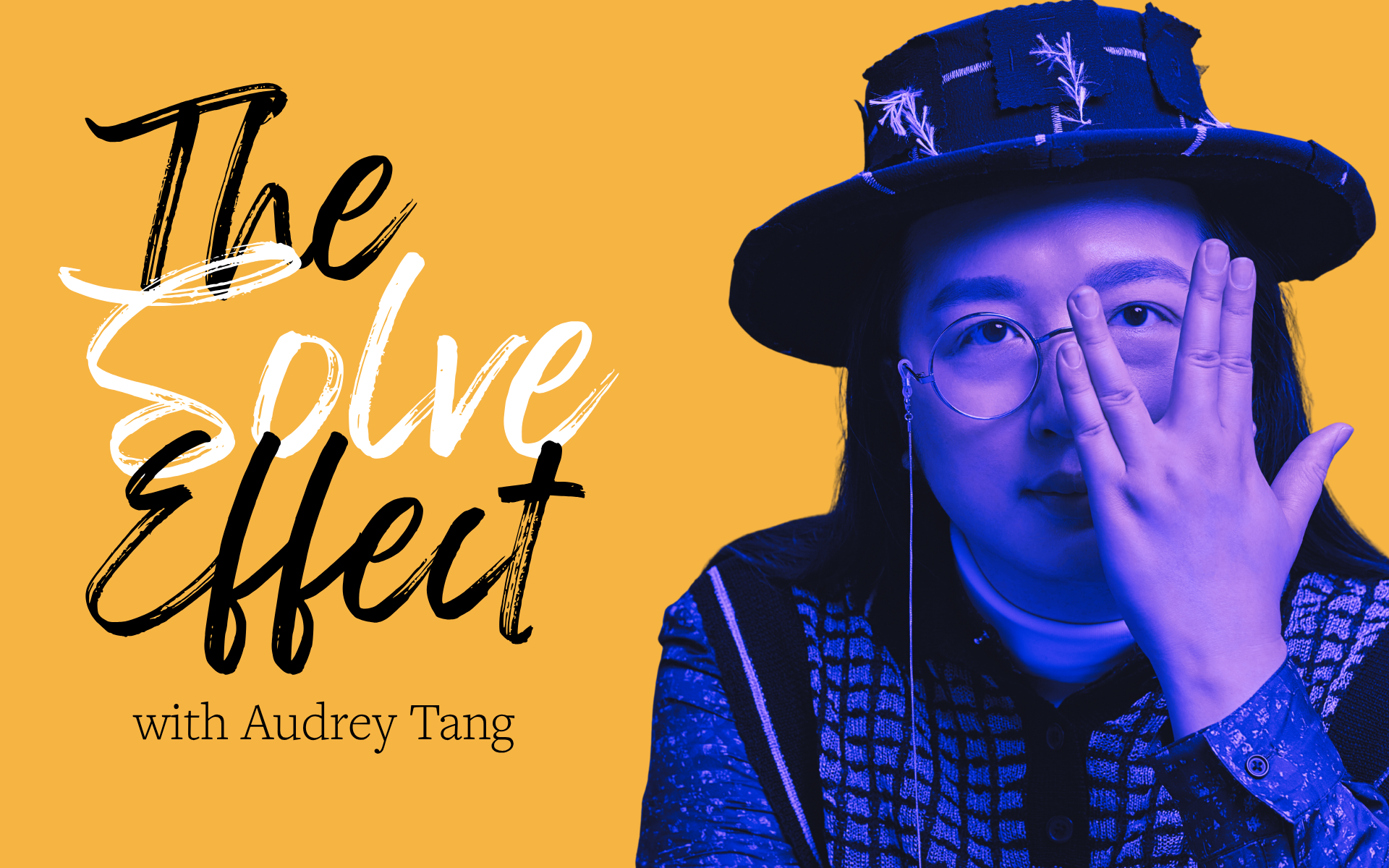
For today's guest, that's her origin story. Audrey Tang grew up with a heart condition so serious that any strong emotion could land her in the hospital. So she learned to stay radically calm. The heart condition was corrected at 12. The equanimity stayed.
In 2014, Taiwan's Sunflower Movement pulled her back home. 300,000 students occupied Parliament. She left Silicon Valley and live-streamed what she clarifies was not a protest, but a demonstration of an alternative way to govern. Two years later, Taiwan's government offered her to become the first digital minister and the youngest. Tang served for eight years - the world's first openly non-binary cabinet minister. She made broadband a human right. The COVID response she built is one of the most praised and studied. She pushed government trust from single digits to about 70%. She even made Taiwan start school an hour later. And she did it all in public, posting every meeting, every transcript, every decision.
She is now Taiwan's Cyber Ambassador, and she is, by her own account, a civic hacker, a conservative anarchist, a poetician, a Taoist meditator, and my personal favorite, a hopemonger.
Audrey, welcome to the Solve Effect.
Audrey Tang
Hello, and happy to meet you here. I travel all the way from the year 1981, where the doctor, when I was five years old, told me that there's just a 50-50 chance of me surviving until surgery. So every night was like a coin toss, and I'm happy that it landed the right way, so we get to meet.
HH
What does it do to a child to spend 12 years learning in such a visceral way that life is a 50-50 toss?
AT
Yeah, it's an existential opportunity, as it were. I got into a habit that I call "I publish before I perish." So every night before going to bed, I would document everything I learned that day, first on cassette tapes. Maybe some of the listeners don't remember, but these are like very early forms of storage. And then floppy disk, and then finally the internet. And I learned something very important, because I didn't have time to be perfect to publish. On the internet, actually, if you publish something perfect, people just “like,” and they swipe away. But if you publish something vulnerable, something half-baked, and everybody was like, “Oh, that was wrong.” And then I made my friends this way. So there's a crack in everything, as Leonard Cohen said, and that's how the light gets in.
HH
[simultaneously] The light gets in.
So imperfection is an invitation. Do you still practice that today?
AT
Yeah, definitely. I think whatever I publish, I think of myself as a “good enough” ancestor. If I'm too perfect, I take away the chance of the next generations to adapt to whatever they care about. But if I'm just good enough, then I leave them with a wider canvas, with some materials. And then they can reassemble it however they want. So not foreclosing future possibilities, good enough, satisficing. I think that is, to me, very important still.
HH
Permission to be imperfect. Love it.
So knowing your own extinction is near, you say it gave you the urge to share, rather than accumulate. I wonder how we make that work for others. Like, I'm thinking of the tech world today, the tech industry. How do we wrestle the accumulation away from the accumulators?
AT
Well, I think there are many places where the more you share, the more you have. For example, language. If you monopolize a language, well, it dies. It depends on people sharing it. And so, to me, there are many open source commons, the internet itself, and so on, that has what I call, and many economists call, this anti-rival good mechanism.
So I think our challenge is actually to think beyond the scarcity mindset. And in every competition, for example, like in AI, instead of a giant model that costs huge amount of electricity that folds our proteins, that folds our laundry, and folds many other things into this giant black box—instead, we need to know what we're doing and train specific models for translation, summarization, the connective tissues of civilization. And then it becomes positive sum. It's like the soil we till, instead of the oil we drill.
HH
Well, it's also Adam Smith's specialization, right? Let's stick to what each thing does best rather than the vision that we're being sold right now, which is data centers on the entire Earth, also in space.
AT
Yeah, taking off.
HH
Taking off.
So you were reading classical literature by four, you were writing poems by four, coding at eight, dropped out of junior high at 14, at which point you were already collaborating with Harvard and Stanford researchers. You built your first startup at 15. Are you trying to make us all feel bad about ourselves?
AT
Well, I think it shows that it is possible for very young people to steer the direction of civilization. This is what I always called a Pygmalion effect. When I was 33, I was tapped to join the cabinet, not as minister, but as a reverse mentor to a minister, so that we young people can tell the ministers what they miss because they have this cached idea of how things work. We can clear their cache by being young.
And when I became minister at 35, I then become old. So I need my own junior reverse mentors. Some of them are not even 18. So there's this lady, Wang Hsuan Ju, who started this e-petition that calls for banning the plastic straws of our national drink, the boba, and got it. And many other interesting petitions like going to school one hour later because studies show one more hour of sleep gets you a better grade than one more hour of study. Imagine that. And so all these young people are challenging the cached stereotype we have in our mind. And so I think I model that, right? There's not anything to do with the fact that I was just 14. I can still do a startup. On the record, it's 15 because labor law.
HH
We won't tell. How do you clear your cache today?
AT
So I sleep, I'm a very competitive sleeper, actually, for eight hours every day. If I wake up in the middle of the night and it's just, oh, six hours. And I imagine that, oh, I can still get two more hours, but what about this great idea? And I just tell that idea to my local bounded agent, kami. I co-cultivate with Tenzin Yangtso. And then the kami goes ahead and do it while I sleep, because that's the Ricardian comparative advantage. It's a better coder, I'm a better sleeper,
HH
And that is locally stored on your...
AT
It's literally on this laptop.
HH
Are you going to open-source that?
AT
It's already open sourced. And people are already finding that it runs on a MacBook Pro and old Mac Studio.. Every computation is auditable; you can repeat it, you can replay it, it's entirely here.
It's frontier class.
HH
You were saying that you found community online, you know, very young, where you could be whoever you wanted to be…
AT
By being wrong on the internet.
HH
Yeah. Publicly wrong and being 15 instead of 14. And I'm just curious what your parents were like. I know your mom created the school that you...
AT
Yeah, she did the experimental education school for my younger brother, and she also co-founded, still today, Taiwan's largest consumer co-op. And my dad was head of Taiwan's first community college as well, and teaches philosophy. So both of them are trained as journalists. So I have nothing but filial piety to the quest of fact-checking, and balancing, and bridging, and truth-finding.
And I think that taught me that it is not about a competitive advantage to accumulate like social status or money or whatever, because all of this makes no sense if the social fabric is gone. If we don't have common knowledge that whatever status you have is in a bubble. And it's profoundly unstable. And Taiwan, because when I was born, it was still under martial law. So it was just extremely centralized, no freedom to have new parties, new press, and so on. And we saw how democratization really added creativity to everyone who associatively formed, like spiritual, civic, and other muscles, what I call civic muscle.
HH
So now I understand a bit more between your parents being, the journalist, the truth-seeking, the history of Taiwan when you were growing up. Because you, when the Sunflower Movement happened in 2014, and these 300,000 students occupied parliament for 24 days, you wrote to a colleague in California, “democracy needs me.”
AT
Yeah, I need to leave now and set up Ethernet connection. I personally hold this 350-meter cable into the occupied parliament so people can see what's going on from the street.
Again, it's about creating common knowledge to make sure that the fog of war, the very high PPM (polarization per minute) on social media can be cleared away, the ignorance, because people really care about our shared future.
If anything, people want to affect their future. It was just that closing the loop was almost impossible. So they turned cynical, they get radicalized, they get extreme on social media, which algorithm, at that time, is just beginning to amplify the engagement through enragement.
So by getting people to tables of 10, to listen to one another, listen deeply, and find the uncommon ground, people found, actually, co-creation is more fun than just dunking each other. And that created a shared peak experience.
HH
I want to go back to a lot of these tools that you're mentioning, but in 2011, the Arab Spring started. And I'm wondering if there was anything that you borrowed from that movement.
AT
I think the Occupy network worldwide, where each Occupy sends two people to every other network, is this early prototype of what some people call stigmergy, radical self-organization on many levels. And we learned from each of them. So during the Occupy in Taiwan, we call ourselves not protesters, but demonstrators.
We demoed the tools, for example, Loomio from Occupy Wellington, for example, Pol.is from Occupy Seattle, many more. And so I think Taiwan is one of the very rare places in the Occupy's history that, because of these tools that we deploy, those civic tech listening, broad listening devices, we converged, day after day, rather than diverged. In other occupied sites, it became much easier to manufacture counter-power than network power, to use Manuel Castells's analysis. But in Taiwan, network power basically ensured that we had a campfire where people with differences, their faces can be illuminated by this bounded civic tech instead of everybody being pulled away, atomizing, into this slop thing called the global social media. That made it a wildfire that consumed the oxygen and make us shadowbox against each other's caricatures.
HH
I understand that in the early 2000s, you actually went to Silicon Valley and you asked to be paid in Bitcoin. Very smart move.
AT
One per hour.
HH
Do you still have them?
AT
Actually, at the time, people did not have Bitcoin accounts. So everybody converted to Fiat. So if you look at GitHub, you can still see my old Bitcoin wallet, but because it was too ahead of its time, people just paid in Fiat. So I'm very pure.
HH
Sometimes it can be too early. But you were inside the machine at the time it was being built. Were you noticing even back then that people who were building it were not paying enough attention, like the early signs of PPM?
AT
Definitely. I think what people naively believed then was that it is a matter of media literacy, or data literacy. So people would educate themselves. But this is actually not true. It's actually far easier to hijack people's reward model in our brain by essentially cooking slop—that is junk food, that is addictive.
It is actually very difficult to cook like Michelin star kind of information nutrition. And so what we have found is that people would say, okay, when it's daytime, when I'm facing an interesting person at the same table, of course I have the willpower to maintain the information diet. But like, closer to my sleep time, maybe not. Which is why I advocate, and I did that for 10 years now, turning all our screens grayscale. So like color filter, filtering out 70% of the color, keeping only a little so that the reality stays more vivid. And then it's not a matter of willpower.
HH
When Taiwan offered you that role of the first digital minister, you (very famously now) wrote a poem as your job description. And it's as much a prayer as it is an incantation.
We can go through the poem if you're up for it, we'd love to hear it, and then hear about how it manifested in practice.
AT
Sure. So in Mandarin, in Taiwan, the word “shùwèi” means both digital, but also plural. So it was also the first minister for plurality. And so it got me thinking, if singularity can become plurality, how do we apply that as kind of a steerable lens to the rest of what Silicon Valley had to offer at the time? So that was 10 years ago. It goes like this:
When we see internet of things, let's make it an internet of beings.
When we see virtual reality, let's make it a shared reality.
When we see machine learning, let's make it collaborative learning.
When we see user experience, let's make it about human experience.
And whenever we hear that a singularity is near, let's always remember the plurality is here.
That was the poem, and I think it worked out very well for many people, especially in policy space. We really needed this proof of concept, this demo, these demonstrations, so that we don't just say, “Oh, this is bad, let's ban it. This is bad, let's ban it.” Like all this whack-a-mole is very taxing for a policy leader because we want to show that here is where we're going, and here is how I'm going there, and here is how all of you can help me. That is leadership.
And without a positive vision, there's just no positive action. So as His Holiness Dalai Lama has said, it's under the greatest adversity there is the greatest potential to do good, not just for oneself, but to others.
And so somewhat fortunately, unfortunately, every other year, Taiwan faces this existential crisis. During the Sunflower, it was the sudden pass of the trade deal with Beijing that would have opened up our telecom publishing and cybersecurity to Beijing investors. And we overcame that.
Then it became the crisis around the rage online, the infodemic, some people call it that. And two years after that, literally the pandemic, the COVID-19. And after that, synthetic intimacy and deepfake fraud.
So, there's no shortage of challenges that we need to overcome with the spirit of plurality.
And in each case, for example, with deepfake scams, we literally sent 200,000 text messages to people around Taiwan asking what will we do together. And thousands volunteered, and we chose 447 people randomly, by lottery, mirroring the population. And we ended up saying, “Okay, if you post ads online, you have to digitally sign it.”
Otherwise, like cigarette label, it should display “probably scam.” And if the platform posts a probably scam, and people did lose millions, they have to pay for the millions. It's joint liability. And if TikTok, at a time, didn't have a Taiwan office, ignore the liability rule, every day they ignore us, we should slow down connection by 1% to their video.
So all these are not my ministerial idea, but rather people's idea, where more than 85% of people agreed, and the other 15% are like, “Yes, we can live with it.”
So we made all of this into law, and throughout last year, 2025, the deepfake scams are just down by more than 94%. It's all but solved, but the point here is that AI here serves in assistive intelligence role. It's not replacing people's judgment.
HH
So you've been able to enforce those laws on the tech companies?
AT
Yes.
HH
That's incredible.
AT
Yes. And to my knowledge, the only jurisdiction so far that combines joint liability with KYC.
HH
Is this part of the advising work that you're doing to governments right now?
AT
Yes. So as Cyber Ambassador, cyber is for cybernetics. I travel.
HH
What is cybernetics?
AT
Cybernetics comes from the Greek “kybernan,” literally to steer, somebody who steers, like a boat.
So the idea is that in Silicon Valley, you hear the doomers saying that we should invest in a bigger brake: stop, pause, control AI. And we have the accelerationists that say we have to invest in the gas pedal so we don't lose the race toward something.
But to me, they both are kind of missing something important. Because if a car doesn't have a steering wheel, the kybernan, well then it falls off a cliff. That's maximum acceleration. But I'm not sure it's the best acceleration. So obviously, first I need to invest in a bigger steering wheel.
HH
You mentioned you're doing this work with California, with Utah. So are these projects you can talk more about?
AT
Yeah, definitely. So in California, with the strong support of Governor Gavin Newsom, but also his first partner, Jennifer, we worked together three years ago now on a platform called Engaged California. And anyone can join there. Consultation is going on right now.
If you're a California resident and you feel AI impacts your work, which is, I guess, everyone, then you can sign up and share your hopes, your fears, and so on. And again, they're going to have a sortation to have a mirror of the larger Californian population and do a real deliberation on what levers the governor can pull on the frontier labs in California.
Now a bill is making its way through the California legislature that will institutionalize this. So it's not just one good idea from a governor that wrote Citizenville, but rather it become a permanent part of the civic picture.
HH
This, I guess, is your vision of a democracy as a social technology that should be updated.
AT
Exactly. Because the bandwidth is very small at this moment.
Every four years, each of us upload maybe one bit if it's referendum, maybe two bits if it's presential, maybe three bits if it's NP, but that's it. Whereas the challenge we face require much higher resolution. So that's what we call broad listening, and then the social media companies can be made into friends.
In Taiwan, when we pass KYC and liability, first Google and then Facebook and others, actually become quite good pro-social citizen, because previously, especially Facebook, was profiting, they get a higher cut from scam ads than normal ads. Which is why their, quite literally careless, algorithm feature more scam ads, because there's more to be gained, right? But after we had this KYC joint liability, the algorithm figured out that this will lose their money, and so they proactively filter it out.
So the economic incentive change is, I think, really the key point. And that brings me to our collaboration through the Project Liberty Institute with Governor Spencer Cox of Utah. If you are a Utahn (Utah resident), starting next July, you will then be able to migrate from one social network to another, say from X to Blue Sky or Black Sky or Truth Social. And then the old network will have to keep forwarding your new likes, new followers, new reactions to the new network. So it's a little bit like if you switch your telecom, you keep your number, number portability. And what it does is that, again, it change incentive. If your telecom cannot keep your number, then it cannot squeeze you. It has to serve you well. And the same goes for social networks.
HH
A race to the top. Do you feel any tension between those practical applications of tech and democracy against Taiwan's role as one of the largest microchip producers?
AT
Yes. Well, we're not just chip and boba. We're also civic AI.
In 1981, when I was born, it was a moment where people are retroactively calling the PC revolution. But the challenge here is that each of those PC is kind of weak, so you have to connect them. So people connected them. And people found, actually, we prefer it this way, even though the compute is kind of restricted. We can figure out how we configure it. And then before long, we have Linux, and then the free software movement. So my point is that we're now seeing more of the same movement now, in AI. We're having a Linux moment of generative AI where this local model runs faster than [Claude’s] Sonnet, reasons better than Sonnet, and also doesn't have this per token API keys or whatever rate limit they're imposing. So I think what we're seeing now is that people would prefer if the user experience become a human experience.
HH
Is the numerator now supercharged with AI? Do you feel like there's more slop?
AT
So I think we are at peak slop. That is to say, we're seeing for the first time that people are moving away from doom scrolling, from this “user,” as in drug user, addicted doom scrolling as the main mode of action, and are much more taken to essentially have a conversational experience with the world.
Which is why I think even without a grayscale hack that makes the reality more vivid than the person in the screen, I think much more attention is now being paid to the world around us instead of just in the screen.
HH
What's at stake if we don't get people, more people, to use grayscale? Where do we go?
AT
I think if our brain is still stuck in this caricature of polarized tribal dunking, then chances are we won't coordinate very well. When AI systems threaten to replace the ABCD of jobs—apprenticeship, belonging, community, and dignity—and then it will lead to social upheaval and a huge backlash.
HH
So against the race to a superintelligent AI in favor of a horizontal collective intelligence. So we all take a nap.
AT
That's actually it, right? So, or siesta, as I prefer to call it.
More seriously, I think what it means to me at least, is that we give much more room for the reflective part of our mind instead of the system one, which is constant, cortisol, instant reaction. We are much more about oxytocin, about sharing our stories, like people around campfire, where the fire illuminates our differences, but then it doesn't burn us.
Unlike a wildfire, which take away the oxygen, the campfire actually adds to the social fabric. It's replenishing the ozone layer of our mutual trust. So the more we deploy AI system this way, as essentially part of the group, assisting the group, instead of as this one-on-one, dyadic chatbot that must flatter you to survive until your next subscription, I think this is much more healthy, the campfire mode, than the wildfire mode.
And the wildfire mode is taken to the extreme draws you in not by engaging your dunking enrichment circuit, but rather by intimacy. Like, oh, now you're in a world of two, just between you and this quasi-conscious machine who wants to be your friend. Which is why when I use some of those cloud models, I still use them, like Claude, I always have this system prompt that says: present me all stakeholder perspectives and the bridging idea that reveals the uncommon ground in visualized HTML. So it's like a brochure, like an interactive webpage.
HH
You said the risk of extinction from AI is probably, it's along pandemic, nuclear risk. And it's more, and therefore it's more of a coordination, global coordination problem. You've also said that you believe we'll have time to align. Why do you think we'll have time to align?
AT
So in Oxford, I'm part of this Ethics in AI Institute, where we argue that accelerating ethics, like building a bigger steering wheel, is more important because it pays dividends. Every year, it can lower the polarization per minute. It can build civic muscle, which is a good thing to coordinate against anything: pandemic, infodemic, whatever. And we still avert extinction as a kind of side effect, but we don't make that the main bill.
HH
I love the parallel that you made also with AI being the cave of a cave, Plato.
AT
Yeah, like we're saying, the fog of war is the weather.
Of course it's not, right? So when Caroline Green, my co-author at Oxford, and Tenzin Yangsong, we went to Dharan Sara together, and they met His Holiness The Dalai Lama, and Tenzin asked The Dalai Lama, who is also named Tenzin, what do you say to the kind of AI systems that are getting much more powerful, more intelligent, but not more wise? The Dalai Lama said, well, I think the job of those machines should be clearing away the ignorance, the fog, the misunderstanding between people, because our minds can change, like, instantly, and machines can stay in the lane, but if we mistake machines for conscious humans, then that's not right.
But the machines are very useful because they can say, “Oh, this is a fog, this is ignorance, let's carry it away.” We can do a social translation, for example, between climate justice ideas and biblical creation care. Language models are very good at modeling language, so it can translate across those norms, but not pretending to be an interlocutor.
HH
Help us clean our cache, I guess.
AT
That's right. Yes.
HH
There's a real thread running through everything you say. You're talking about technology, you're not really talking about technology, you're talking about what happens to us homo sapiens when our relationships to each other are mediated badly, or well.
And when tech moved from, you know, fracking our attention to hacking our attachment, you say that your unit of care or analysis is actually the relationship, not the person, which I guess is a very Taoist idea.
AT
Yes, there's also ethics of care.
So if we, for example, all have a circle of storytelling and we bring our next generation, the young people, and then we share stories. . . the GDP contribution is exactly zero. There's no measurable utility of this activity, because we're literally not in market.
But then if we try to make it measurable, assigning price tags to it, then we enable the measurement of people, and people kind of go out of their way to be measured, quantified. And then that takes away the relational health. So I think we need to reject that.
To put it plainly, it means that if you tell the algorithm that attention is good, keeping people scrolling is good, at some point, it will figure out a reward hack that makes it think it's actually easier to hijack people's reward center than producing good content. So let's go ahead and do that. And then we're caught in the slop, in the dunking, in the engagement through enragement.
Are we feeling better after an AI-mediated conversation or not? If we grow out of the need for this conversation, does it hack our brain to think it's indispensable, or does it say, “Oh, I completely did my job,” like a good therapist?
And so, if you change the reward function to satisficing among all the relational preferences people have, then suddenly. . .you don't pay so much attention to people's revealed preferences, like they're really addicted to smoking, but rather their stated preferences, like, “I want to quit smoking”.
HH
One could argue the world only got Audrey Tang because you were able to transcend so many things: gender, systems, formal education, in ways that most of us cannot. How do we raise more Audreys?
AT
Well, do what Taiwanese young people did, which is one more hour of sleep every day.
I think what I have observed in the younger generation is that they already see that if they compete individually on utilitarian, scoring higher on the game of Go, the ontologically following the rules of Go, well, AlphaGo is going to eat their lunch.
So it's like racing with the horse. What is the point even? But if you focus, again, not just on the siesta, but rather on shared experience, curiosity, collaboration, civic care, then you're riding the horse. You're not racing against the horse anymore.
And so I think we as neuroplastically-endowed human beings can really switch to this kind of riding the horse, this campfire, not wildfire mode, but only if we give our neuron system time to reflect and also to grow, and also to clear our cache. And to clear our cache, again, it's not just siesta, but also deep, reflective conversations, as we're having now with friends.
HH
Okay, I'm going to give you a few choices. Resilience or anti-fragility?
AT
Both. I think we need resilience in order to overcome, and then we also need to crystallize into anti-fragility. So resilience in acute times and build on anti-fragility in chronic times.
HH
Hope or courage?
AT
I think I want “care” to go underneath both hope and courage, because if we're not attentive to each other, then our hope can easily become privileged, so that we stay hopeful, we have a lot of “hopium,” but at a cost of people who cannot afford this kind of hope. So you really need a currency of care. Otherwise, you're hope-mongering at a very high price, and not many people can afford it.
HH
That completely changed my perspective on hope. Yeah, and many things. I could talk to you for another two hours, but I won't do that to you, don't worry.
Thank you so much.
AT
Thank you. Live long and prosper.
HH
And prosper.
Well, Audrey, we are so glad the coin landed right.
Now, everyone, remember:
Let’s light up campfires rather than wildfires.
Let’s till the soil. Don’t drill the oil.
The fog of war is not the weather.
The steering wheel belongs to all of us.
Get 8 hours of sleep.
And let’s be good enough ancestors.
I'm Hala Hanna. Thank you for listening to The Solve Effect.
If you haven’t yet, please subscribe to The Solve Effect wherever you get your podcasts.
This episode was produced by Bridget Weiler and Elisabeth Graham.
Audio engineering by Kurt Schneider at MIT Audiovisual Services.
Music by Tunetank.
For more information about MIT Solve’s tenth anniversary, check out solve.mit.edu.
Tags:
- Podcast
Related articles
-
Stacy Brown-Philpot on TaskRabbit, Trust, and Doing Hard Things
-
Bonus Episode: LIVE from Solve Challenge Finals 2026
Go behind the scenes at Solve Challenge Finals in this bonus episode of “The Solve Effect.”
-
10 Years, 10 Solvers: From 14 Days to Under 60 Minutes—Revolutionizing Radiology Reporting with Rology
Ask Amr Abodraiaa what Rology looks like from the patient's side, and the answer is: nothing at all. Invisibility is the design goal. What the patient gets is the result.