This is a transcript of Episode Sixteen of The Solve Effect, edited and condensed for clarity. Listen on Spotify, Apple Podcasts, and Amazon Music.
Hala Hanna
Welcome to The Solve Effect, where we talk with extraordinary people tackling the world's toughest challenges with bold solutions and moral clarity. I'm your host, Hala Hanna.
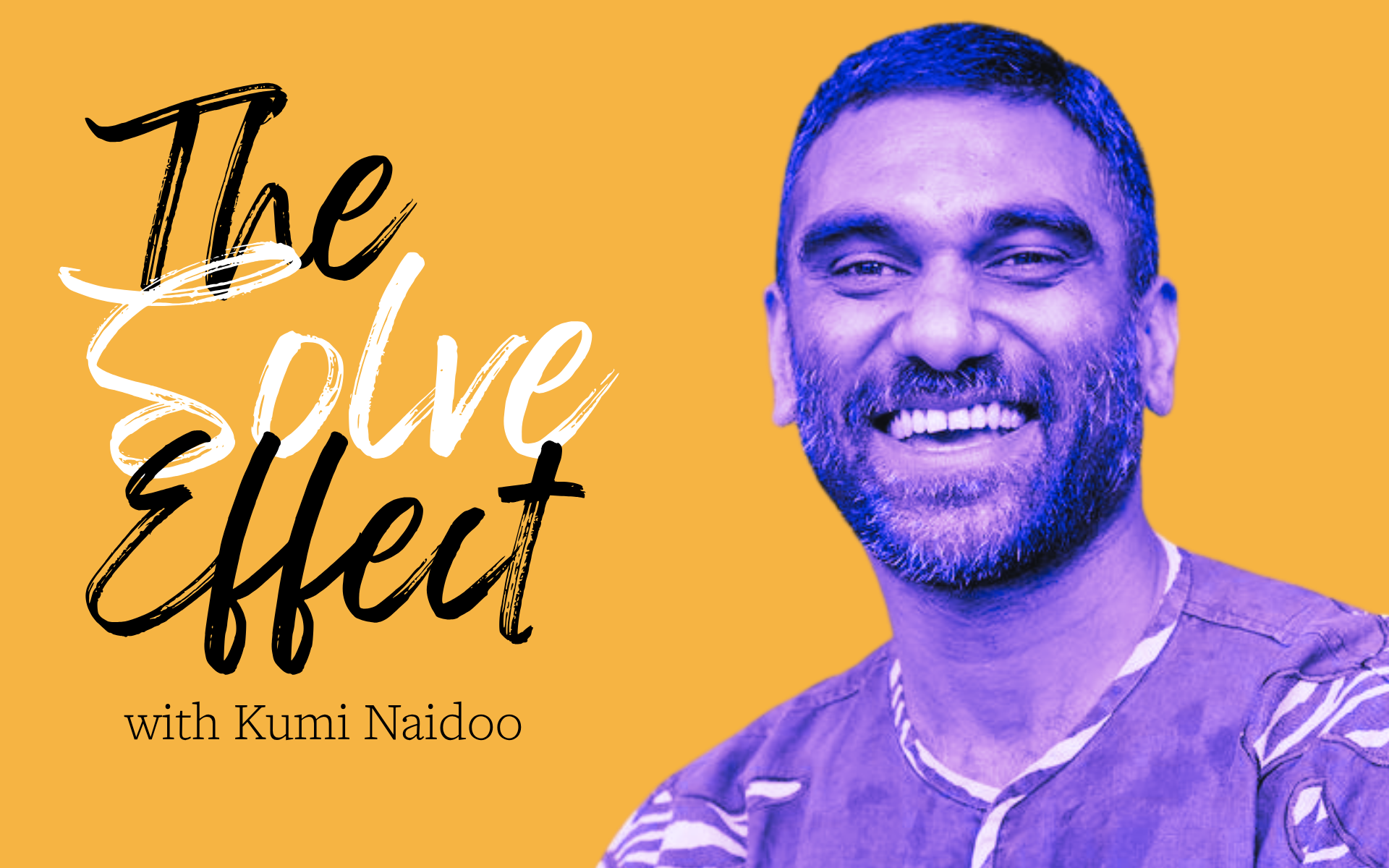
Today's guest is Kumi Naidoo, and if you don't know Kumi, you should. He's a human rights and climate justice activist. He's been tear-gassed in South Africa, exiled in London, arrested in Greenland. He's led Greenpeace International and Amnesty International. He's gone up against governments, fossil fuel companies, and the full machinery of the status quo.
And he keeps showing up.
Today, he's leading one of the most ambitious and urgent climate campaigns of our times as the president of the Fossil Fuel Non-Proliferation Treaty Initiative, which is a push for a binding global agreement to stop expanding fossil fuels and phase them out.
Today, we talk about the fight that's left, what justice looks like during a global energy transition, and why, after four decades of this work, he still believes we can win.
Kumi, welcome to the Solve Effect.
Kumi Naidoo
Thank you so much for having me, and good to be with you and your listeners.
HH
Let's start with the easy question. What's going to get us first, AI or climate change?
KN
Ha! Well, they get us in different ways in the sense that AI is altering the landscape for democracy, for human rights, and so on. But climate change is, you know, I like to say that the planet does not need saving. If we continue on the suicidal path we are on, where we burn up our water resources, destroy our soil, get so hot we can't plant food, we will be gone. The planet will still be here.
The good news for everybody who's concerned about saving the planet: once we become extinct as a species, the oceans will recover, the forests will grow back, and so on. So I understand that the struggle to avert catastrophic climate change is nothing more and nothing less than protecting our children and their children's futures.
HH
You said we are on a suicidal path, and I know you don't use that word lightly because you lost your mom to suicide at 15, and you said you politicized your grief.
Two weeks later, you were expelled from school for protesting. Three years later, you were organizing youth against apartheid. How does a 15-year-old boy turn grief into political action, like you did?
KN
Well you know, when we lose somebody close to us, and people come to share their condolences, they all are very well intended and they, but we all struggle to say the right things. While I appreciated the gestures and the comments that people made, it never helped me at that moment.
But one of my father's friends, who was an activist, said to me, “My boy, I don't know how you recover from something like this. But one thing I can tell you, however bad you're feeling, there are people in our country, in our continent, Africa, and around the world who are actually suffering a much more difficult life on a day-to-day basis. So my advice to you, if you want to do something good with your life, use your knowledge, and your skills, and your capability to work for the betterment of all people, and live with purpose.”
HH
I've heard you describe activism not so much as a career choice or purpose, perhaps, than as a survival mechanism. And there's a real difference, of course, one is something you choose, the other is something you do because there's no alternative. And looking back at that young man growing up in a township under apartheid, do you think you had a choice, or did the world make that decision for you?
KN
I think it's a little bit of both, right? Because in that situation, where your life would be put under risk if you chose to oppose the system, standing up against injustice is really hard because you're putting everything on the line. You can get killed, you can get thrown in prison, and so on.
One of the things some of our leaders used to say: “We have a simple choice. You either can choose to be part of the problem or part of the solution.” And choosing to be indifferent, neutral, and passive, sadly, is the choice of choosing to be part of the problem.
We are living with a terrible reality of eco-anxiety and climate anxiety, right? And we are seeing, youth suicides on the rise and all of that, right? And young people saying things in South Africa to us, like, “We appreciate your generation, you fought the apartheid regime, you buried a lot of friends, but you all had one thing that we didn't have. You all had hope that things will get better.”
And part of what we need to do today is to genuinely, realistically, meaningfully create hope for young people that their participation can actually make things better.
HH
How do you do that? How do you create meaningful hope?
KN
One of the most frequently used lines I have in speeches is this: “In the moment of history that we find ourselves, pessimism is a luxury we simply cannot afford.”
And the pessimism that justifiably emerges from our analysis, our lived experiences, and our observations can, must, and should be responded to by the optimism of our thought, our action, our creativity, our courage, and our sense of humanity.
Now I have to confess: saying it is one thing, living it 24/7 is another thing.
So people need to understand that if you reach that point where you think there is no hope, you are handing victory to the people that are promoting racism, authoritarianism, climate denialism. Participation itself is going to be the biggest antidote to despair and depression, right?
And here’s where the connection with AI comes: because AI, in a way, pulls us into individualized, atomistic existence where we're spending far too much of time just on social media and virtual engagement with the world. And we need people to engage with the world in where they live, where they work, where they worship.
When I say participation is going to be the biggest antidote in this moment of despair, it's also about finding the right way of participation. What I mean by that is, let's say you are an art teacher, and you join a climate justice organization. You should be working with young people, painting murals in the communities where you are operating, right? And getting joy from doing that which you enjoy.
So part of what we need to be doing is creating multiple pathways for people to participate. Because I like to say, and many others say this with me: irrespective of what the question is, the answer is always community, community, community.
HH
Is this something that you're working on creating for others right now, the pathways, or is it a call that you're calling on us to each find it?
KN
Such a wonderful question. Because the best pathway is the pathway that you are going to create for yourself. I mean, listen, it's very simple.
If you're a single mom with four kids and you're concerned about what's happening in the world, your options of the way you can participate is going to be very different from a 22-year-old student at university who has no major family responsibilities, for example. So we have to create a context.
HH
You can go to Greenland.
KN
Yeah, you can go to Greenland, yeah. Let me give you a personal story, right?
My mom died when I was 15, and my eldest sister was 19, right? When you're 15, 19 is very old, right? So my sister was our mom. She was amazing, she really was amazing. And nobody would have considered her to be an activist. But without her, my brother, who was a year younger than me and myself, would not have been able to do half the things that we did. Whether it was giving us the money to print a pamphlet, or hire a bus for a rally, or whether it was hiding us, or creating safe hiding places when the police were looking for us, speaking to her friends, “Would you hide my brother for a few days, please? The police are looking for him.”
Or whether it was taking her husband's keys and leaving it on the windowsill so that we can go at two in the morning, take the keys, go spray, “Free Mandela” slogans all over the township and come and return it by four so that her husband wouldn't know that we had been using his car for a seriously illegal purpose that could have landed us in prison for five years. So to me, my sister was an activist.
HH
What's her name?
KN
Kay. She would say, “Oh, I hope you guys don't get me locked up.” But she never said no once.
So right now, in countries where democracy is under threat, fascism is on the rise, and so on, I say to everybody, “Find your space. It doesn't mean you have to be the most high-profile. In fact, sometimes the most invisible unknown people are the ones that make the biggest contribution.”
And I mean, as a young person, I won't lie. The fact that it was like on the run, the cops were looking for us and so on, there was a buzz about it that at times it energized you, right? We used to say, “Just because you're paranoid doesn't mean the bastards aren't out to kill you,” know what I mean?
And that's the last thing I would say. Keep a sense of humor. Don't take yourself too seriously, right?
HH
How do you, personally, how do you keep joy? Because joy is resistance, right?
KN
Absolutely. And I think that line you just said, we need to say it over and over and over again. Joy is a form of resistance in the current moment, because it would appear that some of the leaders want to suck out all joy from our life and make us miserable to the point where we feel small and insignificant and unable to stand up against some of the actions that they are taking.
So the short answer to your question, how do you do this, is with extreme difficulty. Once I was addressing a group of folks in the US, and at the end of my speech, a very upset delegate put up a hand and said, “Kumi, have you heard of Martin Luther King?” And I said, “Yes, of course, he inspired me and many people in my country during our struggle against apartheid.”
Then she asked me, “Do you know what his most famous speech was called?” And I, thinking it was a trick question, I answered it very gently. I said, “I have a dream.”
And then she shouted out, “Yes, it was, I have a dream. When I hear you speak, it sounds like you have a bloody nightmare. The oceans are rising, the forests, and this fascism on the rise, and so on.” And then she says, “How are you going to motivate people if you are telling such a terrifying story?”
I got it wrong, right, in the way that I sort of spoke. How do we speak truth to power on the one hand and not sanitize the fact that humanity is in a deep crisis? But how can we do that in a way that does not demotivate, depress, and immobilize people? How can you tell the story of where we are in a way that enables people to feel that their contribution and participation is going to make a difference to making things better? For myself, I find happiness in seeing young people not give up. When I see young people laughing, dancing, singing, their messages for a better world, and so on.
HH
It's funny, Kumi, I didn't know I needed this conversation. I'm Lebanese, and I, you know, my first sit-in protest, I was 15, and just hearing you talk now, it just brought me back to the defiance that I felt back then. I think now, I feel more fear than defiance. A friend of mine just lost his house in the south of Lebanon. But the first message that appeared in their family group chat is, “Oh, well, I didn't like the kitchen tiles anyway.”
KN
That's absolutely how we survive. People survive by not letting the pain overwhelm them.
But I think what I would say, though, from my own journey, I would just hasten to head that...don't make the same mistake that I made. So my mistake was… there's so much of injustice and pain in the world, I don't have the luxury to worry about my own pain.
So living with purpose does not mean that you don't create space to deal with your own pain. The work that I'm doing right now, which is building the global artivism movement to address the biggest challenge that activism faces, which is the communications deficit.
That work was heavily inspired by our son, who was a hip hop artist and rapper. One of the things he said to us is that, “One of the mistakes you'll make in your activism is you'll aim all your messages at the brain and you'll ignore the heart, the body, and the soul.”
And sadly, Ricardo also, four weeks later died by suicide. And his passing, obviously, completely devastated our family. It was only really, honestly, fully, after Ricardo's passing, I began to finally start speaking about my whole traumas. Saying to people in civil society, “It is not a shame. In fact, it is irresponsible to just put your head down and continue as if the trauma didn't happen. That's not being brave; that's actually being weak. What's being brave is dealing with the traumas that come with you without letting it overwhelm you and floor you.”
HH
I mean, you've experienced such profound loss. And Riky Rick, I think he gave you one of the most clarifying pieces of communication advice ever. I've heard you say, “Don't be so boring with your facts.”
KN
Haha, yeah!
HH
And it's wonderful how you've used that to just change how you reach people and the way you show up. And I hope this conversation is also an attempt to honor his instruction, as we will hopefully be speaking to the heart.
KN
Thank you. It does.
HH
Tell me more about what is artivism. Tell me more about that work.
KN
When I was Secretary General of Amnesty International, I had an epiphany moment when a close friend, an artist, invites me and says, “Kumi, I need you and Mary Robinson to come to Iceland.” I say, “What's happening in Iceland, Olafour?” Olafur Eliasson. And he says, “We're having a funeral.”
I say, “Oh, I'm so sorry who passed away?” And he said, “An iceberg.”
And on an early Sunday morning, Mary Robinson, the Prime Minister, and myself addressed several 100 people. We climbed up this dead iceberg. There was a funeral service that was done. And the media coverage that that got was more powerful than 95% of the actions that happened under my six-year leadership of Greenpeace. So I had to think, why was this so? Well, it's simple. You didn't talk about 1.5 degrees, 350 parts per million, lots of acronyms. You didn't drown people in the acronym alphabet soup, you talked about loss. We lost something precious that has been with us for centuries, and it's not coming back. And everybody understands loss.
In 2011, when I was at Greenpeace, I was going to occupy an oil rig in Greenland, right? And while I was on that little inflatable boat going from the Greenpeace ship to the oil rig, my colleagues could see that I was looking very nervous because I don't swim very well, right? One of my colleagues says to me, “You know…don't worry, if you fall in this water, you'll survive at least two hours.”
And then I had this horrible thought that if this was the last thing that I was doing in my life, 99% of my friends, family, and colleagues back home in Africa wouldn't know what I was talking about because all the banner said was, “Stop Arctic destruction.”
Anyways, I get arrested, I spend a week in prison, I get deported, and I go home for Easter. And one of the kids in my family says, “Uncle Kumi, what a stupid slogan! ‘Stop Arctic destruction.’ Nobody knew what you were talking about.”
I said, “That's a good point. I don't disagree with you. What would have been a better slogan?” And she jokingly said, “Save Santa Claus now.”
If you had dressed up as Santa Claus and occupied the rig, there'd be children all over the world asking the parents, what is happening with Santa Claus? Why did the police arrest Santa Claus?
So sometimes we are too intellectual in the way we try to move people. We need to understand that the vast majority of people in our world today are time-poor. So for them to actually have space to look at what's happening around them and so on, unless you can do it in song, in dance, and in things that connect to their sense of joy and being in the world.
So that's what artivism is about. Harnessing the full power of arts and culture on its own will not deliver our salvation from the climate crisis and the intersecting crises. However, failing to harness the power of arts and culture almost guarantees that we will fail. And understand that one of the most important contributions that the cultural community can offer and artists can offer at this moment is also one of the most missing things that we don't have. And you know what that is? A sense of imagination about how we can build a certain kind of future.
HH
I use what I call the “auntie test” when I talk about my work. So if someone who loves me but has no background on my work can't understand what I'm talking about in 60 seconds, so I would love to ask you to apply the auntie test to the Fossil Fuel Non-proliferation Treaty, which is what you're currently doing. Okay, 60 seconds.
KN
Okay. So why have we been failing on climate change so far? You rush to work one day, you come back home, and you realize that there's water coming out of your bathroom. You open the bathroom, and you say, “Oh, rushing to work, I left the stopper on, and the tap was dripping, and it's overflowed.”
What do you do first? Do you start mopping the floor first, or do you turn off the tap first? Of course, any sensible person will turn off the tap first, okay?
But for 30 years, when the science told us we needed to get off fossil fuels, oil, coal, and gas, which is 86% of what's driving the problem, right? We have been mopping the floor without turning off the taps. So we've been dealing with the emissions, but we're not dealing with the cause of the emissions.
So finally, 30 years late, we are going to the root cause of the problem, but we need to move fast.
HH
It's a little bit…the Mark Carney’s middle powers, philosophy in action, right? I mean, you're negotiating outside of those powers that have gotten us to where we are and hoping.
KN
What we hope will happen there is that we will actually get fossil fuels mentioned in an outcome document. I mean, imagine how bizarre that is, right? 86% of the cause of climate change is fossil fuels. That's like Alcoholics Anonymous holding 30 years of big conferences, and they don't mention alcohol in the outcome document. It's crazy, right?
Yeah, we're talking about not the coalition of the willing, but the coalition of the ambitious countries who accept the science, who know that it's in the interest of our children's futures that we move quickly, and that we cannot take a short-term approach.
And beyond that, I hope that we'll have a much larger constituency for the idea of a binding treaty to address our phase-out from fossil fuels. And notwithstanding what some governments' denialism is at the moment, we are seeing significant movements towards making renewable energy much cheaper than other forms of energy, and so on. Not that it's without its challenges, but certainly the solutions are there.
HH
I think that's what keeps me hopeful is that, as you said, the youth, the innovators, the creativity, it's all there. It's all there. And what we need is the political will.
KN
The moment of history we are in, what our leaders are doing is rearranging the deck chairs on the Titanic while we sink. Our job is to come up with a solution so that we don't crash into that iceberg. And it's still, it's absolutely still within human capability, ingenuity, creativity and courage to do it. And people should not give up. Thank you so much, Hala
HH
Not giving up. Thank you, thank you so much, Kumi.
I keep thinking of Kay, Kumi’s sister. She never called herself an activist. She didn’t march or give speeches. But she just left car keys on a windowsill at two in the morning so her brothers could spray "Free Mandela" across the township.
That's one of Kumi's biggest arguments: that you don’t have to make speeches and occupy oil rigs. Just find your form: your song, your mural, your windowsill and keep showing up.
And then find your joy. Not as a reward for the work. As part of it. Because as Kumi says, and I think he means it as a literal political act, joy is resistance. They want us small, scared, and exhausted. Don't give them that.
If this conversation stirred something in you, share it with someone else.
We are off on July 1, but will be back on the 7th with another new episode of The Solve Effect.
I'm Hala Hanna. Thank you for listening.
If you haven’t yet, please subscribe to The Solve Effect wherever you get your podcasts.
This episode was produced by Bridget Weiler and Elisabeth Graham.
Audio engineering by Kurt Schneider at MIT Audiovisual Services.
Music by Tunetank.
For more information about MIT Solve’s tenth anniversary, check out solve.mit.edu.
Tags:
- Podcast
Related articles
-
Stacy Brown-Philpot on TaskRabbit, Trust, and Doing Hard Things
-
Bonus Episode: LIVE from Solve Challenge Finals 2026
Go behind the scenes at Solve Challenge Finals in this bonus episode of “The Solve Effect.”
-
10 Years, 10 Solvers: From 14 Days to Under 60 Minutes—Revolutionizing Radiology Reporting with Rology
Ask Amr Abodraiaa what Rology looks like from the patient's side, and the answer is: nothing at all. Invisibility is the design goal. What the patient gets is the result.