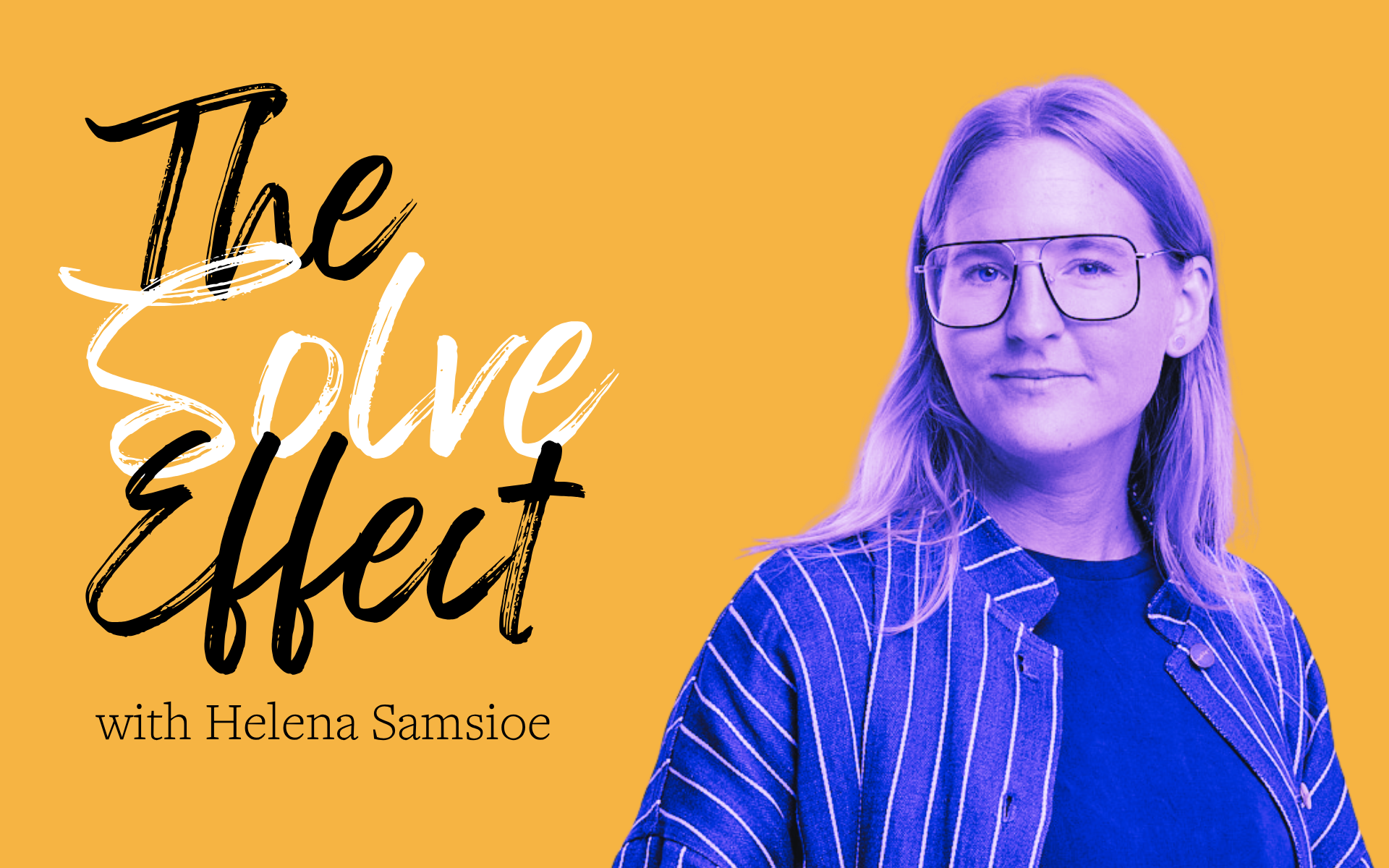
This is a transcript of Episode Twenty of The Solve Effect, edited and condensed for clarity. Listen on Spotify, Apple Podcasts, or Amazon Music.
Show notes
Helena Samsioe is the founder and CEO of Globhe, a Stockholm-based marketplace that connects organizations to more than 12,000 certified drone operators across 150 countries. Clients upload the locations they need mapped, a local operator flies the mission, and the data returns through the platform or an API within days, letting teams inspect wind turbines, telecom towers, forests, and farmland from the cloud instead of on site.
Globhe was selected as a Solver in Solve's 2021 Health Security & Pandemics Challenge for work using drone imagery and AI to identify malaria mosquito breeding sites, a solution later deployed in southern Africa to pinpoint high-risk areas earlier and at lower cost. The name GLOBHE is short for "global health."
The Solve Effect is a production of MIT Solve, MIT's initiative connecting social entrepreneurs to the funding, partnerships, and expertise they need to scale.
Transcript
Hala Hanna
Welcome to The Solve Effect, where we highlight extraordinary people tackling the world’s toughest challenges with bold, innovative solutions. I’m Hala Hanna, Executive Director of MIT Solve.
Solve is celebrating its 10th anniversary this year, and to mark the occasion, you’ll be getting two episodes a month. One of those will be our special series with guest host Alexander Dale, Director of Global Programs at MIT Solve.
This series will highlight 10 Solvers from the past decade who embody the spirit of Solve: innovation, grit, resilience, and impact. Enjoy!
Alexander Dale
Hello, I'm Alexander Dale. We've gotten very used to the idea that we can see the whole planet from space, pull up a map, zoom in anywhere on Earth. But satellites have blind spots, clouds get in the way. You can't tell how tall the trees are from space or what's under them.
And the higher the resolution you need, the closer to the ground the real story lives, the more the picture falls apart, especially in the places that need it most.
Today's guest built a company to fill those gaps, not from orbit, but from a few 100 feet up.
Helena Samsioe is the founder and CEO of Globhe, a marketplace that connects organizations to more than 11,000 drone operators in 150 countries.
Need a fresh, high-resolution map of a flood zone, a malaria-prone lake shore, a new stretch of wind turbines? You place a request, the nearest pilot flies it, and the data is in your hands in days, anywhere on Earth. Today we talk about what it takes to run a marketplace that lives in 150 countries at once and what's next for Globhe.
Helena, welcome to The Solve Effect.
Helena Samsioe
Thank you very much.
ATD
I want to start with you and a little bit of your history. You grew up moving around Africa and Asia with parents who worked as doctors. And I'd love to understand a little bit about what seeing the world that way taught you.
HS
I was probably in over 50 countries before the age of 15. And I think one of the great values of being able to have an international upbringing was that at an early age, I understood that the world looks very differently depending on where you are.
And alongside of that, I also got to meet a lot of incredible people. And of course, that has been really of value for me in my personal life, but it has also created a lot of value for me in my professional business life..
ATD
There's a specific moment that I've heard about where living in Zambia, watching drone pilots shoot really pretty aerial photography, realizing that it could be data and not just pictures. When did that idea happen and when did that change happen from, “That's a really lovely image” to “That could save lives?”
HS
I was lucky to get to know two photographers that worked for National Geographic when I lived in Zambia and they were shooting a lot of the beautiful national parks there. It was also very obvious during one shooting when it had been raining for several days straight, that when we were watching the imagery that the drone had captured from that area, there was a lot of flooding present. So you could see that several roads were not accessible by car. There was a dam that had erupted and a bridge had collapsed and a lot of the houses were significantly damaged as a result of the floods.
Entering your driving route on Google Maps, it just said that, yeah, you can just continue driving straight, but you couldn't because the road was no longer there. It was completely underwater. So I think that was a very concrete example of when it was very evident that drones capture not just beautiful pictures, they capture reality information. And if one drone in one place could obtain that much information, then what happens if you can build a platform that connects to thousands of drones in thousands of different locations?
ATD
From making that realization to actually having an initial drone company: can you take us through that process?
HS
The first version of Globhe as a company was actually not a drone data company. It was a drone delivery company. So we built a platform that connected organizations in need of deliveries with drones, medical deliveries primarily, to the drones that could conduct those deliveries. And we did that for the first three years of Globhe, but it was extremely hard to scale up. The regulatory frameworks were also not in favor of flying drones for that use case or in terms of those distances, what was interesting though was that when we had done quite a lot of deliveries, we were also seeing that we were not just delivering when we were out flying, we were also capturing data from these flights.
So what happened in our third year of deliveries, we're now in about 2019, clients started to ask if we also had the camera on during the deliveries and if so, if they could buy footage from the delivery route. And we started to see that more users were asking for footage from the route than the actual delivery from the route. So it was a very clear moment that the market was looking for something different, and we were able to pivot and provide that through our platform, which was then relaunched in 2020. And since 2020, we have built a global platform that provides drone data from 150 countries.
ATD
I want to pick up on the aspect of drones and regulation. Drones are, as a consumer or more accessible piece, I feel like have exploded onto the scene in the last 10 years. Where did you come into that technology curve and what was the regulatory space like for those early years?
HS
Being now in the drone industry for 10 years, it's almost like 100 years, I guess, for an established industry. Looking back from when we first started as a drone delivery company in 2015, drones were primarily either used as a military equipment tool or they were used to produce Hollywood movies. And there was literally like nothing in between those two use cases. So we saw a big window of opportunity that here is a technology that can provide a lot of value. Why isn't it being done? And part of that reason was regulations.
Drones were normally not allowed to be flown at all. Or there were a few countries that didn't have any restrictions whatsoever. So in the early days, now we're at 2015, 2016 here, a lot of the international drone companies went to Southern Africa because there were two countries that were very proactive in drone regulations: Rwanda and then Malawi. Globhe was flying our first two years in Southern Africa as well as a result of that. And now we been able to add 148 more countries to that.
But with that being said, today, regulatory frameworks are quite mature when it comes to the drone space.
ATD
Have you been able to help move some of those regulations or standardize those regulations as a global operator or global network?
HS
We've been part of a lot of the regulatory discussions, especially in our early days as a company, both in Northern Europe and in Southern Africa. And I think what has been really key for us is that we've been able to deliver data and insights from thousands of real flights across thousands of locations over several years, which then has been used as data for governmental agencies to be able to guide their frameworks forward,
Today we have over 12,000 drone operators who are certified in their countries of regions who fly for Globhe.
ATD
With that, can you walk us through how crowddroning actually works? I'm sitting here in Boston. I place a request for data, maybe in Rwanda. What happens between me and the pilot on the other side of the world?
HS
So when a client is in need of reality data from their assets, it could be Siemens placing a request for their wind turbines across 80 countries, or Ericsson placing a request to get insights from the telco towers across 100 countries, or Amazon needing to get insights from their new data centers that they build in 10 countries, et cetera. They place the location, the geographical location of the asset that they are in need of data from, and they upload those geographical locations to Globhe's platform.
That request is then being sent to the local drone operator that is within that geographical location that the asset needs to be captured, who then flies that mission, captures the data, and uploads it to Globhe's platform where the client can download it, or it's being sent through an API directly into the client platform. So what we enable for our clients is that they can make “digital twins” or digital copies of their wind turbines or of their telco towers, of their data centers, of their forests, of their agriculture fields, et cetera. And they can then by doing so, perform their maintenance inspections and monitoring of their assets and environments from the cloud instead of having to go there physically.
ATD
How much data quality management do you have to do with different drone operators?
HS
So the beautiful developments that we've seen in AI, I would say primarily over the past year, really helps with that. So we have automatic QC or quality control of all the images that are being uploaded to Globhe's platform, where we can make sure that the data that is captured is following the set guidelines that we need to have to deliver quality data. So AI is being used to help scan for resolution or for overlap or for blurriness, for example, and data that is not fulfilling those requirements are then being declined and the drone operator need to re-fly and capture data accordingly.
And in terms of the drone operators themselves, we have a very good database of our operators where they are, when they onboard Globhe, they are required to upload their permission certificates, their insurance certificates, their company certificates, proof of flight hours, quality data samples, et cetera. So there's quite a rigorous process to be able to qualify and have a 100% certified profile, which you need to have in order to be able to match and take on drone missions.
We have a rating system that then also rates the operators based on their skill sets and their level of quality, which of course, if you have a higher rating, then you get prioritized in terms of matching for new missions as well. So it's really great that we have been able to build a platform that combines humans and technology. And I think that's where the greatest values can be achieved.
HH
Hi, it’s me, Hala, and I want to hear from you so that we can make more of what you love on the pod.
Drop a comment below with a moment that stuck with you or a question you have.
You can also email us at thesolveeffect@solve.mit.edu.
See you in the comments!
ATD
Most of your competitors, I think, correct me if this is wrong, own their drones, own their crews, and then you chose to build this marketplace instead. And I'm curious why that local employment…was it a business model piece? Was it a personal decision?
HS
So for Globhe, all our drone operators, they are local, meaning that they reside and they live in the country where they operate. So we never fly drone operators from Sweden, for example, where our headquarters are.
We did that in the beginning when we did not have a global network and the scarcity of drone operators was quite large, especially in certain locations. But now with a lot of local operators being available in the majority of countries in the world, we can tap into local supply. And the reason for that is twofold, there is a clear business perspective in why you would do that. The cost of sending someone a digital mission that they can just pick up and, you know, start flying the hour after versus, you know, putting someone on a on an airplane to go to a location and have their drone there is obviously from a cost perspective, much more feasible…
ATD
And you made sure the quality control can match that. And I think that's the piece that is the reason you would put someone on a plane.
HS
Exactly.
The second one is that more and more countries are not allowing international citizens to fly drones within the countries. You need to be a resident of that country to be able to have the permissions that is required to fly the drone in that country.
ATD
We're back to the regulatory space, interestingly.
HS
Exactly, and then, the last thing, of course, which is primary for Globhe, which is obviously an impact company at the core, is that it's a great way for us to help provide local opportunities for work and also be able to not not fly people all over the world and contribute to polluting our world instead of doing the opposite. So from a cost, regulatory, and impact standpoint, it's the right thing to do.
ATD
That's a good blend of those different pieces. It's nice when those overlap. I want to ask one more piece about the data. Who owns the data that you collect? And how do you think about whether you're involved in some of this movement for data sovereignty at a country level? We just talked about how operators often need to be residents of their countries. There is a movement on the kind of AI sovereignty side. Do you end up seeing that on the data side of it as well? Obviously, many of your requests are coming from private companies for their assets.
HS
So Globhe purchases the data from the drone operator. So when we purchase the data from the operator, Globhe owns the data, and then the client purchased the data from Globhe. And in certain cases, Globhe has main ownership of the data, and the client has a dual ownership of the data. And in some cases, especially when we talk about critical infrastructure, the client ends up owning the data because it's very often the case when we are dealing with more critical information that ownership needs to sit with the end user and the end client of that data.
ATD
If I'm scanning wind turbines, the person who owns the wind turbines should own that data.
HS
Exactly.
ATD
I want to come to that impact space now. So the name Globhe is short for “Global Health.” And you now do substantial work in many other areas as well. We've been talking about wind turbines and solar panels. How do you think about the different problems and sectors that your data and network can help address, and how has that changed over time?
HS
As the company has grown today and moved from a drone delivery company to a drone data company, and also not just capturing data for health applications, but also capturing data for environmental infrastructure, energy, et cetera. Of course, that value is broader than traditional health. And I would say that global health today is also probably much more about how we interact with the environment and not just the health of an individual human, but also the health of our planet and all of us residing on it.
We're very still aligned with our core and everything that we do at Globhe today provides impact in one form or another. Every time you send out a drone to capture data, you are not just making a good deal with a client, you're also making hopefully a good deal for the people that live in their area and for the planet that is benefiting from more wind turbines spinning rather than nonrenewable energies or forests to be reforested instead of deforested and areas that are being able to be monitored for high water levels before they become flooded. So that's the real driving factor for the team that works at Globhe.
ATD
Solve selected Globhe in our 2021 Health Security and Pandemics challenge, coming back to that health origin. That was relatively early in your journey, once you'd done this pivot to drone data.
Can you talk about the journey to fund this project and some of maybe the tensions that you had to resolve with funders and trying to build a global marketplace?
HS
2021, when Globhe also joined Solve as part of the health category there, it was also the year where we first raised VC capital, and the timing for that was, I would say, that the pivot from delivery to data was definitely key. We have been able to prove a more scalable business model at that time.
And of course, they saw a huge potential in the drone industry. And through a business model that is a marketplace that connects to devices that are already out there, you also don't really have the high cost of producing and manufacturing the devices. And I think a lot of that talked to investors.
ATD
What kinds of support were really important and maybe unexpectedly important for you beyond the investment side?
HS
Joining MIT Solve in 2021 was definitely a huge recognition for Globhe as a company. That I would say is still being important for us today, many years later. Besides VC Capital, we've been able to secure a few large grants that have also helped us forward on our journey without necessarily giving away too much equity at a too early stage and still being able to control the path of the company and make sure that the company grows in the direction to both keep the business value and the impact value along that way.
One of the clients that we had when we became part of MIT Solve in the health category was a university who at that point conducted pivotal research in how you could use drones and drone imagery to be able to early identify malaria mosquito breeding sites. And that was the product that we applied to MIT Solve for, and it was a solution that was then rolled out in Southern Africa that the combination of drone data and AI now helps pinpoint high-risk areas of malaria outbreaks, and they are then able to target those areas in a much earlier stage and at a much lower cost than what you were able to do before.
So I think different type of partnerships, whether that is your investors, that is your partnership with your grant givers, or if it's universities for R&D, that combination is what helps Globhe continue growing and help make sure that we also stay on top of technology developments and the latest cutting-edge technology that we can apply to our platform and our offering to make sure that we can provide even more value for our users at the end of the day.
ATD
I want to ask about the flip side of that too. What was the hardest piece, the piece that maybe you could have used more support on during some of those earlier years that didn't seem to exist, wasn't coming from different partners.
HS
I would say that the hardest piece of that journey is probably to some extent the combination of a small team with limited resources, trying to focus on both raising VC money and growing with your clients at the same time.
ATD
We want to spend more time executing, but we don't have the funds to do the execution.
HS
Exactly. I think that was the challenge in combination with the fact that we were not just launching a new product, we were part of launching a new industry. And that takes time. But of course, it's also something that is very incredible to be a part of because we have not just built a company, we have kind of carried a whole industry forward and we have, you know, made a lot of positive developments happen throughout these past 10 years that we are super proud of to have been a part of that has not just benefited our company, but that has also benefited a lot of the countries that we are operating in and continue to do.
ATD
We've talked a lot about how much that change has happened over the last five to 10 years. What do you think is possible in the next five to 10?
HS
I think obviously a cliche working in the drone industry is the typical phrasing of the sky is not the limit. And I think that it really applies to what's able to get done in the next five to 10 years here.
Obviously, the combination of drone technology and AI is extremely interesting for a lot of different reasons. If we are, you know, collecting critical data from a flood or from a wildfire or from anything that's time sensitive, that type of speed is of essence, of course. So I would say that being able to do what we do today in a much faster way and in a real time scenario is going to be extremely interesting and it's going to increase the value that we can provide. At the same time, we've built a platform that is connected to data capturing devices in terms of drones or flying robots. But what other type of devices can you connect to? I mean, there are underwater drones today. There are robots that are out on the streets. What else can you connect to in order to be able to provide even more comprehensive data sets and provide more data layers and provide more information at the end of the day?
ATD
Can I place an order today for an underwater scan, you know, coastal mapping, marine protected areas? Do you have enough drone operators for that or is that an industry you have to also go build?
HS
So if you choose the right location for it, the answer would be yes. But in the majority of the cases, your request will come back and say that we could not match your request with a suitable operator or a suitable device. So that's something that we're currently building.
ATD
If you could give your early career self a piece of advice, what would that look like?
HS
Probably be careful whose advice you take. It's very often that you meet people that want to give advice and to take the advice of someone who's not necessarily built a business themselves or gone through certain type of challenges…their advice could not always be helpful.
You should also trust yourself and the team that you build, because at the end of the day, you are the experts at what you are doing.
ATD
Do you lean more on hope or courage for the future?
HS
That's a tough question. I would go for courage because it takes courage to pursue hope. I think hope alone is hard to sustain if you don't have the courage to do so.
ATD
Thank you so much for taking us through such a big journey and congratulations on so much success in building not just an organization, but as you say, an entire industry through a lot of different regulatory pressures and now helping all of us feel more safe, confident in the world that we're living in, whether that's around health, whether that's around climate, and all the different areas that intersect with those. So thank you so much for joining us here on The Solve Effect.
HS
Thank you so much, Alexander, for having me. And thank you so much to MIT Solve for being such a great partner over the past five years here for Globhe.
HH
If you haven’t yet, please subscribe to The Solve Effect wherever you get your podcasts.
This episode was produced by Bridget Weiler and Elisabeth Graham.
Audio engineering by Kurt Schneider at MIT Audiovisual Services.
Music by Tunetank.
For more information about MIT Solve’s 10th anniversary, check out solve.mit.edu.
Tags:
- Podcast
Related articles
-
Stacy Brown-Philpot on TaskRabbit, Trust, and Doing Hard Things
-
Bonus Episode: LIVE from Solve Challenge Finals 2026
Go behind the scenes at Solve Challenge Finals in this bonus episode of “The Solve Effect.”
-
10 Years, 10 Solvers: From 14 Days to Under 60 Minutes—Revolutionizing Radiology Reporting with Rology
Ask Amr Abodraiaa what Rology looks like from the patient's side, and the answer is: nothing at all. Invisibility is the design goal. What the patient gets is the result.