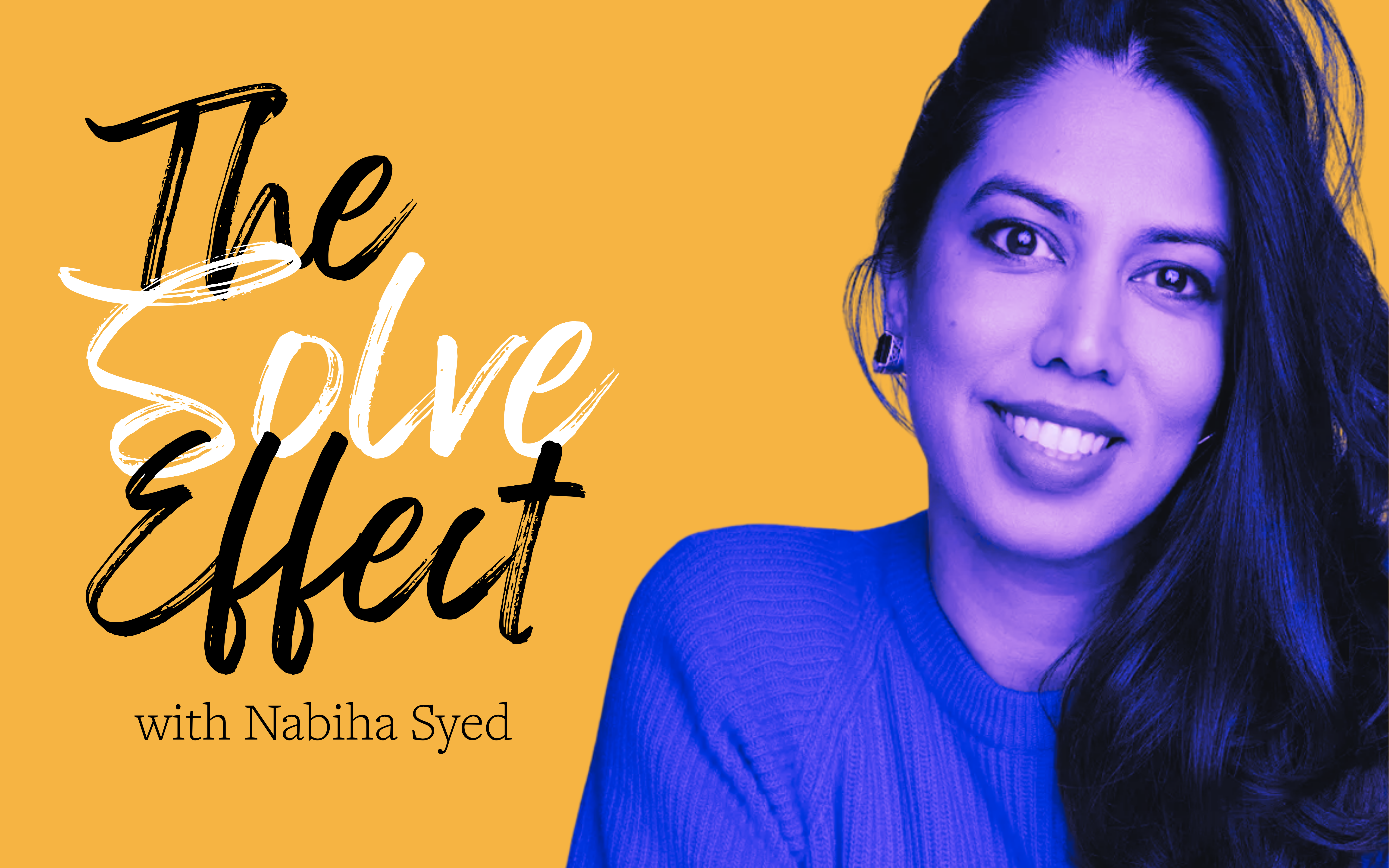
This is a transcript of Episode 21 of The Solve Effect, edited and condensed for clarity. Listen on Spotify, Apple Podcasts, or Amazon Music.
Show Notes
Nabiha Syed has been a media lawyer, a newsroom CEO, and now leads the Mozilla Foundation — three careers, one question: does technology hand people power, or quietly take it away? She and Hala Hanna get into human-scale AI, why trust is becoming the only real moat, and the things we shouldn't build at all. Plus: toasters, aunties, and why curiosity is a birthright.
The Solve Effect is a production of MIT Solve, MIT's initiative connecting social entrepreneurs to the funding, partnerships, and expertise they need to scale.
Transcript
Hala Hanna
Welcome to The Solve Effect. I'm your host, Hala Hanna.
Most people would call law, journalism, and technology three different careers. Nabiha Syed treats them as three ways to ask the same question: does technology hand people power or quietly take it away?
She spent a decade as a media lawyer, the lawyer of the internet, as she calls it, advising on the publication of the Snowden files and the Steele dossier. And then she ran a newsroom startup with the motto: “Big tech is watching you. We are watching big tech.”
Now she leads the Mozilla Foundation, the nonprofit behind Firefox, still fighting to keep the internet in the hands of those who use it. Her thesis is a bold one. You don't resist bad tech only by critiquing it. You build the humane alternative. Which actually has never mattered more because we're handing machines now, not just our schedules, but also our therapy, our grief, our loneliness, which is why I'm so thrilled to have Nabiha on today and discuss when technology becomes the infrastructure for how we learn, how we speak, create, and even grieve, who gets to build what comes next? Who gets to decide?
Nabiha, welcome to the Solve Effect.
Nabiha Syed
Oh my goodness. Thank you so much for having me. I'm so excited for this conversation and I'm such a super fan of the podcast, a super fan of what you're doing. So I'm excited.
HH
Oh, right back at you. So there's a story that you've told of getting online as a kid on those AOL free trial CDs. [laughter] The ones you said you definitely did not take from the neighbor's mailbox.
NS
Definitely.
HH
And teaching yourself to code to make your MySpace look better. And it felt to me when I was listening to the story, like before it was a career or a cause, there was this feeling, and I'm wondering what this feeling was and what it gave you.
NS
The feeling was endless curiosity, right? I was a kid who loved the library. I loved to learn. And the internet was this idea that through this screen, you could experience a world that was so much bigger than the world that was physically around you. It was intoxicating, right? It felt like limitless possibility. That, I think, is something that people don't feel as much anymore because other feelings, like anxiety, fear, worry, about consequences are also present.
HH
And it sounds like also, it's a type of agency. There's another story that really stuck with me that you tell of when you were giving a group of young activists your spiel of, “I fell in love with the internet.” And then this young woman raises her hand and says, “Great that you had that. We never did.”
How do you think a 19-year-old becomes an author of the vision for the future instead of just inherit our past?
NS
I got the benefit of just having experimentation, right? I could just explore because the downsides of surveillance or hyper-optimization or reducing your critical thinking wasn't really possible with the way the technology was at the time.
For a 19-year-old today, in order for them to get the upside, right, to enjoy the curiosity, the capability to build, they have to be very aware of the harms as well. And I think, as a person who is many years away from being 19 years old, it is a responsibility of the elders, of the aunties and the uncles, to really make sure that we have the right regulations in place, that balance between danger and possibility.
HH
We are the aunties now, Nabiha.
NS
We are the aunties. We are. And I love it. Okay, I have too many rings on. I'm like telling the children to go and get me a lemonade. Like I'm into auntie life.
HH
What does it take to create that future? I would imagine it. We must imagine it first. How do we do that?
NS
Imagination is where it all starts.
We live in a time where if we go back to this 19-year-old, they've been told that the innovators are Elon Musk and Sam Altman and Dario Amodei.
There's a few innovators. They sit in Silicon Valley. They build the technology that we then all get to use. And that fundamental premise is the first thing to reject for imagination to take root. Everyone is an innovator. Everyone can dream. Everyone can build for themselves. And we can't accept a world in which we anoint only a few to be the builders, and we're all downstream. Like no, just absolutely not.
Then it's…imagine what, what's the world that you want? What do you want to build? What do you want to see for you, for your friends, for your family, for your people? And then you can look at the technology to say, “Okay, is that something I can build?”
HH
Right. It's like we have to unlearn a lot before we can develop that imagination. You also work a lot with corporations and even with governments. How does that message adapt to those other constituencies?
NS
Oh, it's such a great question.
There's this narrative in policy and government of like, “We're behind, we're behind, we have to catch up. We have to catch up to what corporations are doing.” And I'm like, everybody stop, pencils down. You're not behind. You get to decide, what do you want to do. If you think that industry is running too far ahead: say so. Don’t rush to have bad legislation or imperfect regulation before you understand the technology. And also, don't only listen to how the technology works from the people who stand to benefit quite a lot from teaching you what they think is possible.
It's not to say that the corporations are wrong, but they have a perspective, and they have a goal, which is profit. And any information coming from them has to be contextualized with that.
Of course, Mozilla Foundation, you know, owns Mozilla Corporation. We're very friendly towards for-profits. It's really interrogating what is the benefit of what you're building? Are you operating really for people? How? Are you giving people the choice to leave your platform, which is interoperability and data portability, or are you locking people in? And that is a conversation that sometimes feels hard in the United States, but it feels very easy in other places of the world where people realize corporations don't call the shots for society. Like if it doesn't work for people, it doesn't work.
HH
If it doesn't work for people, it doesn't work. How do you lock that mission in for corporations?
NS
In Mozilla, we have the benefit of having a manifesto that anyone can read. It's been around for over 20 years, and it has principles in it that we commit to. We've committed to privacy. We're committed to people having choice. Are we building that in? And in that spirit, Firefox earlier this year introduced an AI kill switch into the browser saying, there's a lot of people who are like, get AI away from me. I don't want it. And that's a way of living choice in the product. You can say choice, but you have to build it in. That's a design choice.
HH
And I would add that philanthropy also is deciding what alternatives receive the time and the runway.
There are stories from our Solvers that come to mind, which is the entrepreneurs that we work with. Do you know, have you heard of Amini, Kate Kallot?
NS
Oh, yes, of course.
HH
Yeah, so Kate is working with governments in Barbados and other places, Kenya, to say, “We can build data sovereignty.” Frugal AI and data centers that get shipped in containers can still produce what you're looking for.
Something that you have talked about is sometimes critique is about improving a system and sometimes it's about saying, “Actually stop, you shouldn't even be doing this.”
What are things that we actually shouldn't even be building and some things that are fixable design flaws?
NS
For me, the areas in which I would say absolutely not, often focus around human attachment. So what we saw for social media is that we saw the proliferation of a number of design choices that were meant to capture attention. I don't know about you, but I remember when you would scroll on Instagram, and you would get to the bottom of your feed and it would say, “You're all caught up for today.” Right? And the introduction of endless scroll…that is a design choice.
So if that was human attention, we're going to the use of AI chatbots that people are using for loneliness, for romance, for replacing human interaction. What's at risk here isn't just attention, but it's actually capability for human attachment. Learning how to have a friend where they disagree with you and sometimes you're wrong and sometimes they're wrong and you have to apologize, these are all parts of human existence and living in community.
I do think that especially for young, for preteens, for children who are still learning human attachment, we should not allow them to go down this pathway because the consequences are enormous. And frankly, we don't even fully understand them yet.
HH
So are there decision rules where, is it the foreseeable harm? Is it reversibility? Is it consent? Is it concentration? I mean, maybe it's all of these.
NS
I think it's all of them. I think it's all of them.
And so I think one fallacy that happens a lot in civil society and also policy realm is the, “Well, we don't know, so we should ban it.” Like that's certainly one path. The other is we don't know, so we should watch it closely. And that is what's so important to me about having open, auditable systems. And that is a feature of openness as the ability to remedy, to pivot, to learn, to iterate that is deeply, deeply important and core to how we should be building.
HH
It's interesting whether it's hacking our attention or hacking our attachment, the principle of restraint it's like a red thread, and I know that you've also used it when you were talking about journalism and what you need in the face of virality. It's almost like a…almost a theory of power more than a theory of design.
NS
That ability to pause, to restrain, to use the sort of like Clayton Christensen, what is the job to be done here? Because the lure and the attraction is real. The theory of restraint, of balance, of centering the human shows up in Mozilla's work, particularly in the startups we're incubating as what we're calling product-community fit.
There's a whole discipline obviously of how you reach PMF, how you get product market fit. But to balance that with product-community fit, are you actually serving your communities as you intended to when you started out with this technology? Are you making sure that you're not privileging the market over community, that they're in balance?
HH
Are there implications for scale, for profitability? How do you think about that?
NS
Absolutely there's implications, and what matters for the implications is the time horizon.
So in the short term, if there are things that you decide not to do, like I could make money, but it doesn't serve my community, you see the revenue hit. Of course you do. The argument we want to make is that in the long term, treating your community well is actually a wonderful way to maintain a moat in a time where building the technology is getting easier and easier, the durability of a product or of a technology over time, I will bet is going to be honed on the community that continues to show up for you because they believe in what you're doing and they believe and trust you that you'll stay true to that. And so trust is going to become the moat in a way that technology development used to be.
HH
When I think of the, particularly the programs that you've been able to launch in the past couple of years on data, on the Creative Commons, the voices, the languages, that all does require trust for people to give you their data sets and say, actually, I trust you to be a public benefit corporation and keep your word.
NS
It also leads to really interesting inputs of where you should be building. Like I just got back from China, and for Mozilla Data Collective, which is a company we spun out of the foundation just a few months ago. That company, which is a data marketplace committed to making sure that creators receive fair market value for the data they're sharing, and that people who are downloading that data have assurances that it's actually fairly obtained. We've heard from people that they wanted more access to data sets focused on accessibility.
When you're like, we made a Mandarin stutter data set because it's important to us that everybody, no matter how you speak or what you speak, can be understood by the technology around them. And that built trust, right? People are like, I understand what you're doing. It just requires a little bit more work and sacrifice and restraint upfront.
HH
Restraint again. Obviously, by design, this is a lot of the Solvers that we work with. One of them, CoMapeo, is created with Indigenous communities that need to document illegal mining and logging without reliable internet and without surrendering the sensitive, territorial data to a central server.
So those communities they've been able to save, hundreds of thousands of acres from degradation and partnerships in over 11 countries, they've been able to reclaim ancestral land that was theirs, but they could never prove it before. And it's, for me, it's like all of these examples of tech being exploitative, and here we have tech being reparative. That's a model that can in fact exist.
NS
Absolutely. When I was at The Markup, we did this incredible story where reporters on the team had heard from people in a variety of neighborhoods in the United States that they were paying a lot for their internet, but their internet was much slower than their neighbors’.
Reporters collected over a million internet service offers in 45 cities and found that the major providers were offering some of their worst deals to lower-income and less-white neighborhoods. And so the article goes out, of course, and then we opened up our methodology and our tools to say like, “You want to investigate your own neighborhoods? Here you go.”
In Los Angeles, some people ended up going to city council and Los Angeles became the first city to outlaw discriminatory pricing and internet access. You have to create the tools for that openness to happen.
HH
What does that look like in today's age? Like what is the Linux moment of AI?
NS
I'll give a little preview, we are in our next incubator cohort for Mozilla launching what's called human-scale AI. And so we're finding people who are using small, local, open, connected models to develop the technologies for their own communities they actually need. You don't need to be using ChatGPT to make every single thing in the world. It's like using a crane to pick up a pencil. I think in this moment, it's realizing that we have incredible open models that we can be using.
And your access to this technology does not need to be gated through a hyperscaler or a frontier lab, and it goes back to imagination too, because for so many people, they think AI and they think ChatGPT, Claude, maybe Gemini, right? Grok. They think if the technology is necessarily mediated by a large company, and that's the moment to reject.
Just like Firefox was a rejection of you have to go through Netscape Navigator or Microsoft Internet Explorer to access the internet. No, the way to access the technology is possible in a local, open, controlled, private way. It's possible today. And so it's just about using it, feeling the comfort level in it, and we have those ingredients now.
HH
This is such a better story than the single story that we've been sold to date about… it's felt so oppressive, really. And, it has felt so like, oh, well, you have no choice. Like, good luck.
NS
And if you don't, you're left behind. And by the way, you won't have a job, and all of society will end.
HH
Right, exactly.
We've been talking a lot about the builders and creating that future. There's also the duty of the default, what would you say to someone who just wants the default work to not freaking suck?
NS
You're totally right, because there's always going to be the builders, the people who are the first movers and early movers who feel like they can make it their lives and their focus.
There's a bit of privilege sometimes, in being able to do that.
If you're working four jobs and technology is not your main modality of engaging with the world, the idea of being told, “Well, it's on you, go ahead, make it work,” it's not fair, right? We've learned that lesson in so many ways with the progression of different technologies.
So when it came to the automobile, car accidents would happen, and people would fly through their windshield. And it took us a long time and an incredible professor at Johns Hopkins who did the painstaking evidentiary work that resulted in car seats and seatbelts.
When it came to toasters, which is like, as a lawyer, the toaster is a very specific example because it's the basis of a lot of product liability regulation. Literally, they would explode in people's faces.
HH
Not what I want for breakfast.
NS
Exactly. I do not want a burnt face for breakfast. I want slightly crispy toast.
And so product liability required a set of testing in order to make sure that something was safe so you could trust that when you bring your toaster home and you plug it in, you don't get more than what you bargained for, okay? You just get breakfast, not a facelift.
And so for the person who's saying, “I just want this to work for me,” make that known to the people around you who are responsible for making sure that regulation happens. And it doesn't have to be like: march to Washington, D.C., right? There are smaller ways. If you are in a school, you hear that AI curriculum is being rolled out at the school to say, “Hey, tell me more about this. Who's the partner? How is this happening? Where is my data going?” Even asking the question, are you sure? Why? Who does this serve? How do you know? How are you checking? We need to ask the questions, we need to have the rules. And we're seeing that. We're seeing the parents, we're seeing the teachers, we're seeing the artists, we're seeing people ask these questions, and that's the momentum we need to get the regulation that we deserve.
HH
And because also opting out is not actually agency, right? When it's just so embedded in every moment of the day. That's a great call to make good trouble. Ask the questions.
NS
I really believe curiosity is everyone's birthright.
Some part of society's job is to observe and then ask questions. Others is to take those questions and pass good laws. Like that is a regulator's job, but they need to feel the pressure to do it and not just listen to the people who come to their office.
It's the job of innovators, startup founders, to say, “I'm hearing these questions. I'm going to build for that group.” Right? Everyone plays a role.
HH
So what is Mozilla building right now? What is top of mind for you that you feel has been, from your listening, has been percolating, is ripe enough to, there's enough demand for you to build yourself?
NS
The real signal we'd been hearing for the last couple of years, which is why we built and spun out Mozilla Data Collective, was this need from both creators who felt like their data was being scraped, taken, and stolen to say, “We deserve to be paid, right? We deserve to be paid. And we also deserve to be able to say, no, I do not want you to scrape this and take this. I want to control how it gets used.”
And from people who were building to say, “I don't want to use stolen information. I actually want to do the right thing, make it easy for me to do the right thing.” All of that listening is what led to Mozilla Data Collective that we built and spun out a few months ago.
I will say I have the most optimistic job. You get to hear what people are demanding and asking for, and then you get to figure out, well, how can I answer that? at Mozilla, we think a lot about how do you architect the conditions for the best future and find the people and the communities who want to carry that forward, right? We create the container and they run with it.
HH
So in 20 years, when your kids tell you, during this tech revolution, what did you do that made the real difference? What would stand out for you?
NS
Oh, what I want to be able to tell them is, we were the underground. We found the people who believed that the other way was possible. It's not about creating one thing. It's about creating the conditions for many worlds to exist for people to build for themselves.
HH
Let a thousand flowers bloom.
Are there things that shouldn't be teched?
NS
I think that nothing should ever intermediate these like beautiful moments of human connection, right? There's this whole movement for relational tech, right? Things that bring people together and facilitate people being brought together.
We need to facilitate those moments of closeness. And so when I think about FaceTime, right? Which is like how my grandmother sees my two children all the time.
These are ways of keeping the connective tissue alive between people where geography has intervened. But it doesn't replace; in fact, it enhances the beauty of when they actually see each other.
HH
That's right.
NS
Because there's enough warmth that we've kept going through the technology. And so I think a lot about this principle of relational technology: how do we make sure that the technology is not replacing these moments; it is facilitating until we are able to be together.
HH
I'm just coming back from Lebanon, where our two kids just spend the time with their grandparents, and it's like, it's the preservation of the language, of their roots, of the relationship is like so much deeper than tech.
NS
And then when they go back, they can actually participate, right?
HH
Yes!
NS
And that's facilitative, that's relational, it's enhancing, it's not depriving, and that needs to be the lens. Like, are we, is this helping us become better humans?
HH
Yeah.
NS
And if not, I don't want it. Get out. Like, I believe in human beings over technology.
HH
Every day. Most humans, anyway.
NS
But that has to be the North Star. Is this helping us dream? Is it helping us connect? Is it helping us be our best selves? And if not, throw it into the ocean, okay?
HH
We know there's this like third wave of tech money that's now pouring into philanthropy. What is one place you think this money should go and one place you think they absolutely shouldn't?
NS
So where it should go is encouraging entrepreneurs who are experimenting with the technology. We should be using philanthropic capital as risk capital to experiment, to pause and say, “Am I equipping the people closest to the problem to solve problems for their flourishing? Or am I using this capital to enhance my own power to build the world I think is best?”
HH
Oh, you're speaking our love language at Solve.
NS
That's why I love Solve. I love what you're doing. It's so necessary, and it's where the future is going to be born. That's what you're nourishing.
HH
And you as well, Nabiha. Thank you for everything you do.
NS
Oh my gosh, thank you so much for having me. This is a moment where all the good people are thinking about how do we bring into being the best world possible? We just need to find each other. And that's really the mission of this moment.
HH
This was Nabiha Syed, everyone. Quick speedrun of what happened: toasters used to explode, people used to fly through their windshield. Now they don't. That was rules changing. The internet we have is a result of choices, and so is the one we don't have yet. Restraint is a strategy, and trust is gonna be the moat. And you do not need a crane to pick up a pencil.
As Nabiha said, the first step to building this future is finding one another.
So if you're building the humane alternative, or funding it, or just asking your kid's school about where the data goes, come find us - subscribe to the pod.
If you know someone who cares about tech that connects us instead of hijacks us, send them this or tag them in the comments.
I’m Hala Hanna, thank you for tuning in to The Solve Effect.
This episode was produced by Bridget Weiler and Elisabeth Graham.
Audio engineering by Kurt Schneider at MIT Audiovisual Services.
Music by Tunetank.
For more information about MIT Solve’s 10th anniversary, check out solve.mit.edu.
Tags:
- Podcast
Related articles
-
Stacy Brown-Philpot on TaskRabbit, Trust, and Doing Hard Things
-
Bonus Episode: LIVE from Solve Challenge Finals 2026
Go behind the scenes at Solve Challenge Finals in this bonus episode of “The Solve Effect.”
-
10 Years, 10 Solvers: From 14 Days to Under 60 Minutes—Revolutionizing Radiology Reporting with Rology
Ask Amr Abodraiaa what Rology looks like from the patient's side, and the answer is: nothing at all. Invisibility is the design goal. What the patient gets is the result.